




September 08, 2026
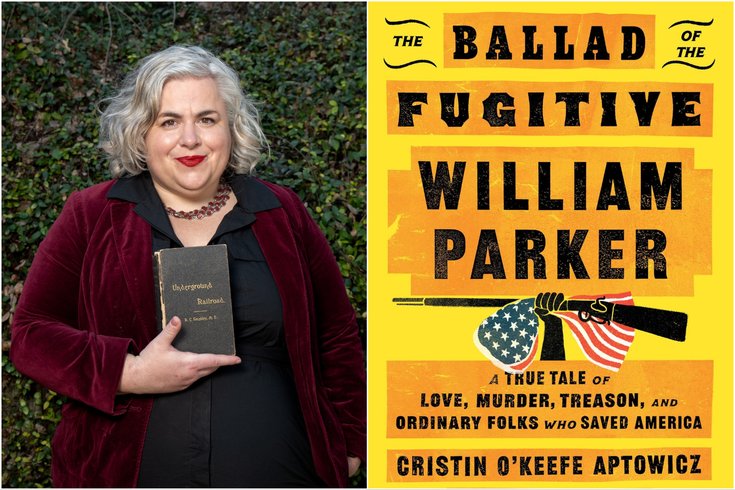 Provided images/Chisum Pierce/Simon & Schuster
Cristin O'Keefe Aptowicz learned of William Parker and her family's involvement in the Underground Railroad through R.C. Smedley's 1883 book. She holds it in the author photo above.
Cristin O'Keefe Aptowicz long believed her Irish-Catholic family immigrated to Philadelphia during the 19th-century potato famine. But about a decade ago, she and her brother dove into their family tree and found an outlier. A branch on her mother's side had been in America since the 1700s and helped disguise people escaping slavery on the Underground Railroad.
As the author read up on the Price women who lent their sewing skills to the cause, she discovered another name again and again: William Parker. His name was all over R.C. Smedley's "The History of the Underground Railroad," a collection of testimonies from southeastern Pennsylvania agents in the network. (Smedley, a doctor, treated many of the aging operatives.) Though Aptowicz had never heard of William Parker, she could sense his importance — and the weight of his associated conflict, the so-called Christiana Riot.
"The way they talked about it was really interesting," she said. "I went to college in New York and lived there for 14 years, and so I was there before, during and after 9/11. We would say, 'Oh, that happened before the towers fell.' Or 'that happened after the towers fell.' It was this shorthand. We didn't need to explain to you what that meant, you understood that it was this seismic, paradigm-changing event. And that's the way that everyone in the book was describing this event, the Christiana Riot."
As Aptowicz details in her new book, "The Ballad of Fugitive William Parker," this incident also occurred on the morning of Sept. 11, at Parker's antebellum home in Lancaster County in 1851. An enslaver and five associates had traveled from Maryland to seize four men under the Fugitive Slave Act. But in a matter of hours, one of the Marylanders was dead and two were badly injured at the hands of formerly enslaved and free Black residents who refused to give their neighbors up. Though the fight happened a full decade before the Civil War, some historians consider the Christiana Riot — or, as it is now more commonly known, Christiana Resistance — its first battle.
Aptowicz's book, out Tuesday, chronicles the event and considerable turmoil that preceded it. Though Parker had escaped from a Maryland plantation himself, he was not the target of the failed mission. Edward Gorsuch was seeking Noah Buley, George Hammond, Nelson Ford and Joshua Hammond, all of whom had fled his "Retreat Farm" in Baltimore County in 1849. Only Ford and Joshua Hammond were actually residing at Parker's home. But the married father of three, whose wife Eliza had strangled a man intent on selling her to slave catchers, was fiercely committed to helping others emancipate themselves.
"I thought of my fellow-servants left behind, bound in the chains of slavery — and I was free!" Parker wrote in a manuscript later published in the Atlantic. "I thought, that, if I had the power, they should be as free as I was; and I formed a resolution that I would assist in liberating every one within my reach at the risk of my life, and I would devise some plan for their entire liberation."
Parker was wholly committed to this mission. As he established a life in rural Pennsylvania, he also built a network for "mutual protection against slaveholders and kidnappers." This group would thwart attempts to drag Black men and women back into slavery. Acting on intel passed among the community, its members chased down bounty hunters, freeing the prisoners by force. They also intimidated collaborators; Parker recalled burning the barn of tavern keeper who pledged to assist enslavers.
"After that mysterious occurrence, the poor fugitive had no better friend than the publican," he wrote.
His work became more dangerous after the 1850 passage of the Fugitive Slave Act. The controversial law made it much easier for enslavers to reclaim their "property" and compelled Northerners to cooperate and assist them. Still, when Gorsuch arrived in Christiana with his cohort — consisting of his son, cousin, nephew, two neighbors and federal marshal Henry Kline — Parker had no intention of backing down. When Kline entered his home with legal warrants, Parker told him to leave on threat of violence. Soon after, Eliza blew a tin fish horn to signal trouble to the community, even as Gorsuch's posse shot bullets at her from outside.
Other formerly enslaved and free Black people heeded the call, sprinting over with scythes, rakes and clubs in their hands. Two white neighbors also approached to inspect the commotion. When Kline tried to conscript them into his service, they both refused and left the property, encouraging him to do the same.
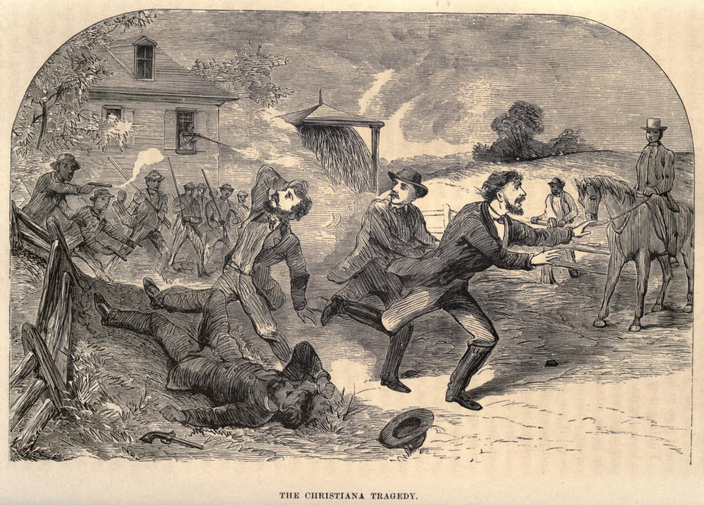
The marshal followed their advice, but the Gorsuch men did not. In the ensuing fracas, the neighbors beat Edward and his cousin Joshua unconscious. His son Dickinson was shot multiple times and initially presumed dead. Edward, also shot, died on the front lawn.
Philly abolitionist William Still's 1872 book on the Underground Railroad included this illustration of the Christiana Resistance.
Law enforcement arrested dozens of people for their roles in the resistance, but not Parker. He ran north, eventually making it to Canada with the help of his white landlords, numerous sympathetic Quakers and Frederick Douglass. Eliza and their children joined him soon after.
In the high-profile case that ensued, federal attorneys put Castner Hanway, one of the white men who refused to help Kline, on trial for treason for disobeying the Fugitive Slave Act. They had hoped convicting Hanway would set the best precedent for prosecuting the remaining prisoners. But when the Philadelphia jury found him not guilty, the case crumbled — and already rising tensions between the North and South mounted considerably.
Aptowicz, a Central High School grad who also penned the bestseller "Dr. Mütter's Marvels," contextualizes the Christiana Resistance within the region's wider anti-slavery movement. As the first free state over the Mason-Dixon Line, Pennsylvania was a crucial stop on enslaved people's journey to freedom. The Philly region alone was home to vital abolitionists like William Still, Lucretia Mott and Robert and Harriet Purvis (daughter of Revolutionary War veteran James Forten). But countless more Pennsylvanians quietly helped the cause, too — and Aptowicz strove to include their stories.
"In doing research for this, I was just astounded at how complex and clever the Underground Railroad actually was," she said. "There were people like my family who — I have no proof that they transported anyone or housed anyone, but you could bring them a group and they would outfit them all in one night. And there were barbers who would come in the middle of the night. There were people who would turn the other eye at the train station. There were spies who would work in the hotels and the restaurants where enslavers and slave catchers would come to meet and hatch their plans. ... (They) were just ordinary working-class Americans who saw injustice for what it was and refused to bow to it."
The climatic events in Christiana earned widespread condemnation from the South. When the Civil War finally erupted, Confederate leader Robert E. Lee allegedly asked where the town was so he could burn it to the ground. But Christiana survived and now celebrates the community's resistance each year. The upcoming 175th anniversary festivities will span three days, with special appearances from Apotwicz and Parker's descendant Frank Parker on the schedule.
"What I learned from this book is it's not about doing everything," Apotwicz said. "It's knowing what you bring to the table as an individual. What can you offer progress, whether that's making art for posters, whether that's making food, whether that's bringing water, whether that's giving speeches, whether that's making content. There's many different angles in which you can bring awareness and compel people to change their minds."
Follow Kristin & PhillyVoice on Twitter: @kristin_hunt
| @thePhillyVoice
Like us on Facebook: PhillyVoice
Have a news tip? Let us know.