




September 08, 2026
 Jeff Tomik/PhillyVoice
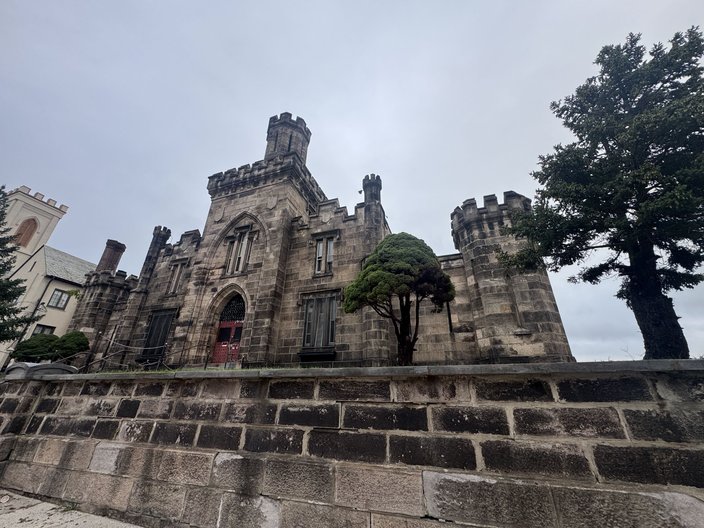
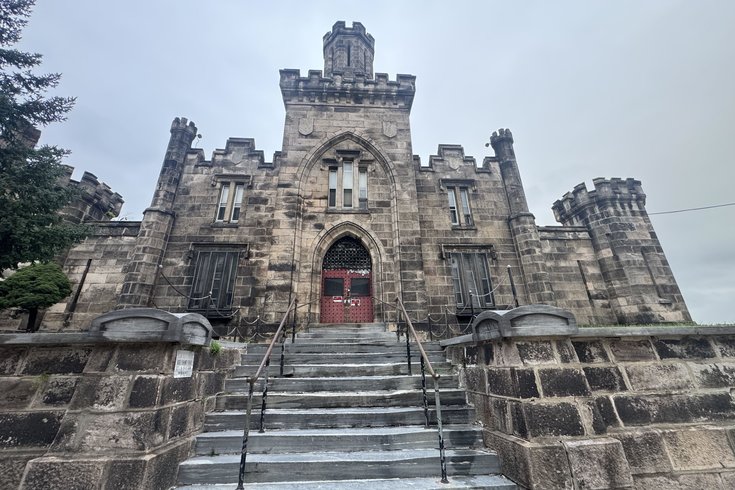
Norristown's Airy Street Prison, built in 1851, was spared from demolition in 2024 when preservationists urged the county to explore redevelopment options. Planners are still seeking ideas for the future of the Gothic-style building — which has been empty since the mid-1980s — and a neighboring parking lot.
The Airy Street Prison in Norristown is one of Montgomery County's most striking examples of 19th-century architecture, a Gothic-style relic whose beauty belies a history of public executions in its courtyard.
The castle-like structure, shuttered since the mid-1980s, sat on the cusp of demolition a few years ago. The roof on a rear addition partially collapsed in 2019, and after decades of failed initiatives to repurpose the property, Montgomery County was prepared to pay about $1 million to be done with the whole structure and its carceral legacy.
"The idea of investing tens of millions of dollars to just take over the site and do something with the prison, it wasn't necessarily supported and viewed as a responsible action to the taxpayers," said Scott France, executive director of the Montgomery County Planning Commission.
Preservationists lined up to fight the prison's tear-down. They argued it's an important historical artifact and feature of Norristown's streetscape. The main building fronting Airy Street, constructed in 1851, features an 85-foot-tall guard tower and imposing perimeter walls that run along Maris Street. It was designed by renowned architect Napoleon LeBrun, whose works include Philadelphia's Academy of Music and the Cathedral Basilica of Saints Peter and Paul.
At public meetings, advocates told county leaders that knocking down Airy Street Prison would be both an erasure of past injustices and a wasted opportunity to leverage the building's character for the future of Norristown.
"We basically managed to make enough noise that the county withdrew their application to demolish it," said Doug Seiler, a Norristown architect and longtime leader of efforts to restore the prison.
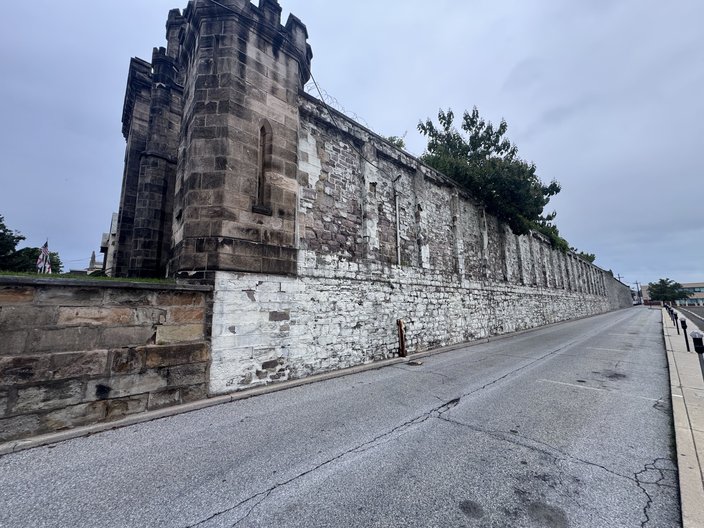
A perimeter wall made of mortared stone masonry stands about 20 feet tall and surrounds Airy Street Prison's east, west and north yards. Above, the wall is shown along Maris Street.
Two and a half years have passed since the county agreed to explore redevelopment options for the prison and its neighboring parking lot, which is now used for jurors at the nearby courthouse. Constructing homes somewhere on the 2.8-acre property, which includes the parking lots, is one of the county's top priorities for a public-private partnership.
Planners hoped to select a project by the end of this summer, but changed course in June after narrowly missing out on a $4 million federal grant to cover the bulk of the site's cleanup. A new call for proposals is expected to be issued this fall, and it's doubtful a project will be chosen before next year when the county reapplies for the brownfield cleanup grant.
"It's such a complex preservation and redevelopment effort," France said. "I think it's fair to say it's certainly taking a slow walk to where we are, but I think that's worthwhile and it's important in order to hopefully get the best outcome that we can."
Deciding what to do with a crumbling prison that hasn't been used in 40 years can become a race against time.
"Every day that goes by, it deteriorates more and gets more expensive simultaneously," said Sam Olshin, a partner at Atkin Olshin Schade architecture firm in Center City, which has been a key player in renovations at Eastern State Penitentiary in Fairmount.
Olshin disclosed that his firm was part of a team that submitted a development proposal for the Airy Street Prison site after Montgomery County first issued its request for expressions of interest in January 2025. He described prisons as different beasts compared with other restoration projects he's worked on, like the Met Philadelphia concert hall and the Lansdowne Theater in Delaware County.
Old prisons are laden with asbestos and lead paint that are difficult and costly to remove. They also have thick walls, few exits and only a limited number of windows. Even if Airy Street Prison remains in decent shape and developers are given leeway to demolish parts of it, the cleanup and restoration work create economic barriers.
"Developers don't want to get their hands dirty on something that complicated," Olshin said. "There's not enough of a profit margin. A library, community center, a theater, museum — they're all community-based assets, but they don't pay big rents."
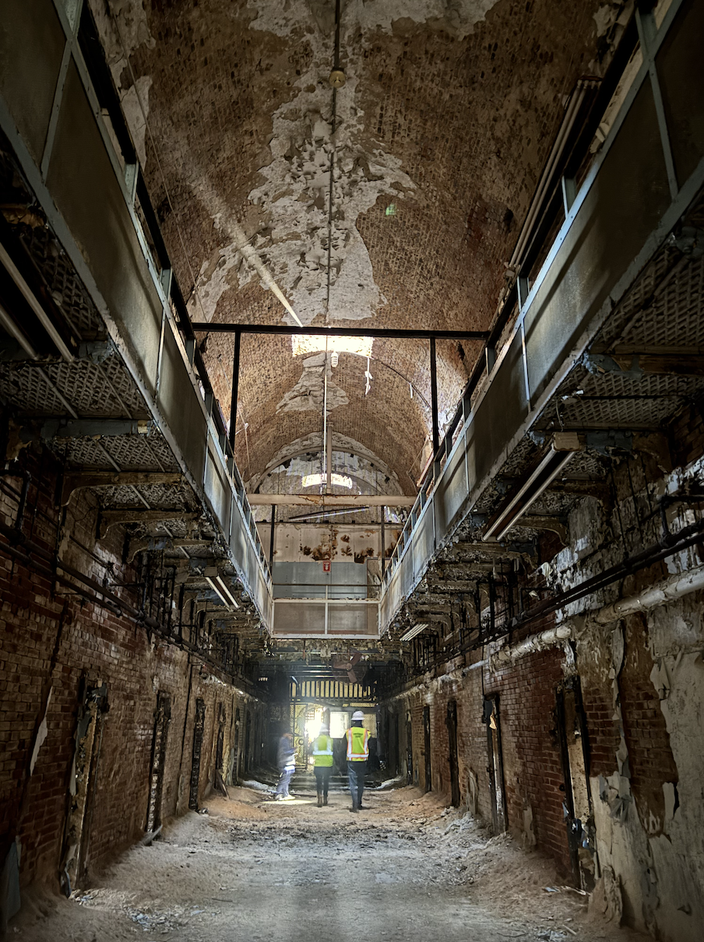
Norristown-based architect Doug Seiler, a longtime advocate for saving Airy Street Prison, has been inside the shuttered building about a dozen times. The photo above shows a portion of the original cell block that had space for 40 inmates across two floors, in addition to a basement. Expansions to the prison were made in the 1890s and 1920s to increase its capacity.
Norristown has struggled economically for decades in comparison to the wealthier county seats in the Philly suburbs. Most of its shopping district, which once thrived in the 1960s, vanished after malls in Plymouth Meeting and King of Prussia were built. Its manufacturing base has largely dissipated and median incomes fall below much of the region's suburbs, creating a tough business climate for nightlife and entertainment.
As one of the region's most racially diverse communities, Norristown also has a varied cultural landscape with wishes that don't always coalesce smoothly when resources are limited.
Apart from the upcoming expansion of the Elmwood Park Zoo, Norristown has had few major development projects that position it as more of a magnet in the region. The Montgomery County Justice Center's $430 million renovation is nearly finished, giving downtown a much-needed refresh, but it's not a recreational hub.
"Not a lot has changed in the 26 years I've been here," Seiler said. "Just about every group you can imagine has tried to promote it over the years. It's hard to kind of solve the Norristown puzzle."
Seiler's firm partnered with another development team on an Airy Street Prison proposal that calls for a mix of dining, entertainment, county offices and retail at the site. The plan envisions a space for live music, a comedy club and restaurants similar to the cluster of attractions at the Fillmore Philadelphia in Fishtown. A series of steel prison cells could be removed from the addition behind LeBrun's core structure to create the music venue, Seiler said, while a restaurant and maker space could fill the original prison.
"The town really needs a destination," Seiler said. "There is only one castle you would want to stand in front of and take your Instagram picture at in this whole downtown."
The Airy Street Prison site is part of the Central Norristown Historic District, which covers about 40 blocks that are listed on the National Regsiter of Historic Places. The prison's fortress layout was inspired by the much larger Eastern State Penitentiary in Philadelphia.
When Montgomery County surveyed nearly 700 residents about the future of Airy Street Prison two years ago, more than half of the respondents supported preserving the building. About 17% said they would like to see the history of the prison recognized at the site through education.
Among the ideas residents suggested for the site were restaurants, retail and residences. Some believe the county should require developers to include a historical component that addresses the prison's troubling history, including decades of conflict over the conditions female inmates faced there.
"One of the things that rarely happens, especially since we're talking about prisons and how to repurpose them, is directly consulting justice-impacted people," said Heather Lewis, a former Norristown City Council member who now runs the nonprofit Reuniting Family Bail Fund. "That would be my first suggestion or demand."
Lewis previously leaned toward demolishing Airy Street Prison while serving on City Council, partly because she felt preservation efforts tended to crop up only at the 11th hour. At one time, she recalled discussions about consolidating Norristown's firehouses at the site.
Any notion that Airy Street Prison could follow the blueprint of Eastern State Penitentiary is likely misguided, county officials said. The site in Norristown is about a quarter the size of the 11-acre property in Philadelphia, and while it is well-served by public transit, the location and history of the prison lack Eastern State's scale and intrigue.
"That's a great, amazing thing that they did with that building and the way it's both popularly and educationally used," France said. "I don't think that same opportunity sits here."
At this stage, France said the county is in close conversations with Norristown officials but has not drawn significant input from City Council. Any selected project eventually will need to go through the legal requirements of land development approval from the city.
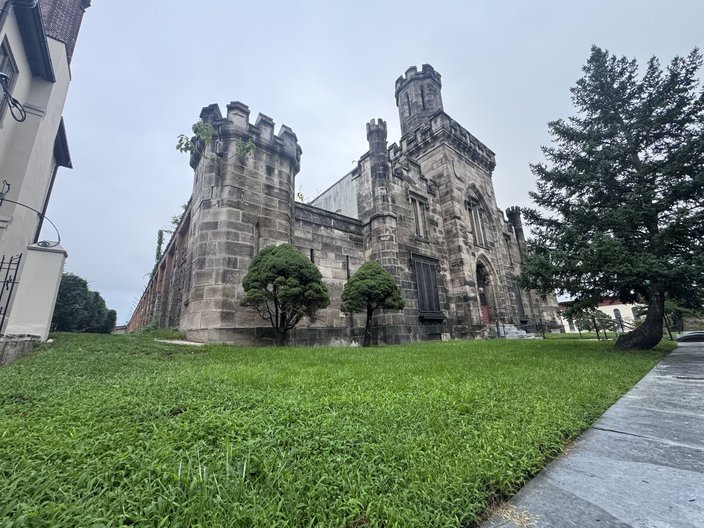
Airy Street Prison's oldest structure, known as the castle, was the main entry to the complex and held the warden's residence. Architect Napoleon LeBrun's design was inspired by Eastern State Penitentiary in Philadelphia, where the model of solitary confinement was viewed as a pioneering system in the 1820s and 1830s.
Lewis appreciates the county's dilemma, but doubts whether Norristown's residents will benefit much from trendy attractions at the building. She would love to see the prison hold an incubator space for small businesses, including entrepreneurs rebuilding their lives after serving time in prison.
"Make it make sense that you would put a brewery in a community that's Black and brown, that's heavily policed, in a prison," Lewis said. "Nobody from Norristown is going to go there. ... Honor what has transpired there — the initial use — and the future use should continue to honor and promote healing within a community."
Montgomery County planners did not say how many proposals they received from the RFEI, but France feels encouraged by the range of ideas that were pitched and those still to come.
"We don't want to put proposals out there until we have enough confidence that there's a viable project, or else we'll be creating more false leads than actual momentum," he said. "One of the elements we are more and more adamant on is wanting to see a residential component there."
Olshin wants to see the county work with several developers who can spread the risk of restoration and pool their best ideas. Seiler insists creativity is crucial to turning the site into something more than a bland mixed-use complex. There have been hints the county's project scope could be "significantly altered," Seiler said, citing conversations with potential development partners.
At a minimum, France said the goal is to preserve the prison's main facade as the centerpiece of a transformational project.
"Not everyone's going to have the same opinion on exactly what should be there," he said. "I'm sure in the end there'll be some disappointment, some great joy. If we succeed in keeping part of the prison and have a successful development, I think overall there's hopefully going to be a lot of satisfaction."