




April 02, 2026
 Provided Image/NASA
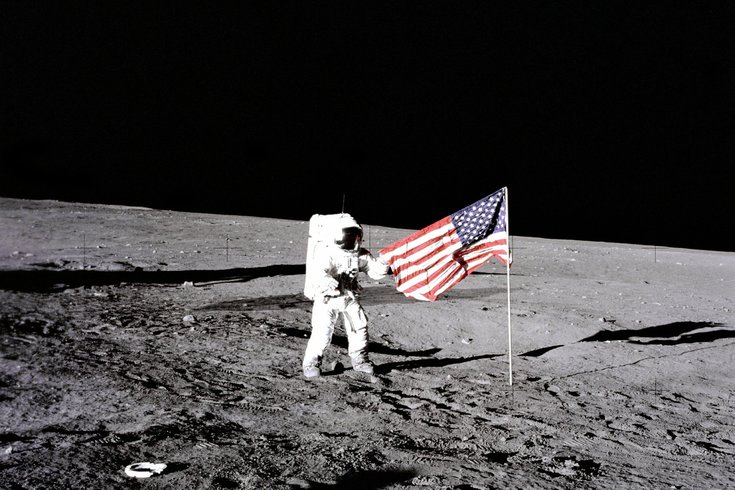
Pete Conrad, who was born in Philadelphia and was raised in Chester County, was the third person to step foot on the moon. Above, Conrad unfurls the American flag during his moonwalk.
A monumental space mission is underway as the crew aboard Artemis II embarks on a 10-day flight around the moon and back to Earth.
It will be the first time a crewed spacecraft has returned to lunar orbit since 1972, and the expedition marks the first woman, person of color and non-American to travel beyond low Earth orbit. It follows the Artemis I mission from 2022 and is being made in preparation for a planned moon landing in 2028.
MORE: Documentary 'Cold War in Philly' revisits Flyers' 1976 win over Soviet team
No one from the Artemis II has ties to the Philadelphia area, but the city has spawned a few prominent astronauts, including Guion Bluford, the first African American to go into space. There have been only 12 people who have ever walked on the moon, and one is from the area. Pete Conrad, who was born in Philadelphia in 1930 and was raised in Devon, Chester County, became the third person to set foot on lunar soil in November 1969, a few months after Neil Armstrong and Buzz Aldrin made their first mission.
In honor of the Artemis' mission, here's a look back on Conrad's life and lasting legacy:
His legal name was Charles Conrad Jr., but his mother insisted he be called Pete.
Aviation was in Conrad's blood, as his father, an investment banker, was a balloonist during World War I. As a teenager, Conrad worked at the Paoli Airport, taking care of the grounds and washing planes to save up money for flying lessons. He attended the Haverford School but later flunked out after struggling with dyslexia, Main Line Today reported. He eventually graduated from the Darrow School in New Lebanon, New York, which incorporated hands-on and project-based learning.
Conrad then went to Princeton University and joined the Navy in 1953, spending time as an instructor pilot and engineer before being invited to apply for NASA's space program. He flew on four missions, the Gemini 5, Gemini 11, Apollo 12 and Skylab 2.
Thomas Sweeney, a senior aeronautical engineer and Princeton classmate, described Conrad to the Princeton Alumni Weekly in 1969 as charming with an "outstanding personality."
"He was not the kind one would call deeply serious, although he did spend a great deal of time working," Sweeney told the outlet. "He was a great mimic. His Donald Duck imitation was outstanding."
Conrad, who died in 1999, was known throughout his life for his wit and love of practical jokes. In 1958, during testing for NASA's first class of astronauts, a psychiatrist showed him a blank white card and asked him to tell a story about it, Main Line Today reported. Conrad responded that he couldn't because the card was upside down. When asked to provide a stool sample, he gift-wrapped it, according to the outlet, and was ultimately deemed “not suited for long-duration flight.”
However, he reapplied and was selected for the second mission, the Apollo 12. Upon touching down on the moon, Armstrong famously said he took a "small step for man." Conrad, who was 5-foot-6, decided to reference him in his first lunar words.
“Whoopee! Man, that may have been a small one for Neil, but that’s a long one for me!” Conrad said.
Despite his humorous nature, he was also known for being a hard worker and remaining steady in times of trouble. On the Apollo 12 mission, he kept the spacecraft ascending after it was struck by lightening twice shortly after the launch. Later, he helped repair a damaged section of Skylab.
Across his four space missions, Conrad spent 49 days, 3 hours and 37 minutes in space, which was a record at the time. He also set a space endurance record after spending 28 days aboard the Skylab.
After he left NASA, Conrad became the vice president of operations and chief operating officers for the American Television and Communications Corporation. He then joined the McDonnell Douglas Corporation, an aerospace manufacturing company, as vice president and consultant in 1976.
Following a motorcycle crash in Ojai, California, Conrad died on July 8, 1999, and was buried in Arlington National Cemetery.
He received a number of awards throughout his life, including NASA Distinguished Service and Exceptional Service medals, Navy Astronaut Wings, a Pennsylvania award for Excellence in Science and Technology and a Silver Medal from the Union League of Philadelphia.