




July 18, 2025
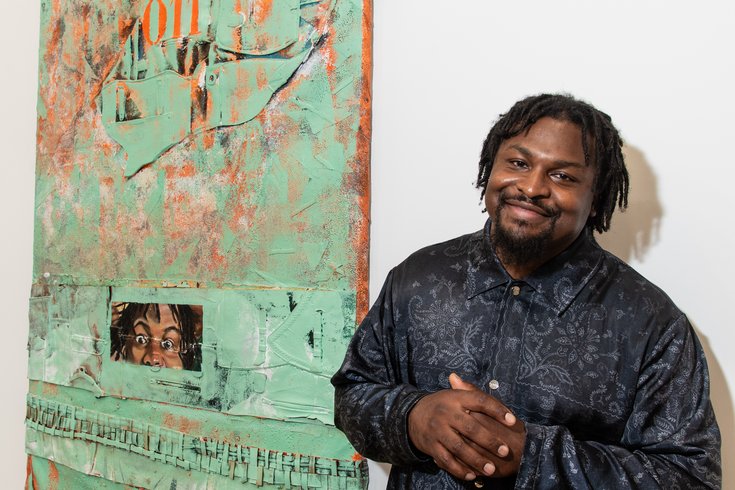 Provided image/The Prisoner
Artist Russell Craig poses in front of his painting 'Cell 11.' The piece is one of many inspired by his past incarceration at SCI Graterford.
Russell Craig wasn't supposed to be at the Mural Arts meeting that propelled his artistic career. It was taking place in a restricted area of SCI Graterford, the former Montgomery County prison, and Craig, who was serving out a sentence there, had not been invited.
But he knew he wanted to pursue art professionally once he was released. So he risked the potential punishment in solitary confinement and introduced himself to Robyn Buseman, then the director of Mural Arts' program for formerly incarcerated artists. She offered her card, which Craig used to contact her after his sentence was up.
That connection got him a spot in the Guild program, creating pieces that still grace the sides of Philly buildings. Now, he has work in the permanent collection of the Brooklyn Museum, and has shown paintings in MoMA PS1 and the African American Museum of Philadelphia.
"You can go to the hole for 90 days for being in an unauthorized area," Craig said. "So it was a risky move, but it paid off."
Though Craig left prison over a decade ago, his time there shaped his artistic education. He remembers drawing pictures as a child — initially to mimic his sister, who got attention for her "Simpsons" sketches in their foster home — but "disconnected" from art in his teen years. After he landed in prison on drug charges, he threw himself back into the practice. He checked out books on color theory and anatomy from the library. He practiced portraiture until he was good enough to charge $40 for his pieces. And he focused on little else, spending all his time in the private world that art created for him.
"I didn't really lift weights, play basketball, play chess, none of that stuff," Craig said. "I just did art or would go to the library."
His first assignment for Mural Arts was working on artist James Burns' project at Broad Street and Lehigh Avenue. (Craig is always glad to see it from the train when he travels from New York, where he now lives, back to Philadelphia.) Though he admits he initially balked at stepping onto the swing stage scaffolding 120 feet up in the air, he was eager to impress a skeptical Burns and says his fear of heights "was completely gone" once he stepped up. Craig would go onto create the "Direction" mural on Stenton Recreation Center and "Prophesied" portrait on the side of the African American Museum of Philadelphia.
The latter piece features dissembled leather bags, sewn together and painted to resemble a person. Craig began working with leather purses soon after his release, initially buying the bags off a mutual friend who was still incarcerated. They became a "signature" for him, and an expression of his commentary on mass incarceration and structural racism.
"I start thinking about the body," Craig said. "Like leather is the skin of the cow to hide. So I'm speaking of the body, the Black body, in the prison system in America, oppression and things like that. How (we're) mistreated. You have to treat leather, you're doing stuff to it, so you could either treat it well or treat it bad."
Materials heighten the message for Craig, who collected cigarette butts off the street for a portrait of Eric Garner and hair clippings from a barber shop for a piece responding to workplace bans on dreadlocks. He used ox blood on one of his most famous works, "Eval," a series of portraits of women killed by the police, rendered in Rorschach-like ink blots. He's also worked with ramen noodles, and drawn inspiration from the men who wove the discarded wrappers into picture frames.
Another recent project is Corrections by the Napa Valley wine brand the Prisoner. Craig is a finalist in consideration to create the next label for the limited-release series, which features commissioned or original artwork on mass incarceration. A portion of its proceeds benefits restorative justice organizations. Though the winner won't be announced until fall, Craig imagines he'd draw on his blood-spattered pieces like "Eval" or the cell door imagery from "Cell 11" for the label, if he's selected.
Craig, who co-founded the Right to Return USA fellowship for formerly incarcerated artists, remembers a time when he felt conflicted about using his real-life imprisonment in his art. He recalled talking to Agnes Gund, a board member of MoMA PS1, about not wanting to paint about "jail all the time." Her response has stayed with him, particularly as he feels attention has been diverted away from mass incarceration.
"She was like, you should never fully abandon it because it's part of your story," Craig said. "... So as I move forward, it'll always be in my work. Because it don't matter what the perception of the people is, (it's) our job to bring things to people's attention, start dialogue, revisit the conversations that might die down, especially if the issue persists. So that's what our duty is as artists. It goes beyond just making something that looks good."
Mural Arts employee Robyn Buseman's name was misspelled in an earlier version of this story. It has been corrected.
Follow Kristin & PhillyVoice on Twitter: @kristin_hunt
| @thePhillyVoice
Like us on Facebook: PhillyVoice
Have a news tip? Let us know.