




March 09, 2026
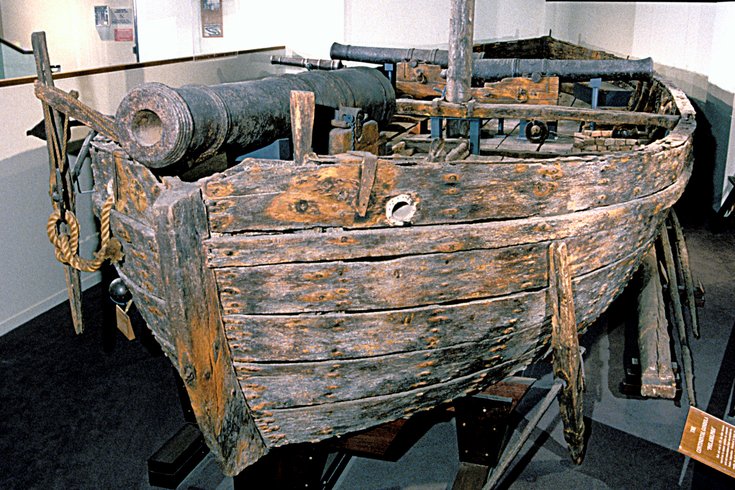 Public domain/Smithsonian Institution
The USS Philadelphia, one of eight gunboats deployed in an early Revolutionary War battle, was found at the bottom of Lake Champlain in 1935.
The wooden boat known as the Philadelphia only fought one battle before it sank into the chilly waters of Lake Champlain. It sat there for 159 years undisturbed, until an amateur archaeologist raised it from the dead and bequeathed it to a major museum. It’s still on display, and for good reason — it’s the oldest surviving U.S. warship, part of the rebelling colonies' first navy.
How did this humble vessel, constructed in present-day Whitehall, New York, and deployed in Adirondack Park, earn the name Philadelphia? The gunboat has surprisingly few connections to its namesake city. But Philadelphia officials still tried to acquire it as a prized piece of their developing waterfront, where it would have stood alongside the Olympia and Moshulu. The Smithsonian got it instead.
The USS Philadelphia was, as the National Park Service would put it, "little more than a rowboat compared with modern vessels." Powered by a sail and oars, the boat spanned 54 feet in length and its mast reached 36 feet into the air. The Philadelphia was one of eight gondolas hastily assembled in the summer of 1776 to defend the New York border in the second year of the Revolutionary War. Rebel forces expected the British to invade from Canada imminently following their clashes in Quebec.
The new boats were built in Skenesboro, a village about 25 miles south of Fort Ticonderoga, where the Continental Army had retreated. (Skenesboro was later renamed Whitehall.) Benedict Arnold, a brigadier general who was still years away from his infamous defection, would oversee the fleet. Experienced shipwrights were in short supply, so Arnold recruited widely, calling up men from New England, New York, New Jersey and Pennsylvania.
Herein lies one possible explanation for the USS Philadelphia. The influx of carpenters included a company from the namesake city, which arrived in Skenesboro in late July. Smithsonian curator Jennifer Jones says that would have been too late, however, for them to work on, much less inspire the name of, the gunboat.
"By this time, the Philadelphia was mostly built and was days from completion," she wrote in an email. "Also, given they were a company of ships carpenters, they almost certainly didn’t have the status to be credited with naming the boat. Only those in command of Skenesboro shipbuilding and officers would have influence to name ships."
That brings us to the Smithsonian's leading theory. One officer did have a connection to Philadelphia — its captain Benjamin Rue.
"(He) had served Arnold in 1775 on the campaign into Canada," Jones said. "And then because he was a known entity to Arnold and had come out of Pennsylvania and had some knowledge of ships, Rue was given command of one of the gunboats. And because he was from Philadelphia, he named it Philadelphia."
The USS Philadelphia, like all of the gondolas, came equipped with a 12-pound cannon, two nine-pounders and swiveling guns. Along with a sloop, two schooners and four row galleys, these boats made up the entire American flotilla.
The redcoats, by contrast, had strapped six 24-pound cannons and six 12-pounders to just one of its vessels, a floating battery called the Thunderer. They had about 50 more boats in their fleet, lending them a significant advantage over the rebel navy. When the two sides met in Valcour Bay, a narrow body of water between New York and Valcour Island, on Oct. 11, 1776, the British unsurprisingly triumphed. But the Americans' stand delayed an enemy invasion just long enough to give the Continental Army a real shot.
This oil painting depicts the Battle of Valcour Island, an early naval skirmish in the Revolutionary War.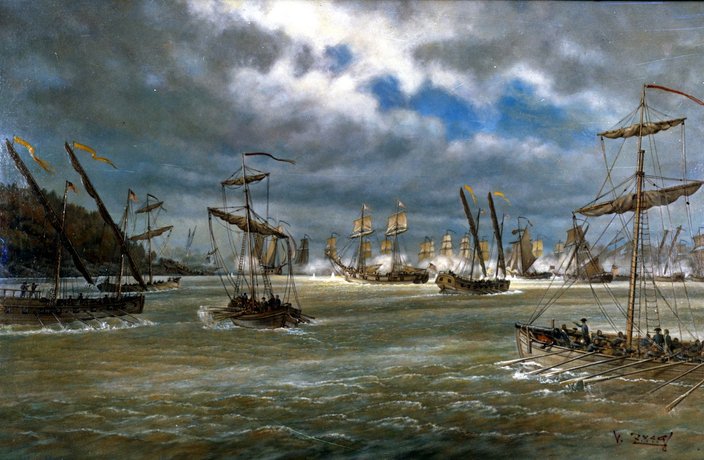 Public domain/V. Zveg
"Once the ship building race started, it delayed the British for over a year," said John Bratten, author of "The Gondola Philadelphia and the Battle of Lake Champlain." "And that year's period gave the Americans time really to build their armies. So even though they lost the battle, by having that time to rebuild, build up an army, the Americans were able to win the battle at Saratoga. And by winning that battle, basically that told the French that the American rebels were serious and influenced the French then to come to the aid."
One of the casualties of the battle was the Philadelphia. The British fleet blew three holes in the gondola, sending it to the bottom of the lake. It might've stayed there, if it weren't for an enterprising diver named Lorenzo Hagglund.
A veteran of both world wars, Col. Hagglund was a marine salvager who searched for shipwrecks in his spare time. He discovered and raised the USS Philadelphia, still intact and in remarkable condition, in 1935.
In the ensuing decades, Hagglund exhibited the boat across New York, eventually setting it up for long-term display in the town of Exeter. But he wanted to find the Philadelphia a permanent home. The Smithsonian, he thought, would be the perfect place. The institution initially turned him down.
"He had written to the Smithsonian even before he raised it," Jones said. "And the Smithsonian said, yeah, we're not really interested in it. At that time, he tried to get Fort Ticonderoga, I think he even tried Albany. So he tried a bunch of places to take the boat even before he raised it."
The institution was more receptive when he tried again in the 1950s. They began negotiations for a gift agreement, though apparently Hagglund entertained other offers. The Smithsonian retains a letter from a Philadelphia commerce official discussing the city's interest in acquiring the gunboat "as one of the most important features of a comprehensive exhibit of historic vessels now being developed in the downtown waterfront." Peter Schauffler, the former deputy commerce director who helped redevelop Penn's Landing, sent it in 1960. The current commerce department could not locate records of this bid.
Hagglund died in 1961, but made it quite clear in his will that the gunboat should go to the Smithsonian. It's been on display at the National Museum of American History for decades, though recent visitors might've noticed people in gloves and masks working on the Revolutionary War relic. The museum is currently in the middle of a preservation project to spruce the boat up for the semiquincentennial to celebrate America's 250th birthday. The team has been sifting sediment and clearing out "critter nests" for months now, Jones says, and will soon begin deep cleaning. With any luck, they'll have the Philadelphia looking closer to how Captain Rue saw it when he embarked on Lake Champlain — outgunned and outmanned but still believing the rebels would ultimately earn their independence.
Follow Kristin & PhillyVoice on Twitter: @kristin_hunt
| @thePhillyVoice
Like us on Facebook: PhillyVoice
Have a news tip? Let us know.