




March 06, 2026
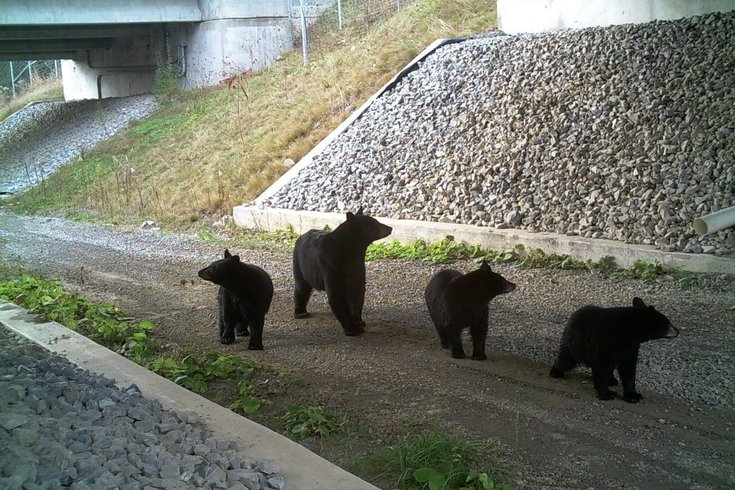 Provided Image/PennDOT
Pennsylvania officials are creating a group that will explore wildlife corridors to help animals move around the state safely. Above, a family of bears walks along a underpass route below Interstate 99 near State College.
Pennsylvania lawmakers are putting together a new group to create "wildlife corridors," which are protected spaces that connect fragmented habitats to help animals that are hunting, foraging, migrating and mating.
These ecological bridges include underpass tunnels to bypass major roadways, fish ladders to help aquatic life move through dams and fencing to keep animals away from highways where they might get hit. Only four other states have a higher rate of animal collisions than Pennsylvania.
The group will include representatives from the state's Game Commission, Fish and Boat Commission and Department of Transportation. Members will work with local governments and private landowners to help protect existing habitats for bears, bobcats, elk, deer, fish and reptiles.
Cindy Adams Dunn, the secretary for Pennsylvania's Department of Conservation and Natural Resources, announced the news Monday during a hearing for the House Appropriations Committee. It follows a resolution in the state House from 2023 which directed lawmakers to find the best way to address some of these issues, and a subsequent report from 2024 which said an interagency approach would be the best method.
"What I expect to come out of that will be a collaborative effort where private landowners can collaborate, state governments and counties can decide how to focus their land conservation," Dunn said during the hearing. "I see a lot of positive voluntary actions coming out of this greater understanding."
Stephanie Wein, a clean water and conservation advocate at the nonprofit Penn Environment, said Pennsylvania has diverse wildlife, including the Eastern Hellbender, a salamander that can grow up to 2 feet. The state is also a key "rest stop" for migrating songbirds, including the red knot which comes from the tip of South America.
"We are a critical piece of the Atlantic flyway, and so when we think about habitat in Pennsylvania, we're actually not just talking about the animals that live here year-round," Wein said. "We're talking about all the ones that move through. We're of this sort of hemispheric importance, Canada and New England only have wonderful songbirds in the summer because they they come up through Pennsylvania in the spring."
Though they're not traveling quite as far, many native animals also need to migrate to different breeding grounds or from forests to ponds to lay eggs. Pollinators, too, need safe meadows and other areas to harvest pollen.
Though the group will be looking at multiple interventions, wildlife crossings will be a key focus. In Pennsylvania, that likely means underpasses below highways and interstates, which are cheaper to build and better for wildlife in this area compared to some of the bridges built in the Western United States.
Wein said she believes the group will approach conservation in a holistic way.
"This isn't just about hitting deer," Wein said. "It's going to be about our songbirds, it's going to be about our amphibians, it's going to be about how we manage the millions of acres of state land and engage with nonprofit partners who are doing conservation work."