




August 22, 2025
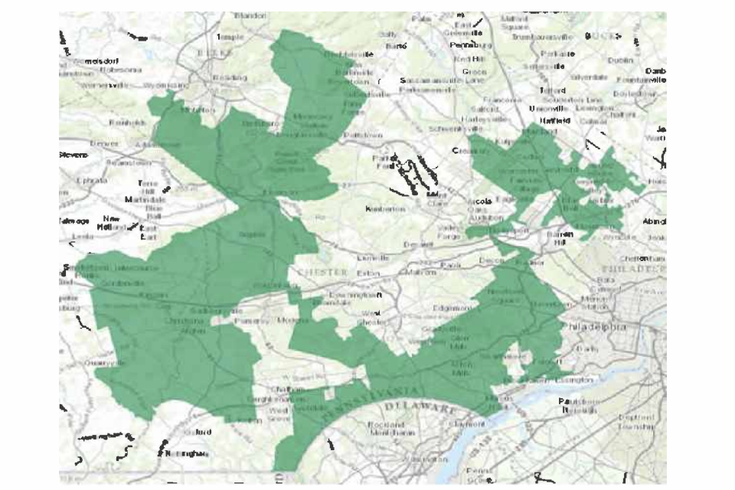 Screenshot/Court documents
This court document of the Seventh Congressional District was filed in 2017 for the League of Women Voters of Pennsylvania v. Pennsylvania case, which focused on alleged partisan gerrymandering. In 2018, the Pennsylvania Supreme Court ruled the map was in violation of the state constitution.
As redistricting fights erupt in Texas and California, line drawers looking for a political edge will have a hard time matching the artistic beauty of the blatant gerrymandering done in Pennsylvania in 2011, when the state became the poster child for the manipulative practice after creating a district that became widely known for resembling Goofy kicking Donald Duck.
After the 2010 Census, Republicans redrew the lines to try to pick up a seat in Southeastern Pennsylvania. They combined suburbs to the north and west of Philadelphia with rural areas outside Reading and Lancaster, while conveniently carving out the city of Chester, to form the Seventh Congressional District.
MORE: Pa. Treasurer Stacy Garrity to run for governor against Josh Shapiro
The shape conjured images of the combating cartoons, with two distinct sections slicing 26 municipalities and snaking through most of Delaware County and portions of Montgomery, Berks, Chester, Montgomery and Lancaster counties. Where Goofy's foot met with Donald's derriere, the district narrowed to the width of the since shuttered Brandywine Hospital in Coatesville (about 1,000 feet.)
In 2014, the Washington Post ranked it among the 10 most gerrymandered districts in the country. In 2018, a New York Times story stated that neighbors had different House representatives, reporting that one resident said "the 7th District has become a national joke."
For Republicans, the partisan practice was not a mockery — but rather a calculated plan that worked. In the 2012 election, Democratic candidates for the state's 18 U.S. House seats won 51% of their state's popular House vote, but that translated to just 5 out of 18 (28%) of the seats, the Washington Post reported.
Republicans consistently held those 13 seats until January 2018, when the Pennsylvania Supreme Court ruled that the congressional map violated the state constitution and ordered new lines be drawn before the primaries in May.
After the 2020 Census, the lines were redrawn again, with the map that's used today being approved in 2022. Goofy and Donald are gone, and so is one of Pennsylvania's U.S. House seats. The state now has 17 U.S. House members, with seven being Democrats and 10 Republicans.
With Pennsylvania's House and Senate being split politically, neither party has enough control to mount a push for another redistricting effort like Republicans are doing in Texas and Democrats are doing in California.
On Wednesday, the Texas state House approved the new election map supported by President Donald Trump that would form five new congressional districts where he won by double-digits in 2024. The map could advance through the state Senate and be sent to the desk of Gov. Greg Abbott (R) for final approval in the coming days.
In California, Gov. Gavin Newsom (D) has led a countermove, and Democrats are set to pass a new map with five additional winnable seats for their party.
The national redistricting fight comes ahead of the 2026 midterms, with the GOP holding a narrow three-vote majority in the U.S. House. While the line drawers in Texas and California have gotten creative to put their controlling parties in prime position to pick up more seats, neither of the proposed new maps has produced any shapes that resemble Disney characters.