



March 10, 2026
 Kyle Ross/Imagn Images
Can the Sixers bring back both of their top free agents this summer?
The pool of questions submitted for our weekly Sixers mailbag typically is fairly representative of the overarching mood of Sixers fans. So, perhaps it is no surprise given the current state of affairs that this week's call for questions elicited many responses pertaining to the upcoming offseason.
The unfortunate news for Sixers fans ready to see major changes: it is difficult to envision the organization having a whole lot of maneuverability this summer. Joel Embiid and Paul George are signed to arguably the two most onerous contracts in the NBA; they are likely not movable and carry such significant cap hits that it will be nearly impossible for the Sixers to make significant changes to their roster without trading Tyrese Maxey, which would be a fool's errand.
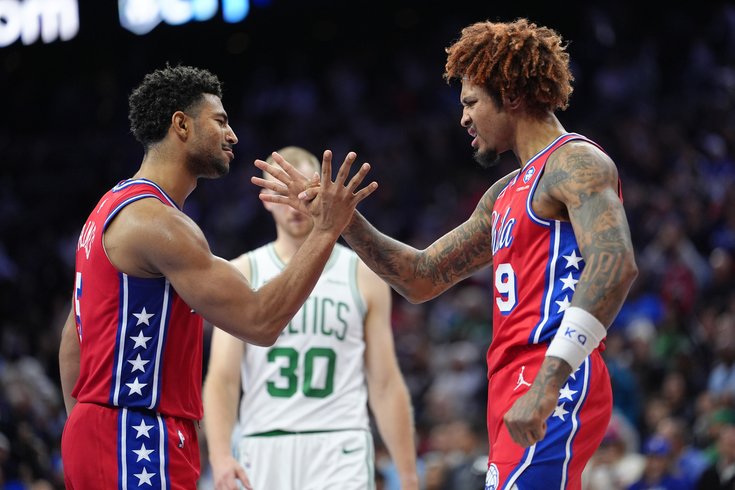
It appears that the two most important pivot points of the upcoming summer will be the Sixers' two highest-profile free agents, Kelly Oubre Jr. and Quentin Grimes. Both players are on expiring contracts of more than $8 million this season, both players will enter unrestricted free agency in the summer and both players will be Full Bird free agents, meaning the Sixers do not have any limitations in what they can offer either player as long as they do not trigger a hard cap at either of the aprons.
In this week's Sixers mailbag, diving into the likelihood of Grimes and Oubre returning and the Sixers' options elsewhere:
From @ChrisBernucca: Is there a path to keeping Quentin Grimes and Kelly Oubre Jr. this offseason?
The short answer: absolutely. Since both players are Full Bird free agents, the Sixers have the ability to meet the top of the market on one or both of Grimes and Oubre should they choose to do so. Either player could accept an offer from another team without giving the Sixers a formal opportunity to match, but it would be foolish for them to not consider returning if the Sixers are willing to make it worth their while financially.
The better questions: how far will the Sixers be willing to go to retain either player, and would one of them re-signing make it less likely the other one is back?
Assuming the Sixers pick up the team options of Dominick Barlow and Trendon Watford, keep the first-round pick they acquired from the Houston Rockets and decide against waiving the partially guaranteed salaries of Jabari Walker and Adem Bona, they will enter free agency with 11 players under contract and in the ballpark of $18 million below the luxury tax threshold, $27 million below the first apron and $40 million below the second apron (these figures and their implications will be explored in response to the next question).
Some might view that as an inherent statement that the Sixers will only spend about $18 million more on their roster because remaining under the tax is the organization's priority. But even as they have frustratingly ducked the tax repeatedly, the Sixers have consistently started seasons over the tax line while giving themselves enough flexibility to get under it if they decide to closer to the trade deadline. If they want to keep Grimes and Oubre but those contracts lead to the team being over the tax, the Sixers would likely not let that stop them.
From a basketball perspective, the Sixers do not have obvious replacements for Grimes or Oubre. Grimes is the third of three surefire rotation-caliber guards on their roster, and letting the 25-year-old walk after trading away Jared McCain would both be an optics disaster and a gross mismanagement of resources. The Sixers would have gone from a "glut of guards" to zero backcourt depth in less than a calendar year. Grimes' trip to restricted free agency last summer was disastrous and fruitless; Grimes has since hired new representation.
"We talked to his representation quite a bit through this period," Sixers President of Basketball Operations Daryl Morey said after the trade deadline. "Obviously, who knows exactly what the future brings, but we think he's a tremendous fit with our other guards, a two-way player, and we hope to re-sign him."
Oubre, meanwhile, is one of the only two rotation-caliber wings on the team, and given George's constant availability questions the team needs reliability there. Oubre picked up his $8.3 million player option last summer because he sensed he could not beat that money in a barren market with little to no cap space, but like Grimes he is set to enter a much more favorable market for players in 2026. If Oubre's career-best three-point shooting season continues, perhaps there will be more interest in the veteran swingman than previously expected ahead of his 12th NBA season.
While Oubre is an imperfect player, he has given the Sixers much more than they ever could have hoped to receive when they signed him to a veteran's minimum contract before the 2023-24 season. He has been available, intense and bought-in on both ends of the floor. At this time last year, it might have seemed like a reasonable expectation that Justin Edwards could fill Oubre's role by the 2026-27 season, but Edwards has stagnated as a sophomore. He has not done nearly enough for the Sixers to be comfortable entrusting him with a regular rotation role.
Back to the original question from Chris: there is absolutely a path to both players being back, and there is even a path to both players being back and the Sixers ending next season below the tax line if they continue to prioritize that. It is too early to forecast exactly what the market will look like for either player, both in terms of interested suitors and potential contract length and average annual value. The most reasonable projection would probably have Grimes in the range of $10 to $12 million per year on a multi-year deal and Oubre closer to the $8 million range on a one- or two-year deal – the Sixers should have interest in both players if those estimates prove true – but all it takes is one team to drive the price higher than that, and to a place the Sixers are not willing to go. Grimes is likely more of a flight risk than Oubre given his ceiling in Philadelphia is a sixth man, he should have more suitors as a younger player and he has already had a deeply unpleasant experience negotiating with the Sixers.
MORE: Life without Maxey, ominous Eastern Conference outlook, more
From @jfishman2727: What cap space do the Sixers have available this summer if they decide not to retain Grimes?
If Oubre returns on a salary similar to the $8.3 million he is making this year – we will call it $8 million flat for the sake of this hypothetical – and Grimes departs, the Sixers will have around $10 million in tax room as well as $19 million or so in space below the first apron. That could give them a chance to use the entirety or vast majority of the non-taxpayer's mid-level exception, which the organization has not used since it signed PJ Tucker.
Using the non-tax mid-level forces a hard cap at the first apron, though, meaning if the Sixers utilized it they would not be allowed to exceed that threshold at any point all season no matter what. An offer comprising of the entire non-tax mid-level is currently projected to four years at just over $65 million, a fairly significant investment.
Last summer, the Atlanta Hawks signed Nickeil Alexander-Walker to a deal at the full mid-level, and he has blossomed from an elite sixth man to a high-level starter. Coming off a strong season which built on his lengthy track record of being one of the league's best 3&D wings, Dorian Finney-Smith signed with the Houston Rockets on a four-year deal a bit under the full mid-level with only two guaranteed seasons. The Sacramento Kings gave Dennis Schröder a three-year deal at the non-tax mid-level to be their starting point guard. Bobby Portis re-signed with the Milwaukee Bucks for nearly an identical price over three years.
Among the players set to hit restricted free agency who could be attainable in this sort of price range: C.J. McCollum, Anfernee Simons and Collin Sexton at guard; Rui Hachimura, Lu Dort and Jonathan Kuminga on the wing; Mitchell Robinson and John Collins in the frontcourt.
While using the non-taxpayer's mid-level exception is not a pathway to adding a star, it is as close to a sure thing as there is to acquiring a reliable, playoff-caliber rotation player. If the Sixers used it, though, they would have very little flexibility beneath their hard cap at the first apron. They would be best served trying to save a small portion off of the full four-year, $65 million offer they could make to ensure they are able to fill out the rest of their roster comfortably.
If the Sixers were uninterested in incurring such a hard cap, they could use the taxpayer's mid-level exception instead. Projected to be worth up to two years and $12.5 million this summer, the tax mid-level is a much worse bet than the non-tax mid-level in terms of impact, but a safer bet than the minimum market and also a helpful tool for future trades (if the player signed to a tax mid-level deal does not pan out, they can be useful salary filler in trades without being much of a negative-value contract).
This is the price old friend Guerschon Yabusele needed to leave Philadelphia for the New York Knicks. It is also what fellow former Sixers big Al Horford signed with the Golden State Warriors. Most players signed in this range of the salary cap project to be useful bench pieces, but there is always some level of downside, whether it stems from a short track record, injury risk or age. But it is a better aisle to shop in than the minimum market, even while acknowledging Morey's excellent history navigating that price point with the Sixers.
MORE: Answering questions about Sixers' potential playoff matchups, rotations