




July 15, 2025
 Provided Image/Camden County Historical Society
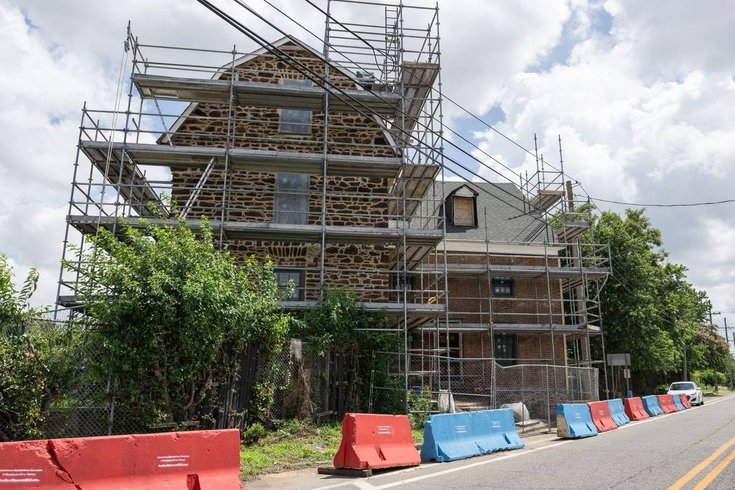
The Benjamin Cooper House in Camden will be restored into a museum celebrating the area's role in the Revolutionary War. The first floor is set to open to visitors by the summer of 2026.
A nearly 300-year-old former tavern in Camden is undergoing a $4 million restoration to be transformed into a museum honoring South Jersey's Revolutionary War history — just in time for the nation's semiquincentennial celebration next summer.
After spending over $1 million to stabilize the building, the Camden Historical Society broke ground last week on the work inside to establish the American Revolution Museum of Southern New Jersey at the Benjamin Cooper Tavern at 60 Erie St. The entire project won't be finished by the summer of 2026, when America will be celebrating its 250th birthday, but the organization plans to have the first floor ready for visitors by that time.
Jack O'Byrne, the executive director of the historical society, said he plans to have additional exhibits on the upper floors by September 2027, which will be the 250th anniversary of British soldiers occupying Philadelphia. It will also be the trailhead for the Camden County LINK trail, a 34-mile route that will connect a number of towns to the Jersey Shore.
The tavern was built in 1734 by Benjamin Cooper, a ferry operator who lived there until 1761. The building changed hands a number of times in the centuries since, including stints as a boardinghouse and later a drafting room for U.S. Navy engineers during World War I. However, it primarily functioned as a shipyard building until it was vacant in 1992. Developer 75 Erie Street purchased it in 2019 and the historical society signed a 30-year lease in 2021 to use it as a museum.
With prominent cultural events such as George Washington crossing the Delaware River near Trenton and the signing of both the Declaration of Independence and Constitution at Independence Hall in Philadelphia, O'Byrne said South Jersey's Revolutionary War history is often overlooked. The area was the sight of several small battles, and the Benjamin Cooper Tavern was the headquarters for British troops who were foraging for food during the occupation of Philadelphia, according to O'Byrne.
The museum will also include the wartime history of Burlington, Gloucester, Salem, Cumberland, Atlantic, Cape May and Ocean counties, in addition to Camden.
"North Jersey and Philadelphia, they completely overshadow our history in South Jersey, which nobody talks about," O'Byrne said. "But basically, it was a civil war back then between the loyalists and American sympathizers and the British and the Hessians against the militia and the American continentals. So in all eight counties that we are calling South Jersey, there's a tremendous amount of war activity."
O'Byrne said the first part of the project was an exterior renovation to make sure the building wouldn't fall in on itself. That's nearly complete, so teams will now focus on making it habitable, including adding plumbing, heating and electric. The only original feature left inside is the banister along the stairs, which will be restored.
The tavern and nearby Cooper's Ferry were also the site of slave auctions in the 1760s. The historical society put up a market denoting this history a few years ago, and O'Byrne said they plan to also include that part of the building's past in the museum.
The museum will also feature an exhibit on the continued issue of equality in the United States. The display will showcase a number of moments, from the "all men are created equal" line in the Declaration of Independence that excluded the majority of the population, to the Americans with Disabilities Act and the fight for same-sex marriage.
"We want to focus on that history of two steps forward, one step back of equality in the United States," O'Byrne said.