





February 20, 2026
 Kristin Hunt/for PhillyVoice
Artist Isaiah Zagar hid recurring characters and messages in his mosaics across South Philly.
No two Isaiah Zagar mosaics were exactly alike.
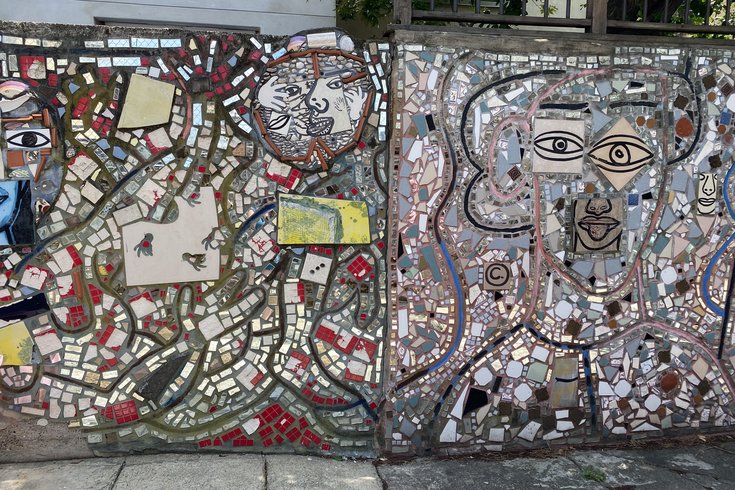
The South Philly artist, who died Thursday, smashed up bottles, mirrors and teapots to create his murals, squeezing small portraits or phrases into the labyrinth of pieces that, once assembled, made a work of art. The variety of textures and shapes, along with Zagar's habit of choosing scraps at random, lent each mosaic a one-of-a-kind quality.
Still, the founder of Philadelphia's Magic Gardens had several trademarks as an artist. Some of them, like the bright colors or sense of ordered chaos, are obvious. Others require a closer look.
Certain characters and sayings repeat across Zagar mosaics, revealing his attitudes toward art and family. Scan enough of his walls on South Street and you're sure to spy a man in a hat, a distinctive maternal figure and a looping phrase, among other motifs. Here's what they all mean, and how to spot them:
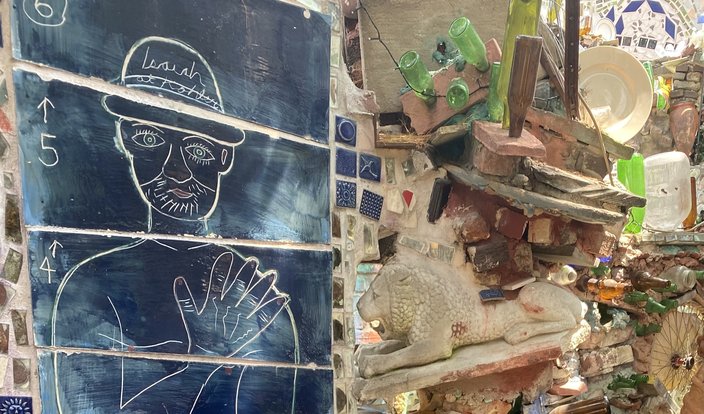
Zagar often put himself in his pieces. Though his self-portraits vary, he usually shows up as a man in a broad-brimmed hat. Sometimes he has multiple arms or legs, or is fusing with another figure. These extra limbs reflect Zagar's interest in Hindu deities – particularly the destructive goddess Shiva – and his preferred mode of working. Zagar approached a new canvas with a bucket of pieces and tools in one hand, using the other to quickly place and paste fragments onto the wall. His speed, he said, made it look like he had other arms.
Isaiah Zagar made many self-portraits. He often appears as a man in hat, sometimes with multiple arms. The character is seen in a section of the Magic Gardens sculpture garden above.
Zagar's wife of over 60 years, Julia (nee Papiroff) Zagar, was a lifelong muse. She appears across countless mosaics, occasionally as a bride but more often as an expectant mother. This continued even after she gave birth to the couple's two children, Zeke and Jeremiah.
"He likes to show Julia pregnant very often, even when she's not," Allison Boyle, events and marketing manager for Magic Gardens, said in a past interview. "Just because she's that sort of like matriarchal figure. That was just her, very motherly."
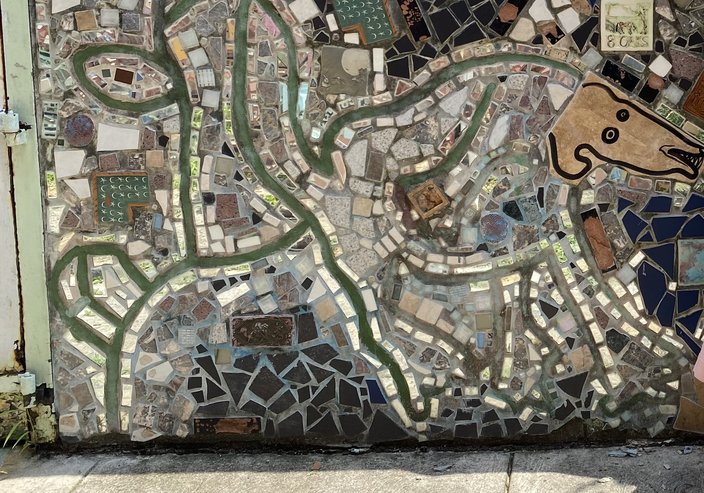
Furry friends populate the corners of several Zagar originals. The artist worked his actual pets, including his beloved poodle Blue, into multiple mosaics, sometimes in the service of a full family portrait with Julia and his sons.
Isaiah Zagar worked dogs into his mosaics, like this mural near his Magic Gardens in South Philly.
Zagar frequently paid tribute to artists who inspired him, sometimes by incorporating their sculptures directly into his work. This is particularly noticeable at the Magic Gardens, where angels, mermaids and owls by (mostly) Mexican artists line the walls of the outdoor sculpture garden. Zagar also made portraits of people he admired, such as the straw paintings of Simon Rodia he created with popotillo artist Luz Maria Salinas.
The references show up in more subtle ways, too. Zagar riffed on the work of Marcel Duchamp, a major artistic influence, by writing "The Bride has many suitors, even" – a play on Duchamp's "The Bride Stripped Bare By Her Bachelors, Even" – across the former Painted Bride Art Center. He also hid the names of his heroes in the mosaics. See if you can find Sandro Botticelli's name in on the second floor of Jim's Steaks. Before it became the flashiest cheesesteak dining room in Philly, it was the home of the Zagars' Eye's Gallery.
"Art is the center of the real world" was Zagar's personal mantra which, in Boyle's words, he put "everywhere." (His self-portrait at the Pennsylvania Academy of the Fine Arts is even named that.) The whole phrase appears across multiple works, but sometimes it's abbreviated into AITCOTRW, which is much easier to sneak between shards of teacups.
Follow Kristin & PhillyVoice on Twitter: @kristin_hunt
| @thePhillyVoice
Like us on Facebook: PhillyVoice
Have a news tip? Let us know.