




April 06, 2026
 Provided image/Billy Cook/Museum for Art in Wood
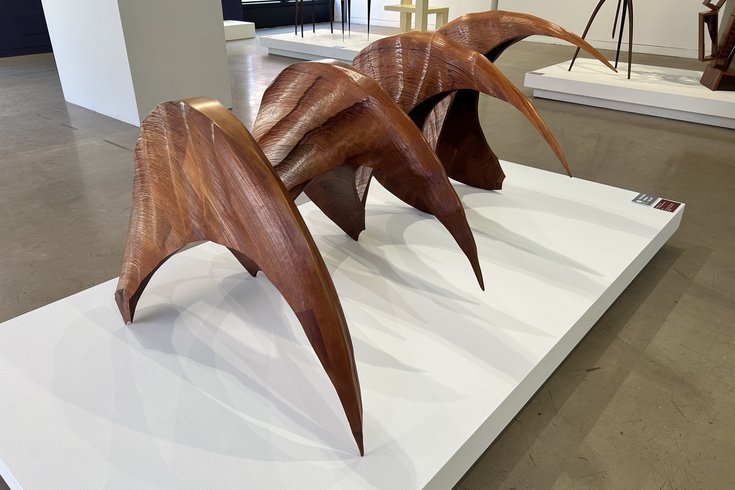
'Once Upon a Sandbank' by Ted Hunter was part of the 'From the Vault: Rarely Seen Works from the Museum’s Permanent Collection' exhibit.
Perhaps the most striking piece in the Museum for Art in Wood collection is also one of its most rarely seen — for good reason. "Once Upon a Sandbank" is made up of four sculpted cherry wood pieces, spanning over 5 feet in depth and 2 and 1/2 feet in height. It can't be disassembled and must be lifted by multiple people out of its crate in careful coordination, so as not to stress the delicate points where the pieces join.
It's an intricate process, though not nearly as elaborate as the one that created it. The man who sculpted "Once Upon a Sandbank" spent a year and a half building a machine that would help him replicate the texture of sand piled on the beaches of Canada, making the finished product a feat of engineering and artistry.
Ted Hunter may have employed technology for this piece, but he was guided by nature. The Canadian artist wanted to create a piece that mimicked the shape of waves crashing on a beach and replicated the rippled texture that wind blew into the sand — all on wood, a natural material. He would need to come up with his own contraption and multi-step systems to achieve this.
To start, he built his machine, a mid-1980s DIY version of what is now a widely used piece of woodworking equipment: a CNC router. Hunter's device consisted of two turntables and a router attached to a movable arm that hovered over them, cutting the wood on one table based on the contours of a template on the other.
For that template, Hunter molded a plaster cast of a sandbank on Wasaga Beach in Ontario with the help of two collaborators. Dragging several pieces of bulky equipment onto the shore, they searched for an ideal sandbank. Once they had found it, they dropped a five-foot circular ring around the formation and began mixing plaster in buckets with the help of a portable generator and drill. The trio slowly poured the paste into the ring, spreading one even layer and then another. They reinforced the setting cast with plywood.
"It was hard to find the perfect ripples," Norah Jackson, Hunter's wife and business partner, said via email. "They went out on a cold windy day in the fall. The sand needed to have the proper consistency, not too wet or dry, to hold its shape while the plaster was poured and dried on top of it. Very tricky to do!"
Back at Hunter's studio, he placed the dry plaster cast on one turntable and a piece of wood that he had already shaped on another. After thousands of revolutions, he had his sculpture.
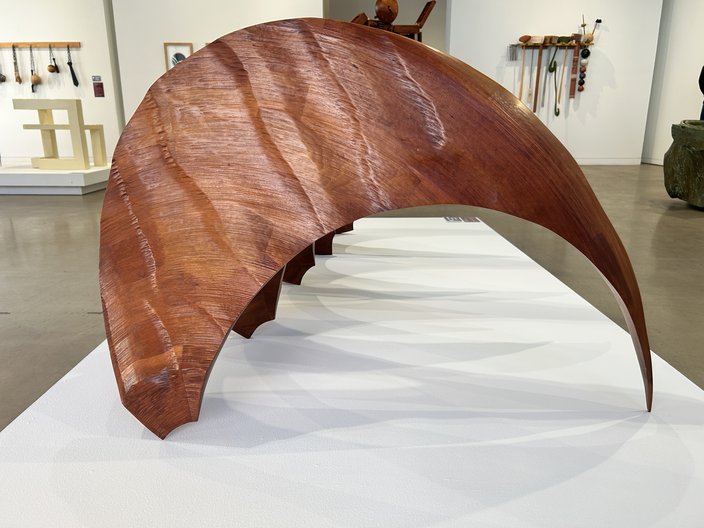
A closer look at 'Once Upon a Sandbank' reveals textured waves carved based on plaster casts of sand from an Ontario beach.
"All elements in Nature are linked to one another," Hunter wrote in Woodturning magazine. "Wind and sand were both needed to create the sand patterns on the beach. I have tried to make this sculpture another link in that process by integrating the sand patterns with my skills as a tool builder and artist. I hope that, by drawing attention to Nature's beauty, this sculpture will make people more aware of their own connections with Nature."
Hunter continued to work out of Canada, where he taught for decades and founded a skateboard company. (He also created sculptures for Canadian director David Cronenberg's film "Dead Ringers.") But he had a special connection to the Museum of Art in Wood through its co-founder Albert LeCoff.
LeCoff was an experienced Philadelphia woodturner, a craftsman who uses a lathe to shape wood into functional objects or art. He and his brother Alan created the Wood Turning Center, the nonprofit organization from which the museum grew, after leading a series of symposia and exhibits on the technique between 1976 and 1986.
"He was an incredible mentor to a lot of artists who were starting to figure themselves out in terms of the material and what they were doing, what they knew how to do with it," said Jennifer-Navva Milliken, the executive director and chief curator for the Museum of Art in Wood. "He would come in and talk to them about the possibilities and things that they hadn't even considered. And so he was so influential in the careers, and then the thinking and the ideation and inspiration, of a lot of artists that are now figureheads in our field. That was the story behind the work of this artist, is that (LeCoff) offered him a window into what his work could really be."
LeCoff had a vast collection of art made from wood before he had a real space to house it — the Wood Turning Center, in fact, was run out of his Germantown home until 2000. The nonprofit moved to Old City that year, but not its current space at 141 N. 3rd St. That move came in 2011, along with a name change: the Center for Art in the Wood. This shift reflected an expansion in the mission; the center wanted to encompass additional techniques like chiseling and wood-burning (pyrography), as well as broader definitions of the material. Paper and thematic video installations would be welcomed under the new umbrella. The center then became the Museum for Art in Wood in 2023.
The collection that LeCoff initially cobbled together from craft shows, galleries and direct appeals to the artists themselves has now grown to 1,402 pieces. Many are interspersed between the stacks of the museum library or displayed in glass cases on the second floor. The museum's treasured ram stands proudly in the middle of the carved bowls, billy clubs, chairs, toys and jewelry. Milliken says the piece, created by an artist in residency, is one of their most popular. (His wool is made from curled wood shavings.)
The museum's unnamed ram is popular among visitors.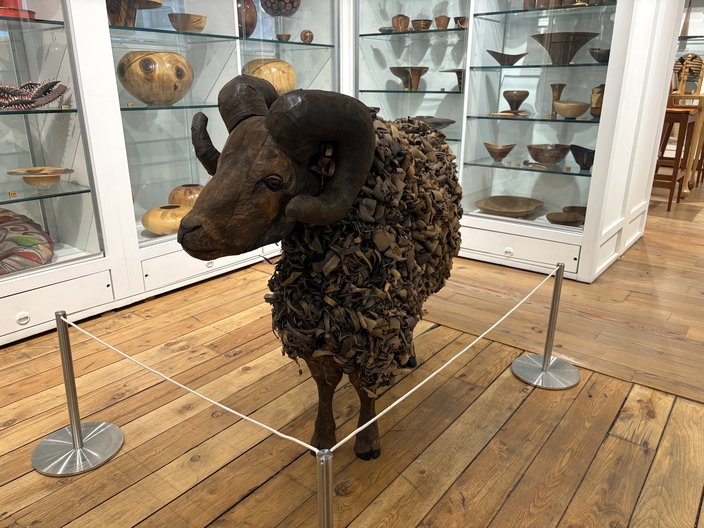 Kristin Hunt/for PhillyVoice
The residency program is a point of pride for the museum, which partners with NextFab to give artists from around the world the room (figuratively and mentally) to experiment with shaping techniques and forms over two months in the summer. The model hasn't changed significantly in over 30 years, Milliken said, apart from the location. Resident artists previously worked out of the George School in Bucks County and then the University of the Arts.
The museum may be unusual in a broad sense in its focus on a material, but it's not that novel in Philadelphia. As Milliken notes, they have like-minded peers in the Clay Studio, Print Center and Fabric Workshop and Museum, all located within a roughly 2-mile radius.
"I can't think of another city, and I've lived in a lot of cities around the world, that has so many institutional missions dedicated to specific materials," Milliken said. "And I think this is fantastic. I can't think of being in another city."
What draws artists to wood over more traditional media like canvas or clay? The museum's leaders see an almost spiritual aspect to creating art out of the trunks of former trees.
"I find that a lot of the artists who decide to work with wood do so with a kind of humility and a respect for material and where it comes from," Milliken said. "... The material is really special, not just in terms of its physical properties and what it lets humans do to it, or tools do to it, but just the fact that it carries this beingness in it. It comes from living creatures that have these full lives that we get to read in their fibers. So that has a lot of impact on artists."
Follow Kristin & PhillyVoice on Twitter: @kristin_hunt
| @thePhillyVoice
Like us on Facebook: PhillyVoice
Have a news tip? Let us know.