




April 01, 2026
 Kristin Hunt/for PhillyVoice
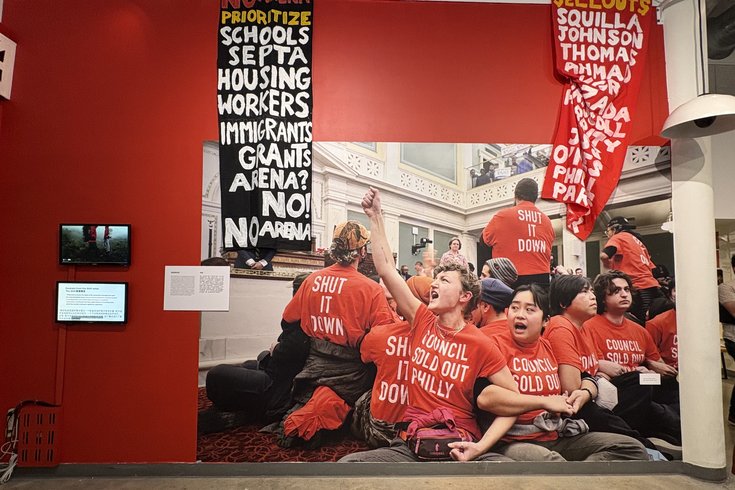
'No Arena: Making a Movement' catalogs the dramatic confrontation between protestors and City Council during the 2024 legislative sessions about the proposed 76ers arena.
For its semiquincentennial exhibit, the Asian Arts Initiative didn't have to sift through centuries-old letters or dusty, decaying artifacts. It drew on a very recent chapter of Philadelphia history: the fight over the 76ers arena.
"No Arena: Making a Movement," open now through July 11, tells the story of the ultimately triumphant protest movement that mobilized in response to the 76 Place project. Activists demonstrated regularly over two and a half years, arguing the planned construction at 10th and Market streets would displace Chinatown residents, decimate the neighborhood's businesses and throttle traffic in Center City — putting the safety of patients heading to Thomas Jefferson University Hospital for emergency care at risk. Though City Council cleared 76ers ownership to proceed in a series of dramatic legislative sessions, the team later struck a deal with Comcast Spectacor in January 2025 to stay in the stadium district.
Dave Kyu, the program director at AAI, said this protest movement fit naturally with the themes of America's founding.
"We wanted to celebrate this democratic movement that was decentralized, that was so people-focused and people-powered," he said. "At a moment when we're looking at what democracy can be, we wanted to highlight this moment that was led for and by people of color. It's certainly not the only model, but we thought this was a very successful model that we wanted to take the time to reflect on fully as we think about what is the future of our democracy."
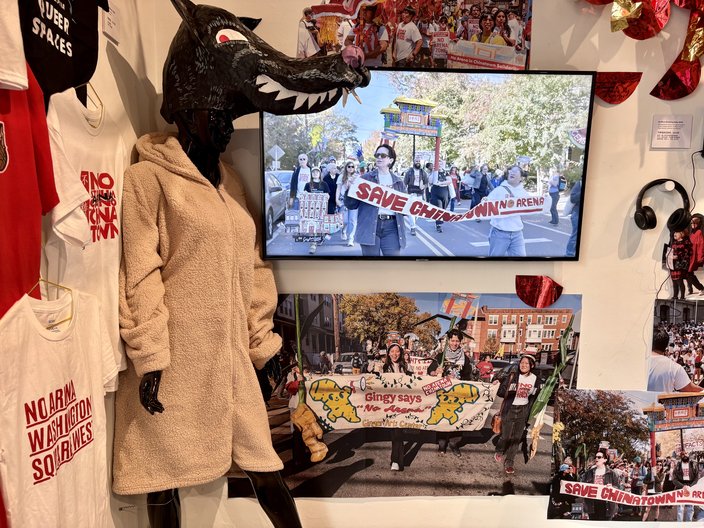
The exhibit is organized into five sections. It starts with a "joy and gathering" theme, highlighting the colorful and creative ways the activist channeled their dissent. Numerous banners hang from the ceiling, above a screen playing clips of activists singing, dancing and marching. A wolf in sheep's clothing — more of a fleece coat, in this case — grins from the corner, while a replica of the Chinatown gate stands near the window. An enormous red dragon snakes across the wall into the next area.
Video screens on the walls loop footage of demonstrations and testimony against the proposed 76 Place arena project. The exhibit also features large-scale props that activists used, including a 'wolf in sheep's clothing.'
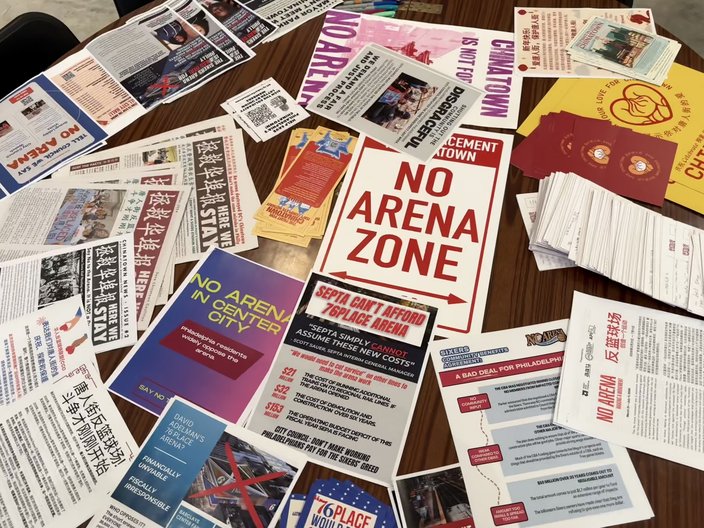
Here the exhibit spotlights "participation." A table in the center is piled with pamphlets and postcards from the numerous groups that joined the Chinatown-led movement. Photos of them marching cover the walls. And visitors can respond to a prompt nestled between the images, asking "How were you involved in the No Arena fight?"
The collection also recaps Chinatown's established "movement culture" through the neighborhood's previous fights against proposed casino and baseball stadium projects. (Neither of them moved forward.) This all builds to the "confrontation" section, which features a replica City Council podium and a television playing protestor testimony before the lawmakers. The exhibit ends on a note of "transformation," pondering where the movement goes next.
Asian Arts Initiative collected dozens of flyers, postcards and pamphlets that protesters distributed during the push against the arena.
"No Arena: Making a Movement" came together in a matter of months in a "messy way" that "reflected organizing process itself," Kyu said. He and his co-curators, some of whom took leading roles in the demonstrations, tapped their extensive network to gather documents, photos, props and video from people on the ground. The team used the exhibit themes as a framework for their selections, but sifting through the collection wasn't exactly easy.
"We had a huge archive to be pulling from, which did make things a little easier, but also sometimes harder," said Jenny Zhang, a Philadelphia organizer with Asian Pacific Islander Political Alliance. "There was so much good stuff."
The curators view the exhibit as a "living history" that they may revisit again years down the line. (As Kyu acknowledges, the arena battle is "still too recent and too close to all of us.") But first they'll have to figure out how to archive it. Some of the objects may go to Temple University's Special Collections Research Center for preservation or become part of a "lending library" of protest props. AAI, APIPA and other collaborators like the Philadelphia Folklore Project and Asian Americans United have numerous projects in the works aimed at memorializing different aspects of the protest movement.
As they continue to catalog and reflect upon the No Arena fight, the exhibit organizers also hope to glean lessons and strategies they can share with like-minded protesters.
"I think a lot of people are feeling a lot of anxiety, a lot of fear (right now)," Zhang said. "But seeing an example in our own neighborhood, in our own city, (of) fighting back, people coming together, people power winning, especially right now, is really, really powerful. And I think it gives us this little hope that if we know our neighbors, if we know the people around us, there's something that we can do with all of this."
Follow Kristin & PhillyVoice on Twitter: @kristin_hunt
| @thePhillyVoice
Like us on Facebook: PhillyVoice
Have a news tip? Let us know.