



April 13, 2026
Nobody had an idea what to expect from the 2025-26 Sixers after the nightmarish season that preceded it. But they had a thrilling win on opening night, featuring one of the best NBA debuts of all time from rookie guard VJ Edgecombe. That turned into a 4-0 start to the season. From Oct. 22 and on, the Sixers have been above .500.
Yet, after 82 games have come and gone, the Sixers won 45 games – one short of what they needed to earn one of the Eastern Conference's six best records. They are going to the Play-In Tournament.
While the last several weeks have featured many challenges – a lot of which will persist as the postseason begins – the Sixers were never a bad team. After winning 24 games last season, that is something. There have been significant positives from this season – most notably that Edgecombe and Tyrese Maxey look primed to be one of the NBA's best backcourts for years to come.
So, why do the Sixers have to win another game to get into the playoffs? In this week's 5 Sixers thoughts, diving into the issues which hampered them from October to April:
Joel Embiid played 38 of the Sixers' 82 regular-season games; even before his emergency appendectomy on Thursday the former NBA MVP was going to come up short of even appearing in half of this season's Sixers games. He sat for at least one half of every back-to-back, part of the management plan for his left knee. He had a nine-game absence in November because of a right knee injury. He missed the first 13 games of March with an oblique issue. He missed games due to multiple illnesses, too, and was also dealing with an ankle ailment about midway through the season.
Of Embiid's 38 games, about a third of them came at a level of performance well below the standard he haas set for himself. Many of them came on strict minutes restrictions, at one point as low as 20. January is when Embiid started to look more like himself; from Jan. 1 on he played in 24 of 51 games. Despite all of this, Embiid doubled his 19 games played last season.
Paul George, meanwhile, finished 2025-26 at 37 games, one behind Embiid, after serving a 25-game suspension for violating the NBA's anti-drug policy. The nine-time All-Star missed the first dozen games of the season as a result of an offseason surgery on his left knee, and prior to his suspension at the end of January was also not available for both legs of any back-to-backs. George also spent his first several games playing on a minutes limit. George followed through on his word and suited up for each of the Sixers' final 10 games of the season, but the Sixers have been without their defensive stabilizer more than they have been with him.
Elsewhere, Tyrese Maxey missed three weeks in March (a 10-game stretch) with a right finger injury. He returned from it earlier than expected and is clearly playing through pain. Maxey's absence coincided with Embiid's oblique injury and the home stretch of George's suspension, which left the Sixers severely undermanned.
There have been so many illnesses: Maxey's only two absences of the season prior to his finger injury were because of a sickness. Quentin Grimes has missed time due to an illness on three separate occasions this season. Jabari Walker went the longest of any Sixer without being unavailable for physical reasons to start the season; that streak was derailed when he got sick. A bug went around the team twice, both times forcing multiple key players out.
Six quarters into his Sixers tenure, Dominick Barlow was forced into a cast that kept his right arm perfectly straight. He missed multiple weeks, and his shooting mechanics were messed up in the aftermath of it. Trendon Watford had a challenging start because he got hurt in training camp, and just when he found some momentum he went down again. Kelly Oubre Jr., a starter for the vast majority of his appearances, sprained the LCL in his left knee and his left elbow, each forcing him to miss multiple weeks. Edgecombe had a brief calf issue, then a lower back one.
Jared McCain missed the first six games of the season, then came back as a total shell of himself, playing 31 lackluster games. Only then did the Sixers get four games out of a healthier-looking McCain before he was traded. Cam Payne, signed out of Serbia to replace McCain in the guard mix midseason, was just waived because he suffered a hamstring strain. Johni Broome, relegated to the G League for most of the season, tore his meniscus playing for the Delaware Blue Coats in February and still has not returned to game action.
The Sixers deserve credit for handling the adversity they have faced this season a whole lot better than they did a year ago. But if any one player was simply available for a game they could not play in and turned the outcome from a loss to a win, the Sixers would have a few days off as they prepared to face the New York Knicks in a seven-game series.
MORE: Will George's post-suspension surge make him a trade asset this offseason?
The Sixers have, for Embiid's entire career, prioritized shooting in bigs set to play alongside him. But with Embiid clearly not capable of handling the workload he once could as a rebounder and rim protector, the focus shifted.
Barlow and Jabari Walker, both signed to two-way contracts despite having three years of NBA experience, represented that change. They are not respected shooters, but they have athleticism, play with physicality and crash the glass.
As far as offensive rebounding is concerned, the Sixers have been one of the NBA's best teams this season. But on the other side, the same old story has plagued this team for years now. The Sixers still do not have a ton of size in the frontcourt, and the limitations Embiid has played with for much of the year hamstrung their ability to end possessions.
But this is far from just an Embiid problem:
A miscommunication between Adem Bona and Cam Payne puts the Sixers in a 4-on-3 bind defensively; the open corner three is missed but Bona does not secure the defensive rebound: pic.twitter.com/4O2AEqXOxe
— Adam Aaronson's clips (@SixersAdamClips) March 11, 2026
Paul George falls asleep on the glass, and an opposing player easily goes around him for an offensive rebound which leads to a wide open three-point shot: pic.twitter.com/BjsRVtsZ6G
— Adam Aaronson's clips (@SixersAdamClips) January 11, 2025
This is a long-term issue for the Sixers, and it is layered. At times, they have put out smaller lineups with distinct advantages – perhaps spacing or defensive versatility or multiple ball-handling options – and been willing to live with less muscle inside. They would allow their opponents more frequent second-chance opportunities, but created advantages in other respects.
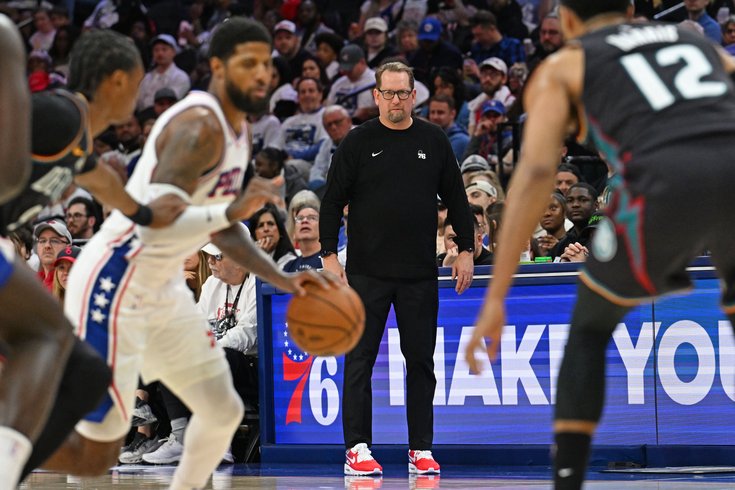
But on many occasions this season, Sixers head coach Nick Nurse has had personnel on the floor more than capable of certifying stops by just getting a rebound, and watched his team find ways to gift the opposition additional shot attempts. It will continue to be an issue for however much longer the Sixers are playing.
MORE: Embiid calls out Daryl Morey, derailing mood after Sixers' statement win
That last point speaks to a larger issue: the Sixers shoot themselves in the foot a whole lot. Nurse's aggressive defensive scheme, which calls for ambitious defensive gambles and leads to frustratingly open three-point shots for other teams, draws enough ire with plays like this:
On a possession during which the Sixers' primary goal should have been to prevent Brooklyn from getting a good look at a three-pointer, they somehow leave two shooters open on the same side of the floor: pic.twitter.com/MVIPeXDW2l
— Adam Aaronson's clips (@SixersAdamClips) March 15, 2026
Whether or not Nurse goes too far encouraging his team to hunt turnovers is debatable; one could argue that at times the Sixers have been so limited in terms of either offensive firepower or rim protection that winning the possession battle dramatically was their only pathway to success.
A bizarre late-season trend that is completely inexcusable, though: the Sixers continually not getting back on defense after their own made shots.
The Sixers continue to get burned in transition after their own made baskets: pic.twitter.com/7Gkx2yLwiN
— Adam Aaronson's clips (@SixersAdamClips) April 7, 2026
In the NBA, having a good offense goes a long way toward having a good defense, because scoring more baskets allows a team to set its defense more often. But the Sixers have, on many occasions over the last few weeks, allowed opponents to take the ball out from under their own basket and simply inherit a transition opportunity.
After a made basket, the Sixers do not guard the best shooter on the other team: pic.twitter.com/u3pAm6dFno
— Adam Aaronson's clips (@SixersAdamClips) April 10, 2026
The Sixers' transition defense has been problematic all season. Not putting in the effort or proper communication to prevent it from being exposed will not do them any good.
Sixers President of Basketball Operations Daryl Morey commented at his infamous press conference after this season's trade deadline that none of the Sixers' competitors in the Eastern Conference made trades that moved the needle or materially altered championship odds.
Statistically, that might be true. But other teams still got better.
The Detroit Pistons added Kevin Huerter to their bench mix, removing Jaden Ivey at the right time. The Boston Celtics reshuffled some of their rotation to account for Jayson Tatum's return; their team now looks like a juggernaut. Morey's comments at the time were viewed as a slight of James Harden, acquired by the Cleveland Cavaliers. In addition to swapping Darius Garland for Harden, the Cavaliers made significant upgrades to their depth that bode well for their chances of making a playoff run. Even the cap-strapped New York Knicks found a way to get Jose Alvarado, a quality rotation guard who tormented the Sixers in one of his first games with his new team.
The Sixers, on the other hand, traded McCain for a package strictly comprised of draft picks. Then Eric Gordon was salary dumped at the cost of a future second-round pick, and suddenly the deadline had passed. For the first time in six deadlines with the Sixers, Morey did not trade for a single player under NBA contract.
Morey said that he traded McCain in advance of deadline day in part because he hoped to reroute some of the picks the Sixers acquired for him to bolster the rotation, but ultimately nothing ever materialized. McCain's absence was immediately felt, as the Sixers' shallow guard rotation became the subject of multiple injuries. Morey signed Payne to backfill McCain's spot, and it did not go well.
This point is less about McCain – though an elite three-point shooter with ball-handling chops would have been awfully helpful at many points over the last nine weeks – and more about the fact that there were never any sort of reinforcements provided to this roster.
For those who do not how the NBA's relatively new addition to its playoff bracket works, here is a rather simple rundown:
In each conference, the No. 7 seed hosts the No. 8 seed; the winner becomes the No. 7 seed in the playoff bracket. The No. 9 seed hosts the No. 10 seed; the loser is eliminated. Then the loser of the first game hosts the winner of the second game in another elimination game; the winner becomes the No. 8 seed in the playoff bracket.
If the No. 7 seed Sixers beat the No. 8 seed Orlando Magic, they will face the No. 2 seed Celtics in a best-of-seven series. If they lose, they will face the winner of the No. 9 vs. No. 10 game between the Charlotte Hornets and Miami Heat, with their season on the line and a chance to earn the right to go up against the No. 1 seed Pistons in a seven-game set.
MORE: Can major changes be made this summer? What would McCain's role be now?