





July 14, 2025
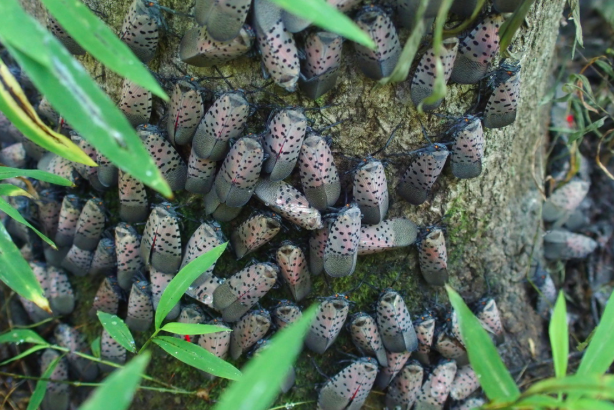
Five years ago, during the throes of the COVID-19 pandemic, the Philadelphia region was teeming with spotted lanternflies and their squashed remnants. It became a unifying sport to stomp out the invasive insects in mini massacres of duty to protect the realm from agricultural destruction.
These days? They appear more sparsely, like sad stragglers bopping around here and there without the strength of the swarm. It might be tempting to unfurl the "Mission Accomplished" flag, but many mysteries of the spotted lanternfly remain to be solved. An "out of sight, out of mind" strategy isn't going to keep them at bay.
MORE: Marijuana legalization bill in Pa. Senate is 'smart, fair and realistic,' co-sponsor says
"This darn thing is constantly moving. That's why it's such a problem to manage," said Julie Urban, a research associate professor in Penn State University's Department of Entomology.
Urban was among the first group of scientists tapped by the U.S. Department of Agriculture to study spotted lanternflies when they first arrived in Berks County in 2014. The resilient planthoppers, native to China and surrounding countries, can feed on more than 70 plant species in North America and have few natural predators here. Their ability to hitchhike with humans makes them a potentially catastrophic threat to vineyards, and they've established populations in 18 states over the past decade.
"If you think of that initial infestation as a donut moving out, or a wave, there's a natural expansion out from those core areas," Urban said. "You're going to see fluctuation over the years."
Multiple factors likely explain why some years are more intense than others from place to place. In the Philly area, one theory is that the past few years of drought conditions have slowed the replenishment of feeding grounds that spotted lanternflies depleted, Urban said. The region saw heavy rainfall in 2019, the year before spotted lanternflies arrived in jaw-dropping numbers. Sap from the tree of heaven — their favorite food source and host plant — was plentiful for the adults to thrive during the summer and early fall of 2020.
There's evidence that these feeding frenzies are cyclical, making it premature to call the initial threat overhyped. Parts of Berks County are now experiencing a heavy resurgence after getting their worst wave of spotted lanternflies in 2017. And in New Jersey, where the insects arrived in 2018, their populations have shifted to the northern counties in recent years after first wreaking the most havoc in South Jersey.
Because the bugs are always on the move, they tend to leave some areas untouched and ripe for revisiting.
"When Philadelphia was overrun, it was still patchily distributed. I'm sure there are some streets where there weren't any," Urban said. "Even in highly infested areas, it's never a solid thing. If Berks County is a predictor, then I bet you will see them again."
Pennsylvania's spotted lanternfly quarantine zone now covers nearly the entire state. In June, the state Department of Agriculture said it received 765 public reports of the insects, including 51 reports in Philadelphia. Those figures are more of a representation of public awareness than prevalence, but the state noted "dramatic drop-offs" in numbers last year that suggests either progress or a temporary reprieve.
Beyond urging people to scrape lanternfly egg masses off trees from the late fall into spring, the state is focused on monitoring high-risk areas like transportation corridors and tourist attractions that help the insects reach new territory.
The most critical areas in need of protection are the grape vineyards surrounding Lake Erie that are used to make juice. To date, despite some sightings, grape growers in the northwestern part of the state have been spared a full-blown infestation. Spotted lanternflies would be devastating to the grape juice industry because most of the growers produce for large cooperatives. They face stricter rules for spraying insecticides than private growers, and their profit margins are smaller than wine vineyards'.
"This is the next shoe we're waiting for to drop," Urban said.
In Berks County and other parts of Pennsylvania, vineyard owners have had to adapt their growing and harvesting schedules to recover from past waves of spotted lanternflies. Grant-funded research has helped them refine techniques to manage populations and protect crops.
"The vineyards that were obliterated and looked like they'd been burned out several years ago, they've learned methods to control (spotted lanternflies), and we have products labeled to control them," Shannon Powers, press secretary for the Pennsylvania Department of Agriculture, said of the state's progress combatting lanternflies. "Our grape industry, in particular, has a lot more information to be able to protect their vineyards."
Elsewhere in the United States, the spread of spotted lanternflies is seen as a race against time. The New York Times reported this month on the fears of California grape growers who know the insects are likely headed for their large-scale wine vineyards in the coming decade.
Urban has been working closely with the National Grape Research Alliance to strategize with growers and prepare them for the coming threat. NGRA members, including some from California, joined Urban on a visit to a vineyard in Berks County in October.
"They saw it absolutely swarming with lanternflies," Urban said. "One grower turned white and he said, 'This will kill us.'"
An insect expert from Penn State University says the fight against spotted lanternflies — a major threat to vineyards — is far from over.
Estimating the potential economic damage from spotted lanternflies has proven difficult. One Penn State study published in 2020 projected that costs related to infestation could total about $50 million per year in Pennsylvania alone. Researchers have since backed off those estimates as they work to gather more data on the ground.
Fortunately, some of the worst-case scenarios now seem less dire. The timber industry likely is not as vulnerable as originally thought, since studies have shown many hardwood tree species can withstand the stress of spotted lanternflies.
"The only thing to date that it will outright kill from feeding is grape vine, tree of heaven and then an occasional black walnut sapling," Urban said.
The mitigation strategies in place today — including the stomp campaign — are important mainly to buy time for a long-term solution. The most hopeful of them is called biological control, a method that involves introducing another non-native species to serve as a natural deterrent to the target species. It's a delicate science that requires extreme care to avoid unintended harm to ecosystems. Studies typically take years to advance out of lab settings and into the wild.
To fight spotted lanternflies, the USDA has spent the last several years experimenting with two different species of parasitic wasps from China. One wasp candidate attacks spotted lanternfly eggs, but it also targets moths and stinkbugs. Another has been observed wrestling spotted lanternfly nymphs and laying eggs inside them.
"That one is going great," Urban said. "Really, the biological control angle is likely the most long-term, promising, sustainable option."
Urban's passion for spotted lanterflies is studying their reproduction and "freaky" insides. She said the species has organs that co-evolved with ancient bacteria that no longer exist naturally on their own. The insects draw sustenance from bacteria that they don't get from their diet.
"I'm interested in ultimately trying to disrupt the transmission of those bacteria to the egg masses," Urban said.
Until scientists are ready to unleash a safe method for eradicating spotted lanternflies, the name of the game will be vigilance in protecting sensitive territory.
"The longer we can keep it out of these high value areas, that buys us time to move these solutions forward," Urban said.