


July 21, 2025
 Provided image/Woodmere
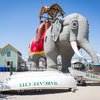
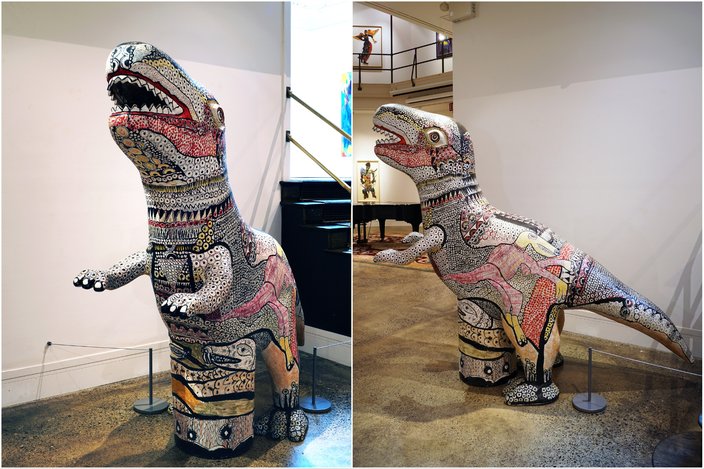
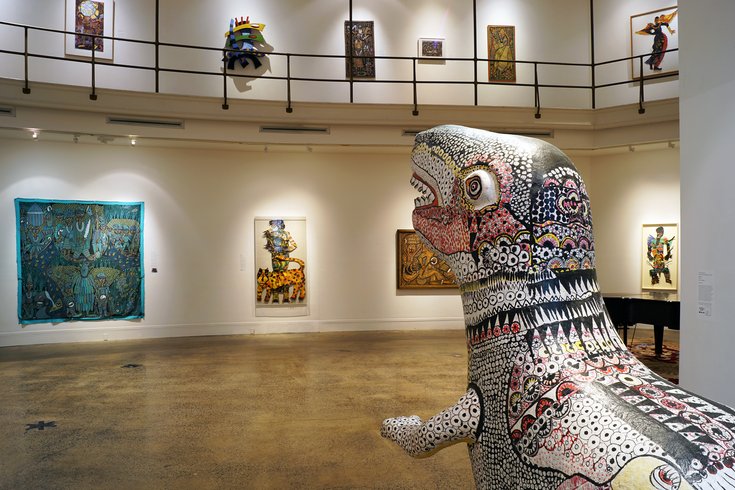
'Dinosaur' by Twins Seven-Seven was last seen at Woodmere in a 2020 exhibit. It'll be displayed in the museum's forthcoming Maguire Hall.
About five years ago, a 7-foot dinosaur entered the halls of Woodmere — and it's been living at the Chestnut Hill museum ever since.
The fiberglass statue originally arrived on loan from Material Culture, the sprawling art emporium in East Falls. Its proprietor George Jevremović had rescued the T.rex from a shuttering amusement park in Pakistan, then turned it over to his artist-in-residence Twins Seven-Seven to paint for display in the shop. When Woodmere put together an exhibit that featured the work of the late Twins Seven-Seven, its director William Valerio asked to borrow it. But after the exhibition closed, Valerio convinced Jevremović to let the museum keep it.
It's now the only dinosaur in Woodmere's over 11,000-piece collection, but it's been sitting in storage due to its size. The dino will soon receive prominent placement, however, in the museum's new Maguire Hall, opening later this fall.
"We always knew we needed a special place for him because he's a big guy," Valerio said. "She's a big guy, I should say. She's a she-tyrannosaurus because she's a mother."
This piece of the figure's identity is reflected on her belly, where two smaller dinosaurs are painted. They're twins, Valerio explains, tying into the artist's adopted name and legend. Twins Seven-Seven, born Taiwo Bamidele Olaniyi Oyewale Oyekale Aitoyeje Osuntoki, claimed to be the only surviving child in seven sets of twins his mother bore. According to the Nigerian artist, he was an abiku, a Yoruba term for a child that dies young and is reincarnated and born again to the same parent. This story shows up in multiple pieces that Twins painted, from "Healing of Abiku Children" to "The Spirits of My Reincarnation Brothers and Sisters," a piece in the Philadelphia Museum of Art collection. (He made another version of the latter, which the Woodmere also acquired.)
Twins Seven-Seven painted a white fiberglass dinosaur in his trademark lines and patterns. It was displayed at Material Culture, where the artist lived and worked, before it entered the Woodmere collection.
"He believed that the spirit of his 13 brothers and sisters lived in him, and he carried this incredible strength of spirit with him in life," Valerio said.
Twins initially drew attention as the star student of an arts school in Osogbo, Nigeria, led by European expats Ulli and Georgina Beier. According to the artist's biographer, he quickly progressed from drawings with ink and pen to etchings, paintings and laminated paintings on wood. He began showing his work internationally, including in New York City. At one of those exhibits, Philadelphia dancer Arthur Hall invited Twins to the city. It would become a second home for Twins, who became heavily involved with the Ile-Ife Black Humanitarian Center, a cultural hub in North Philly that Hall founded in the late 1960s. Twins shared Yoruba folklore with new friends in Philadelphia, including Lois Fernandez, who later organized the long-running Odunde Festival. The event always features a tribute to the Yoruba water goddess Oshun, a key figure in Twins' work.
No space is wasted in a Twins Seven-Seven piece. The artist filled each animal, spirit and person he painted with precise lines and patterns, adopting what he called a "tattoo" technique. Even the foreground or sky behind his subjects typically contains colorful, repeating designs. Valerio says this choice reflects the Yoruba belief in the "interconnectedness" of life — the tiny shapes inside larger ones could represent a twin spirit still with the artist, or the energy of a fish or plant a person consumes.
"He is an African artist and he's doing the figure in different ways," he continued. "He's using line in different ways. Abstraction is a part of his work, but it's a very different kind of abstraction than you get in western art. There's a kind of stretching and an elongation of figures. His lines grow like vines. It's all about growth and energy."
Yoruba traditions, stories and oral histories informed Twins' work. Deities like Oshun appear in his paintings, as do scarier creatures drawn from his dreams and masks used in rituals. (See, for instance, "The Smelling Ghost.") Though he spent many years in Philadelphia — including a comeback period in the aughts bolstered by Jevremović, who championed, employed and housed the then-struggling artist — he frequently returned to Nigeria. There he was a prince, a descendant of a former king of the city of Ibadan. Twins had ambitions of becoming king himself, but passed from complications from a stroke in 2011 before he ascended the throne. His royal lineage now runs through his grandson, Eagles linebacker Azeez Ojulari.
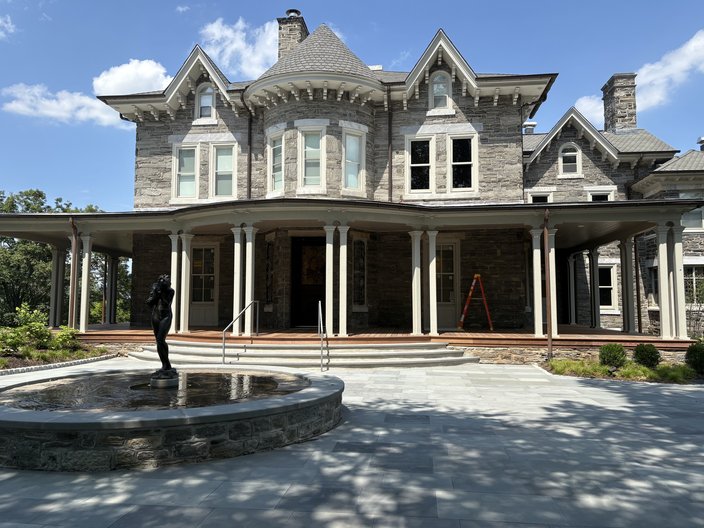
While Twins' tyrannosaurus is still in storage as of July, it will soon stomp into the first floor of the new Maguire Hall, located roughly two blocks from the flagship Woodmere building on Germantown Avenue. The museum purchased the 4-acre estate, formerly the St. Michael's Hall convent, in 2021 with a $10 million gift from the Maguire Foundation and another $18 million in fundraising
The building will house 14 additional galleries, including five dedicated to contemporary art in Philadelphia. That's where the dinosaur will live, alongside works from Henry Bermudez and Anne Minich. The doors are scheduled to open in November.
Woodmere's new building Maguire Hall, a former convent, will house 'Dinosaur' by Twins Seven-Seven and other contemporary pieces from Philadelphia artists.
Valerio sees these galleries as an "active, diverse dialogue of the artists of Philadelphia" and a springboard for curious visitors to learn more about the city's art scene.
"A museum is an educational institution, and this is an opportunity to learn," he said. "(Twins) opens a lot of different doors for a lot of different people, and it's accessible. I mean, you can't not be curious about it.
"He really is somebody who has moved the needle in the arts. The arts of Philadelphia look different because of Twins, and that's why we're interested in him."
Follow Kristin & PhillyVoice on Twitter: @kristin_hunt
| @thePhillyVoice
Like us on Facebook: PhillyVoice
Have a news tip? Let us know.