

September 25, 2025
 Provided image/Stephanie Berger
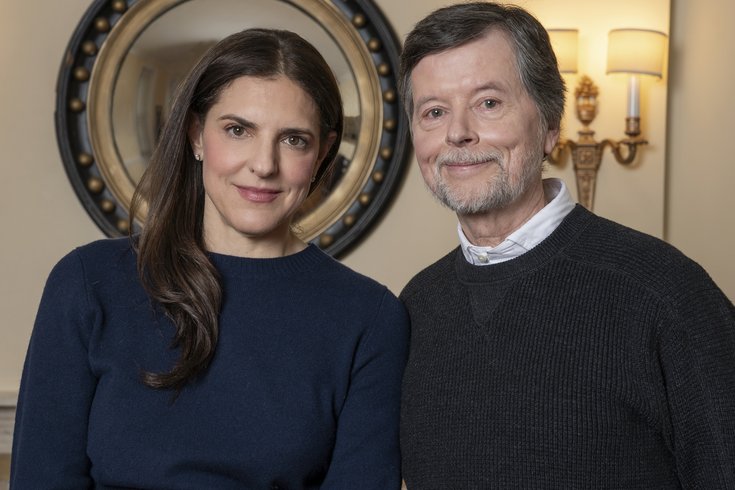
Ken Burns, right, directed 'The American Revolution' with Sarah Botstein, left, and David Schmidt. The six-part docuseries premieres Sunday, Nov. 16, on PBS.
When Ken Burns started making his series on the American Revolution nearly a decade ago, he knew one of his biggest challenges would be casting George Washington.
The renowned documentarian has worked with an impressive roster of voice talent in his career, many of them now regulars in his projects. But he knew he couldn't ask, say, Tom Hanks to play the country's first president — he needed someone "enigmatic and opaque," whose voice wouldn't be instantly recognizable. (Hanks plays numerous secondary characters instead.) The answer came to Burns when he was flying back from Rome and hit play on "Dune: Part Two." The instant Josh Brolin spoke, he was sold. He called his co-director before he was even home.
Viewers will hear Brolin's take on Washington in "The American Revolution," a six-part documentary airing Sunday, Nov. 16, through Friday, Nov. 21, on PBS. The series follows hundreds of characters through the eight years of the Revolutionary War, using letters from the era, maps, paintings, reenactments, historians' perspectives and music to tell their story. Burns has been touring the country ahead of its release and will arrive in Philadelphia for a discussion and preview on Thursday, Oct. 9.
The filmmaker, who directed with longtime collaborators Sarah Botstein and David Schmidt, said the project aims to challenge the "superficial version" of the revolution most Americans are taught.
"People are in powdered wigs and waist coats and breeches and stockings and buckled shoes, and there's a hard way to get to them," Burns said. "We've spent a decade trying to make them real and human and dimensional and not just the familiar, top-down people who I hope we're giving real human dimension to, but also scores of other people that you've never heard of, that we'd never heard of, that we get to share."
The series incorporates the first-person accounts of almost 200 historical figures, voiced by what Burns calls "the greatest all-star cast, I think, ever assembled." In addition to Brolin, the documentary features Jeff Daniels as Thomas Jefferson and Paul Giamatti reprising his Emmy-winning turn as John Adams. Claire Danes voices his wife Abigail, while Meryl Streep portrays early American historian and satirist Mercy Otis Warren. Amanda Gorman, the former national youth poet laureate, lends her voice to poet Phillis Wheatley. The cast also includes Hanks, Samuel L. Jackson, Morgan Freeman, Edward Norton, Mandy Patinkin, Ethan Hawke, Michael Keaton, Laura Linney, Kenneth Branagh, Craig Ferguson, Jonathan Groff and many others.
Burns could not rely on the living witnesses he employed for "The Vietnam War" or even the photographs he had for "The Civil War" on this series. An advisory board of roughly two dozen historians helped fill in the gaps. These experts not only gave on-camera interviews but real-time feedback as the production progressed. This approach is markedly different from most documentary filmmaking, which is separated into sequential research, script writing, shooting and editing periods.
"We're shooting from the very beginning," Burns said. "We never stop researching. We never stop writing. We never stop filming. And so it attenuates our process, but it permits us the ability to be corrigible, to learn new scholarship, to change directions, to have a kind of flexibility about it, and a willingness to let the weakest voice inside you that says, hmm, I'm not so sure, that for six months you've just ignored because everyone else seems to like it, and then all of a sudden you've got that chance to go, you know what, what if we change that? Isn't there a better shot? And then there's always a better shot."
Some of the shots involve reenactments. Though Burns has historically shied away from this documentary tool, he embraced it for "The American Revolution." The series filmed at nearly 100 locations over seven years, capturing battlefields, encampments and other historical sites in every season.
"It is a sort of love letter to the landscape in a way, but also these historically important battlefields and places, making them feel fresh and new, but also historically accurate and scary and bloody," Botstein said.
The cinematography also let the filmmakers illustrate common scenes that weren't represented in the era's paintings. One of Burns' favorite shots is of women washing blood off the soldiers' tattered clothes. It's followed by a close-up of a Black soldier in a Continental Army uniform holding a musket in his hand. Visual cues like these instantly remind viewers that women and Black men were involved in the conflict, Burns says, "without anybody didactically telling you."
Philadelphia will naturally take a starring role in the series; Burns said the region appears in every episode, through the signing of the Declaration of Independence, the Paoli Massacre, the Battle of Germantown, the Siege of Fort Mifflin and so many other pivotal moments. ("You do not have to worry about Philadelphia," he joked.) But the docuseries is aimed at reaching audiences well beyond the Delaware Valley. PBS has developed educational materials with leading scholars for students in grades 3-12 so that "The American Revolution" can be taught in the classroom.
Through these offerings, Burns' national speaking tour and the documentary's debut on public media, the filmmakers hope to engage as many Americans as possible ahead of the semiquincentennial.
"It was a complicated moment in American history," Botstein said. "And this is a complicated moment in American history. And the 250 years in between are really, really interesting. I hope audiences will take away what an unlikely and inspiring and surprising, and really deeply patriotic story our founding is."
Follow Kristin & PhillyVoice on Twitter: @kristin_hunt
| @thePhillyVoice
Like us on Facebook: PhillyVoice
Have a news tip? Let us know.