





March 25, 2026
 Provided Image/City of Philadelphia
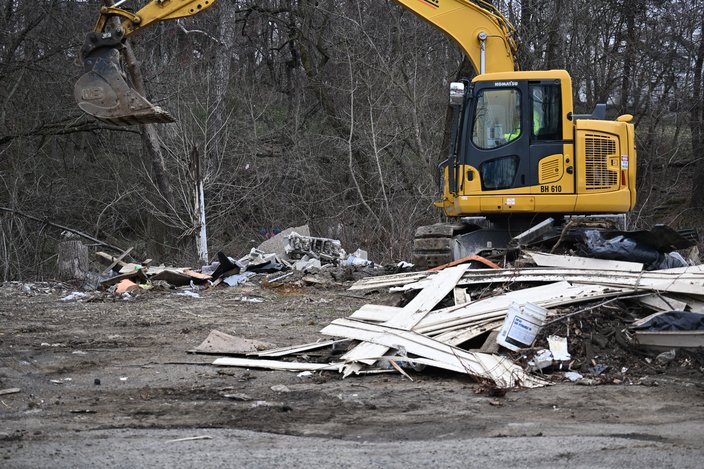
An illegal dumpsite at Pennypark Park, near the intersection of Holmesburg and Frankford avenues, is being cleaned up in a public-private partnership.
A section of Pennypack Park in Northeast Philly that has been used as an illegal dumpsite for years is being cleaned up in a public-private partnership to prevent future waste disposal at the location, city officials said.
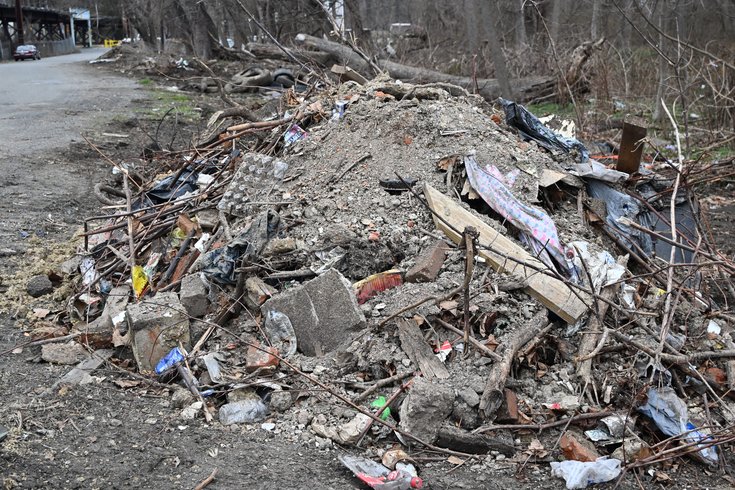
The dumping ground at the intersection of Holmesburg and Frankford avenues is littered with construction and demolition debris, discarded furniture, appliances, tires and other waste that has accumulated over the years.
"This is an area in the Pennypack that doesn't have trail access, but it is still part of the park," Philadelphia Parks & Recreation spokesperson Natalie Walker said. "There's a home right next to it, but there's also a bunch of businesses. It's an area that's not really frequented otherwise, so we're not getting a lot of 311 requests. It's hidden and people have used it over the years almost as a trash dump."
Pennypack Park covers about 1,600 acres surrounding the roughly nine-mile Pennypack Creek, which meets the Delaware River near State Road in Holmesburg. The dumping site drains into the creek, whose runoff enters the river near the city's Baxter Water Treatment Plant.
"We're trying to really protect our green spaces that are such an amenity to residents," Walker said.
Remediation of the dumpsite is being led by the city's Office of Clean and Green Initiatives with assistance from Parks & Recreation, the Philadelphia Water Department and the Department of Sanitation. United By Blue, the sustainable apparel brand that aids large-scale cleanups in oceans and waterways, also will participate in the project with additional funding from the climate-focused bank GreenFi.
The project started last week and will continue into April. Once the site is cleaned up, fencing will be added to the area and signage will be installed to warn against future waste disposal. The city also is removing illegally parked vehicles that have been a nuisance to nearby residents.
"We're planning to create a barrier so that a truck can't just come up and unload materials on the site," Walker said. "We're seeing dumping as we're cleaning it up, so that piece is going to be really important."
Crews have been out at Pennypack Park since last week to remove debris from an illegal dumping hotspot near Holmesburg and Frankford avenues.
Philadelphia's illegal dumping enforcement has ramped up in recent years. A law passed in 2022 increased fines to $5,000 per illegally dumped item when a car is used to get rid of trash and $2,000 per item when trash is dumped on foot. Before that, violators generally were issued tickets up to about $500, an amount many dumpers treated as a business cost.
In November, the city formed a new task force to patrol streets, vacant lots and underpasses frequently used as dumping sites. At some locations, street cameras have been deployed to aid in catching violators, and civil prosecution has been used in some cases to hold dumpers accountable for hefty fines.
"We have a list of over a hundred hotspots where we see repeat dumping, and that can look a lot of ways," Walker said of Parks & Rec's efforts to track the problem.
Compared with the Department of Sanitation, Parks & Rec historically has lacked the staff and equipment needed to keep up with illegal dumping. The open spaces and woods at city parks allow dumpers to enter secluded areas undetected, and once trash starts piling up at a given spot, it often encourages other dumpers to use that site. Park staff are regularly diverted from other activities to clean dumpsites.
"It really does take away from city resources and staff time that could be used on other things," Walker said.
Moving forward, the department will have more tools to prevent illegal dumpling. A grant from the William Penn Foundation is helping Parks & Rec acquire excavation equipment in the coming year. The department will also seek funding to hire staff for a dedicated crew that cleans dumpsites at city parks.
Pennypack Park is one of Philly's five primary watershed parks along with Fairmount Park, Wissahickon Valley Park, Cobbs Creek Park and Tacony Creek Park. Walker said areas of these parks make up a large portion of Parks & Rec's illegal dumping hotspots.
Last March, more than 4,000 tires were illegally dumped in Tacony Creek on property managed by Parks & Rec. Investigators said they believed violators had cut through a lock to access the area. The site was cleaned up in a partnership between the city, the nonprofit Tookany/Tacony-Frankford Watershed and other groups.
Some hotspots at parks are filled with household trash from nearby residents, Walker said, and the waste piles up because Parks & Rec's pickup schedules are not as frequent as the sanitation department's. In those instances, the department hopes to communicate with neighbors and organize bulk collection events to prevent dumping.
Carlton Williams, director of the Office of Clean and Green Initiatives, has often compared illegal dumping to a game of "whack-a-mole" with violators moving from site to site.
“Illegal dumping hurts our neighborhoods, our parks, and our waterways," Williams said in a statement about the cleanup at Pennypack Park. "This project delivers real results for residents — cleaner public spaces, healthier waterways, and long-term solutions that prevent dumping from happening again.”
Walked said coordination is the most effective way to combine cleanups with deterrence.
"We're working to build stronger partnerships across the city, but also with community groups and partners to really try to turn some of these sites around that have been degrading our public assets," Walker said.