


December 22, 2025
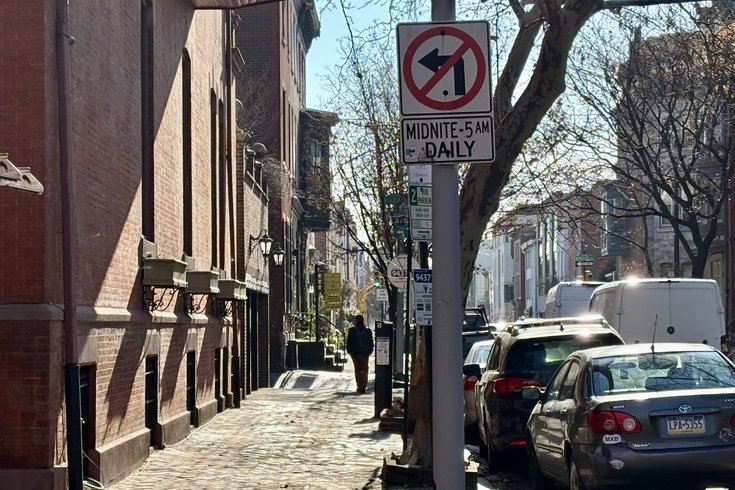 Kristin Hunt/for PhillyVoice
A sign that still stands on the 2000 block of Delancey Street was installed in 1974 to stop gay men from circling the streets.
At the end of a Rittenhouse block of stately old townhomes, several of which are listed on the National Register of Historic Places, lies another relic of a bygone time. A traffic sign, erected in 1974, prohibiting cars from making left turns.
It would be unremarkable, were it not for the specificity. The traffic rule is only in effect on the 2000 block of Delancey Street from midnight to 5 a.m., during what would have been peak cruising hours for gay men in the 1970s.
The sign has endured well past the Frank Rizzo administration's anti-gay policies that birthed it, even as anti-discrimination legislation broadened to include sexual orientation and gay marriage became the law of the land. While Los Angeles took down its own hyper-specific "no U-turns" signs in 2024 to much fanfare, the one in Philadelphia has stayed quietly in place.
That may be because no one knows much about it. The Streets Department said it had "no definitive records regarding installation of the sign" and would "welcome any feedback from the residents of Delancey Street if there is interest in reassessing the current necessity of this restriction," echoing similar comments made to Philadelphia Magazine in 2017. Newspaper clippings reveal that residents asked for the sign, supposedly to address late-night traffic noise. But few believed even then that it would deter cruising, or resolve tensions between the largely liberal neighborhood and the men who circled the block looking for hook-ups. It was an issue far too complicated for a simple street posting to solve.
The story of the anti-cruising sign is really the story of queer Philadelphia. As far back as the immediate post-World War II era, LGBTQ+ communities gathered heavily in Center City, particularly in Rittenhouse and the area now know as the Gayborhood. Rents and mortgages hadn't yet soared to their current heights, and there was a thriving nightlife scene. Queer activist Kiyoshi Kuromiya remembered there being 30 or 40 gay bars in Center City at the scene's peak in the 1960s and 1970s. Maxine's, Allegro, Surf Club, the Steps, Westbury, the Pirate Ship, Drury Lane and the Hush Room were just a few of the options. Rittenhouse Square was also a popular park for cruising, as was Schuylkill River Park. Gay men who frequented the latter called it "Judy Garland Park."
It was perhaps only natural that a park located at the end of Spruce Street would earn this nickname. The road was so strongly associated with the queer community that it often wormed its way into insinuations and playful quips. "Spruce Street boys" was a catty code for gay men who lived in the Center City neighborhood. In "City of Sisterly and Brotherly Loves," gay activist Tom Malim recalled a saying he heard when he moved to Philadelphia in the 1950s: "Do you live on Spruce Street or are you straight?"
But there was another reason that gay men and lesbians congregated in Center City. It was the heart of Philadelphia's entertainment scene — and as affluent white residents ran to the suburbs in the 1950s, the lineup became sleazier. Strip shows and sex work replaced upscale acts. The police preferred to keep queer people, who were then committing illegal acts, close to the rest of the vice.
"That was pretty common practice at that time, that the police would corral this kind of seediness, this red light life into one neighborhood," said Max Gaida, a Ph.D. student at the University of Cologne writing his dissertation on the Gayborhood and the creator of the Queer Philly Map. "Because that meant they could control it, that meant they could make money off of it."
Locked into the Center City grid by multiple forces, the LGBTQ+ community lived publicly in the streets, spilling onto the sidewalks when the bars closed and house parties broke up. And when after-hours haunts like Rittenhouse Square or Judy Garland Park didn't work out, gay men could go cruising along the "Merry-Go-Round," a circuit where a curious traffic sign would soon materialize.
There's some debate about which streets constituted the "Merry-Go-Round." An old Inquirer article defines it as the square of Delancey to Spruce streets bounded by 20th and 21st streets. Philadelphia Magazine extended it to Pine, while "City of Sisterly and Brotherly Loves" broadened it to include 18th. But the corner of Delancey where the anti-cruising sign was installed fits inside any one of these maps.
It went up during late spring in 1974, at the request of homeowners who, the Inquirer wrote, "cared little for the heavy traffic and even less for the drivers" on the "Merry-Go-Round." Though the sign was designed to decrease traffic, even the city officials installing it expressed a surprising lack of faith in its impact.
"It's kind of stretching it to think you can regulate human behavior with a traffic sign," Deputy Streets Commissioner John M. Scruggs told the paper.
The residents who requested it seemed mixed on the sign in practice. Its very existence clashed with the area's reputation as a liberal stronghold with plenty of gay neighbors. While at least one unnamed source in Center City grumbled slurs to the press, others hadn't minded the traffic, appreciating the added eyes on the road.
“I really feel much safer knowing they're out there cruising," Deena Pollock told the Inquirer in 1974. "For a single girl, I think this must be the safest block in the city."
In Gaida's view, the complaint about traffic was at least somewhat understandable, given louder and larger cars of the '70s and narrow confines of Delancey Street. Drivers who cranked their windows down in the summer — and many did; air conditioning wasn't a standard feature in cars then — added even more noise as their conversations bounced around townhouse windows. But these gripes also provided convenient cover for more hateful attitudes.
"It's a useful excuse," Gaida said. "Because of course blaming it on the noise is sex-blind, color-blind, something everyone can agree on because who likes to be woken up at night? There's a partial legitimacy. And then on the other hand, there is also probably a strong anti-gay animus animating certainly some of the residents."
Some neighbors regretted the move mere days later, when they realized how much it affected their parking. According to the Inquirer, a resident circulated a petition to the remove the sign after her husband received a ticket on a drive home from the theater. She collected 28 signatures, but the city took no further action. The original petition for the sign had received just 79.
For the past two years, Temple University assistant professor Bench Ansfield has taught students about the sign in their class on Philadelphia history. They even award extra credit to anyone who goes to Rittenhouse and snaps a current photo of it. Ansfield says students, who often don't know what cruising is at the start of the class, are consistently "blown away" by the story.
Philadelphia's anti-cruising sign, now in its 51st year, is still up. No left turns -- but only from midnight to 5am. Thank you Frank Rizzo!
— Bench Ansfield (@benchansfield) December 4, 2025
I taught about this in my Philly Arts & Culture class and a student captured this shot for extra credit <3 pic.twitter.com/VAPylr1jwF
"They don't see traffic signals as political," they said. "I think it's this kind of hidden in plain sight quality that is really eye-opening."
Ansfield sees the story as a lesson on how the infrastructural decisions of the past haunt the present. For Gaida, it's an encapsulation of the uneasy compromises inherent in urban life.
"That design in a way neatly represents how the city is trying to deal with changing neighborhoods in Center City," he said. "How they're not able to fully police, because most of the neighbors probably wouldn't like that, because they imagine themselves as cosmopolitan or liberal enough to actually be OK with their gay neighbors. And then also there's a lot of gay residents themselves who wouldn't want the police to come in there, but something needs to be done.
"I think that speaks to the experience living in a city, too. We're all trying to figure out how to get along with each other more or less, to be good neighbors most of the time, or somehow agree, and then we have these situations where there really isn't a solution."
Follow Kristin & PhillyVoice on Twitter: @kristin_hunt
| @thePhillyVoice
Like us on Facebook: PhillyVoice
Have a news tip? Let us know.