





February 10, 2026
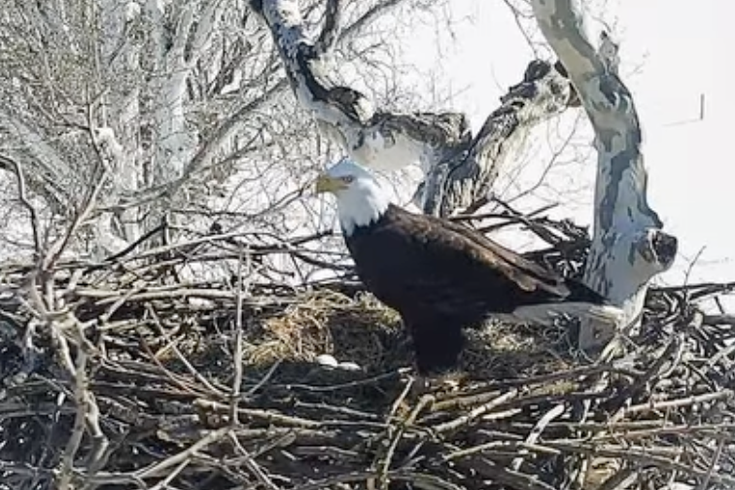 Provided Image/HDonTap
A female bald eagle stands over two eggs she laid this month at a nest in Lancaster County. A camera, hosted by the Pennsylvania Game Commission and HDOnTap, is running 24/7 to catch the expected hatching in March.
A pair of bald eagles nesting at a farm in Lancaster County will have two eggs to tend to in the coming weeks as their offspring get ready to hatch some time in March. Nature lovers can keep an eye on the family using a 24/7 livestream of the nest.
The PA Farm Country Eagles Live Cam, one of two bald eagle livestreams hosted by the Pennsylvania Game Commission and HDOnTap, shows two eggs that appeared in the nest over the past week. The second egg was laid Saturday afternoon, and on Monday morning the female could be seen standing watch over both eggs.
The location of the nest in Lancaster County is kept secret to protect the safety of the eagles and their eggs. The site has hosted the annual livestream since 2019, logging highlights and viewer-submitted screen captures at HDOnTap's website.
The state's other eagle cam is at Codorus State Park in Hanover, York County, where a livestream has been available since 2014. A pair of eagles have been spotted there since December, but no eggs appeared in their nest as of Tuesday afternoon.
Adult bald eagles usually form long-term mating pairs, often returning to the same nest each year. Their eggs incubate for a period of 35 to 40 days, during which time both parents rotate them and sit on them to maintain their temperature. Females do most of the incubation while males fetch food and bring it back to the mother at the nest.
Around four days before an egg is ready to hatch, an eaglet will develop an "egg tooth" at the end of its bill to crack through. The effort usually takes a day or two. Eggs that haven't hatched after 40 days typically are no longer viable.
Fans of the eagles in Lancaster County often refer to them as Lisa and Oliver, although many wildlife advocates don't support naming wild animals because it can lead to emotional attachments that impact research.
In New Jersey, Duke Farms in Somerset County has a nest with an eagle cam in a restored wildlife habitat. The eagle pair at the farm this year has a clutch of three eggs, the last of which was laid Jan. 18. The eaglets will hatch toward the end of February.
Once eaglets hatch, their fledging period with their parents usually lasts until June or July. When they leave the nest, they remain solitary for four to five years until they reach maturity and seek lifelong mates. The eagle cams in Pennsylvania remain active through the fledging period.
Bald eagle populations have recovered across much of the United States, including Pennsylvania and New Jersey, after decades of decline due to pesticide exposure, hunting and habitat loss. A state survey shows there are now more than 300 bald eagle nests in Pennsylvania, which removed the species from the state's list of endangered and threatened species in 2014. New Jersey delisted the species last year after recording a record 293 nesting pairs in 2024. Bald eagles were removed from the federal list of endangered species in 2007.