




November 11, 2025
 Larry Horricks/Netflix
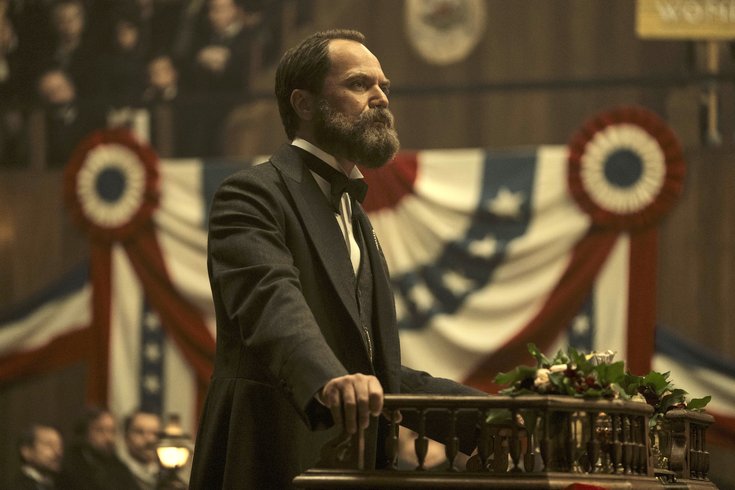
James Garfield rose to the White House with the help of Philadelphia banker and publisher Wharton Barker. Above, Michael Shannon plays the 20th president in the Netflix miniseries 'Death by Lightning.'
In the first episode of the Netflix miniseries "Death by Lightning," a man from Pennsylvania changes history by submitting a single vote for James Garfield at the 1880 Republican National Convention. Garfield wasn't seeking the presidential nomination. He was there to boost another candidate. But as the convention continued, more and more delegates switched their votes to Garfield.
By the next day, he was the GOP's candidate. The following year, he was sworn in as the 20th president of the United States.
That delegate from Pennsylvania was W.A.M. Grier, a partner in a Hazleton banking firm. He shows up briefly during the dramatized convention in "Death by Lightning," which details Garfield's short time in office and his assassination. But the man who apparently put Grier up to the stunt – and masterminded a plot to get Garfield the nomination – doesn't appear in the series. He was Wharton Barker, a Philadelphia publisher and financier who is buried at Laurel Hill Cemetery.
Barker had been scheming to get Garfield in the White House long before the Republican delegates gathered in Chicago in early June. Though he was, like Grier, a banker by trade, Barker also dabbled in political writing through his publication, the Penn Monthly. He had floated Garfield as a presidential candidate in its pages as early as May 1879, when he praised the politician, then a member of Congress, for his "gift of keeping on gentlemanly terms with both his friends and enemies." Barker stumped for Garfield again in his September 1879 issue, calling him "a man at once of fine courtesy, high principle and a good record."
Few others were betting on Garfield for president. Most Republicans were either lobbying Ulysses S. Grant for a third term, or propping up James Blaine, a U.S. senator from Maine, as an alternative. Garfield himself was committed to a dark horse candidate, Secretary of Treasury John Sherman, and had agreed to speak on his behalf at the Republican National Convention.
By Barker's amateur (though ultimately accurate) political calculations, the crowded race presented an opportunity. He said as much to Garfield in a February 1880 meeting in Washington, though the future president was uninterested.
"He also told me that they were organizing Young Republican Clubs in Pennsylvania; that they do not believe that either of the three candidates Grant, Blaine or Sherman can be elected and he and his friends were in favor of nominating me," Garfield wrote in his diary. "I told him I would not be a candidate and did not wish my name discussed in that connection ... that I was working in good faith for Sherman and should continue to do so."
The banker from Philly tried again to sway his presidential pick in April, arguing the divided anti-Grant factions would eventually unite for his nomination, but not Blaine or Sherman's. Garfield remained unconvinced.
"In short, Barker thinks this is likely to be the outcome," he wrote in his diary. "I do not. I should be greatly distressed if I thought otherwise."
Before the convention began on June 2, Barker took extra steps to ensure Garfield's presidency, whether the man himself liked it or not. As historian Frank B. Evans notes, the reluctant candidate could reject an initial nomination on the convention floor. So rather than taking the official route, Barker employed a sneaky political maneuver. He asked Grier to vote for Garfield early in the ballot process, after the candidates for the Republican ticket had already been selected. That way, they would be putting his name up for consideration without actually seeking permission to do so.
Grier did as he promised in the second round of voting, when the tally resulted in 305 for Grant, 282 for Blaine, 94 for Sherman and just one for Garfield. That lone vote remained just that for several more rounds, occasionally rising to two. It wasn't until the 34th attempt that another piece of Barker's plan kicked into action, Evans writes. A Garfield fan from Wisconsin had agreed to switch his state's votes from Blaine to Garfield when the right moment arrived. The Indiana delegation, whom Barker had also pitched before the convention, followed suit in the next round. With their support, Garfield's tally rose from one or two to 17 to 50. In the final 36th round of voting, he secured the nomination with 399 votes.
Though Garfield went on to win the election against Democratic nominee Winfield Scott Hancock, his presidency was short-lived. He was assassinated less than fourth months into his term by Charles Guiteau, a mentally unstable supporter who believed Garfield owed him a political appointment. As for Barker, he went on to mount an unsuccessful bid for the presidency in 1900. When he died two decades later, his obituary called him "Garfield's first boomer."
Follow Kristin & PhillyVoice on Twitter: @kristin_hunt
| @thePhillyVoice
Like us on Facebook: PhillyVoice
Have a news tip? Let us know.