



April 13, 2026
 Jimmy/for PhillyVoice
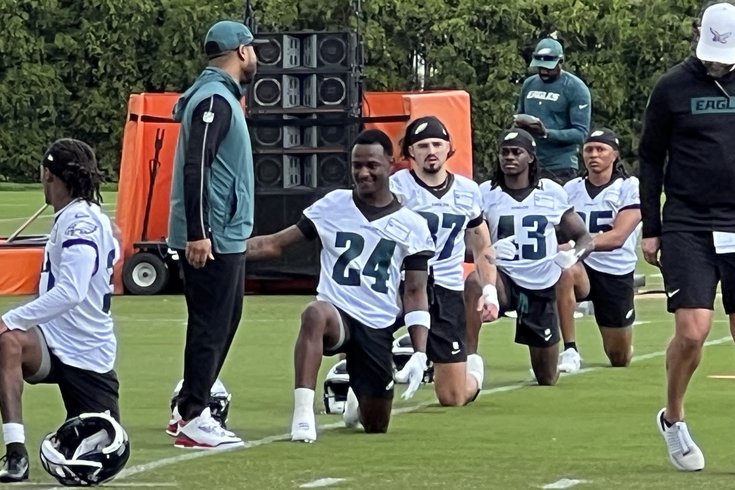
Andrew Mukuba is one starting safety for the Eagles in 2026. The other starter is a gigantic question mark.
When the Eagles watched three-year starting safety Reed Blankenship walk to the Houston Texans in free agency for a modest contract, conventional wisdom was that they would have a replacement plan in either bargain free agency, the trade market or the draft.
While any and all of those options remain available, the Eagles' actions so far this offseason suggest they aren't very concerned about the loss of Blankenship, a tremendous story of development who went from undrafted free agent out of Middle Tennessee State to Super Bowl champion with 50 career starts under his belt.
Their lack of moves outside of re-signing Michael Carter II, a nickelback by trade who has worked at safety, and Marcus Epps, a 30-year-old veteran backup, suggest the Eagles still don't prioritize the position.
Blankenship signed a deal with the Texans worth $8 million annually and with just $16.5 million guaranteed. That's not bank-breaking money. The Eagles have also addressed starting holes and depth at other positions, especially wide receiver and cornerback, more actively than they have at safety.
Heck, the Eagles even signed a running back – a position where they didn't need more depth – while still needing to find a legit starter opposite second-year safety Andrew Mukuba, a talented kid who has a slight body frame and already showed a struggle to stay healthy as a rookie. After dealing with injuries in training camp, Mukuba played just 10 games as a rookie and ended the season on Injured Reserve because of an ankle fracture.
Mukuba will start, but right now, the other safety is a battle between Epps, Carter II and special teamers Andre' Sam and J.T. Gray. That's just not enough.
So, what are the Eagles' plans? Do they even have one?
Let's examine the options:
If they weren't going to spend a measly $8 million annually on Blankenship, the Eagles were never going to be in the market for Bryan Cook, Jalen Thompson, Coby Byrant or any of the better safeties in this year's lackluster free agent class.
Turns out, they weren't even going to be competitive for average-level starters like Dane Belton, old friend C.J. Gardner-Johnson, Nick Scott or Andre Cisco, all of whom signed one-year deals in the $2-3 million neighborhood.
At this point, it doesn't make sense for the Eagles to sign a safety who would hurt them in the compensatory pick formula when they can wait until after the draft, when free agent signings no longer count against the formula.
There aren't many good options from our list of best available safeties but there are some, including Donovan Wilson of the Cowboys and Jordan Poyer, last with the Bills. The name I keep coming back to is Ashtyn Davis, formerly of the Dolphins. Davis was drafted by current Eagles exec Joe Douglas when Douglas was GM of the Jets, is only 29 and has 34 career starts.
It's important to remember that Roseman has made some critical free agent signings beyond the first few weeks of March, including LeGarrett Blount, Mekhi Becton, Chris Long and James Bradberry.
It's also important to remember that Roseman once tried to fill a starting safety spot with Terrell Edmunds and Justin Evans, which failed miserably.
In 2022, the Eagles were dangerously close to starting the season with a safety tandem of Anthony Harris and Marcus Epps, with Jaquiski Tartt or K'von Wallace as next man up. Wow, what a disaster that would've been. But on Aug. 30, less than two weeks before the season opener, Roseman shrewdly traded for Saints nickelback C.J. Gardner-Johnson with plans on converting him to safety.
Gardner-Johnson started alongside Epps – Harris was immediately released after the trade – and led the Eagles with six interceptions, helping them get to the Super Bowl. It was a brilliant move by Roseman to find a third-year player at a position he needed who wasn't going to re-sign with the team that drafted him and therefore became available somewhat cheaply (basically a fifth-rounder).
The trade was reminiscent of Roseman in 2017 dealing away Jordan Matthews and a third-round pick for Bills cornerback Ronald Darby in August to acquire another starter who had become available because the player wasn't going to be re-signed by the team that drafted him. The move helped the Eagles win their first Super Bowl.
Is there a trade option who could similarly help the Eagles this year? Here are three who would fit the mold:
• Lions S Brian Branch: An excellent and versatile DB who hasn't yet been extended but is also coming off an Achilles tear in December, clouding his status for the start of the season. So perhaps not the best option. The Lions already have their other safety, Kerby Joseph, under an extension, so they might not want to pay Branch for the long term, but they also probably don't want to trade him to another NFC contender.
• Commanders S Quan Martin: He was likely pushed into a backup role when the team signed free agent Nick Cross. The Commanders dealt Jahan Dotson to the Eagles two years ago, so they probably wouldn't be afraid to do the same with Martin. Is Martin much of an upgrade over what's left in bargain free agency? That's the big question. But he has started 37 games and turns just 26 before the season.
• Niners S Ji'Ayir Brown: He could be an interesting option. Roseman loves former 49ers (Danny Gray, Trey Sermon, Cam Latu, Tariq Castro-Fields, Ty Davis-Price...) and the former Penn Stater is extension eligible going into his fourth season after being drafted in the third round. Brown has had an up-and-down career in the Bay Area, with 31 starts in three seasons. If San Francisco adds to its safety group in the draft, the 26-year-old Brown could be a trade candidate.
There are probably others in the same situation as those three. Roseman is good at finding them. It just requires patience.
This could be the riskiest option for Roseman. The best safety in the 2026 draft, Ohio State's Caleb Downs, will probably be off the board in the top 12. Even if he drops a little, the Eagles would have to package picks to move up from 23rd overall. Safety isn't a position we've seen the Eagles aggressively pursue in the draft.
Prospects more in their range would be Toledo's Emmanuel McNeil-Warren and Oregon's Dillon Thieneman. Even if they're available at 23, given the Eagles' value of other positions, including offensive line and wide receiver, safety isn't likely to be the top prospect on their board there.
The Eagles could come away with a safety on Day 2 or early Day 3, and that prospect would immediately be in the mix to start opposite Mukuba, but prospects outside the first two rounds are also riskiest to start as rookies.
The Eagles didn't draft Cooper DeJean to play safety and don't want to move the All Pro out of his natural nickelback position, where his versatility and impact is key in Vic Fangio's scheme. But the option is on the table if they need to break glass in case of an emergency.
Fangio has always said he would only move DeJean to another position if he felt comfortable with DeJean's replacement on the inside. Michael Carter II was once a premier nickelback with the Jets. Last year's fifth-round pick, Mac McWilliams, is more suited for inside than outside. McWilliams didn't impress Fangio in Year 1 but could make a big jump this offseason.
In OTAs last year, Fangio first experimented with DeJean at safety in base defense before doing the same at outside corner.
In the same vein, Fangio could also be really pleased with what he sees from Carter II at safety. Carter is still just 27 years old and might have some long-term potential.
SIGN UP HERE to receive PhillyVoice's Sports newsletters.
Follow Geoff on Twitter/X: @geoffpmosher
Like us on Facebook: PhillyVoice Sports