





March 25, 2026
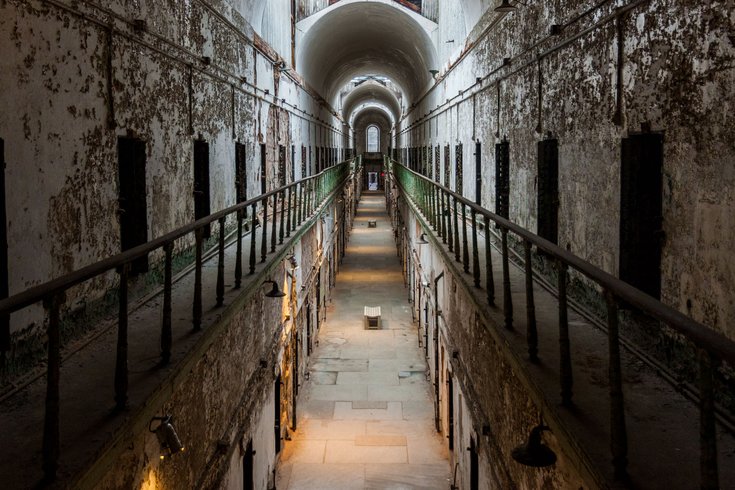 Thom Carroll/for PhillyVoice
Roughly 100 people escaped Eastern State Penitentiary while it was an active prison. The museum will highlight these stories in its spring break programming starting Friday.
Eastern State Penitentiary couldn't contain everyone in its stone walls. While the historic site was an active prison, about 100 people inside it escaped over ladders, through the gatehouse window and out the front door. But the most famous jailbreak involved a secret tunnel running underneath the penitentiary courtyard.
A dozen men crawled through it to freedom on April 3, 1945, after months of planning. Tumbling out onto Fairmount Avenue in muddy uniforms, they ran as fast and as far as they could, but authorities apprehended all 12 in a matter of weeks — including the flashiest fugitive of the group, "Slick Willie" Sutton.
Their breakout, which is part of the museum's "great escape" programming that's opening Friday, was the result of an opportune work placement. In the mid-1940s, prison staff entrusted Clarence Klinedinst with fixing the stone of a crumbling cell in the west side of the building. The quiet inmate's long record of good behavior had earned him certain privileges, among them the ability to work through the day and exercise in the evening. He also got the blueprints to Cellblock 7, where he lived and worked with little supervision.
"Tunnel escape attempts before hadn't really worked primarily because they would run into plumbing lines," said Bug Finegar, education manager for Eastern State Penitentiary Historic Site. "And the plumbing at Eastern State was such a problem that guards would go down there pretty often and see those tunnels. He did not run into a Cellblock 7 plumbing line, probably thanks to a lot of the plan information."
Klinedinst carved a hole in the cell wall, covering his tunnel entrance with a panel. Then, with the help of his cellmate William Russell, he dug.
The work took the better part of a year. Klinedinst and Russell first burrowed straight down into the ground, using Klinedinst's masonry tools and, press reports claimed, handmade knives formed from bits of metal in the prison workshops. The pair dumped excess dirt in the exercise yard, on the baseball field or down drain pipes. Sometimes, Finegar said, they'd bundle a plaster face mask up into one of their beds so one of them could work through the night. The other would keep watch in case the guards discovered the ruse.
Once they'd tunneled 15 feet, they started digging horizontally beneath the courtyard. This stretch spanned 97 feet, and was supported by wooden beams and illuminated by light bulbs running along an electrical cord. All that was left then was to tunnel back up. The path ended at the garden in the front of Eastern State Penitentiary.
It's unclear when the other 10 men got involved. But as word spread, more conspirators signed onto the scheme. One of them was "Slick Willie" Sutton, a prolific robber known for his expensive clothes and many disguises. By the FBI's count, he posed as a mailman, telegraph messenger, police officer and maintenance man to knock off banks and jewelry stores.
'Slick Willie' Sutton, a bank robber who was part of the 1945 tunnel escape, tried to break out of Eastern State Penitentiary numerous times.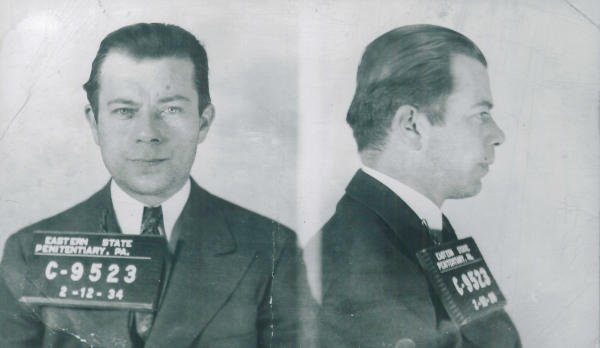 Provided image/Eastern State Penitentiary Historic Site/Gift of the family of John D. Shearer
Sutton wasn't just known for evading authorities. In 1932, he had escaped Sing Sing prison with another inmate by scaling the walls with two nine-foot ladders they "spliced together" — and he had already tried to bust out of Eastern State multiple times. According to his memoir "I, Willie Sutton," the escape artist had attempted to flee through the sewers and, later, high-tail it across the yard with a grappling hook, leaving behind a plaster bust and hand in his bed as a decoy.
Perhaps that's why the press initially pegged him as the ringleader. (Sutton was only too happy to take credit.) But it was quiet Klinedinst, who skipped breakfast the morning of April 3, slipping through the tunnel in his cell with Russell and 10 others around 6:20 a.m.
Unfortunately for several of them, their cover was blown minutes after they hit the front lawn. Six were apprehended later that day, including Sutton, reportedly busted with a fake gun in his pocket.
"I leaped from the hole, began to run and came face to face with two policeman," he wrote. "They stood for a moment, paralyzed with amazement. I was soaking wet and my face was covered in mud."
Four stole a milk truck, but ultimately crashed it into the police car pursuing them around 30th and Poplar streets. Klinedinst made it to 11th Street and Lehigh Avenue before law enforcement nabbed him. While the other six weren't caught quite as quickly, Eastern State had apprehended the entire crew within two weeks, Finegar said.
The scheme might've failed, but it became and remains the best-known jailbreak in Eastern State Penitentiary history. Sutton added to the intrigue with his books — he followed "I, Willie Sutton" with "Where the Money Was" — and continued exploits. After so many failed escapes, he slipped out of Holmesburg Prison in 1947 disguised as a guard and remained at large for the next five years. Before he was finally caught, he made the FBI's Ten Most Wanted list.
While Finegar acknowledges there's no concrete evidence that the 1945 tunnel escape inspired classic stories like "The Shawshank Redemption," they like to think it indirectly informed fictional tales of prisoners making it to the other side.
"There's aspects of this escape that are repeated in other escapes around the country that eventually become really big tropes, essentially," Finegar said. "... So that's the assumption. But I haven't seen any direct connection."
Follow Kristin & PhillyVoice on Twitter: @kristin_hunt
| @thePhillyVoice
Like us on Facebook: PhillyVoice
Have a news tip? Let us know.