






January 15, 2026

 Courtenay Harris Bond/PhillyVoice
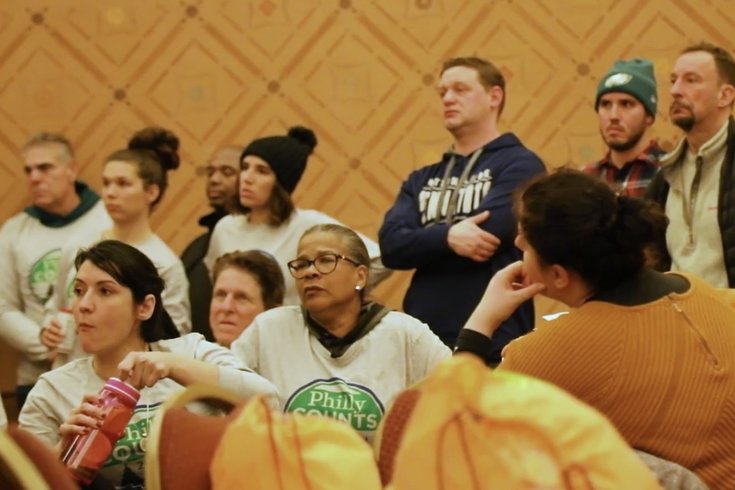
Philly's point-in-time count of the city's homeless population happens in late January every year. Above, volunteers prepare for Philly's point-in-time count in 2018.
Philadelphia's point-in-time count – a federally-mandated survey of homelessness in the city – happens each year in late January. On that night, volunteers fan out across the city to document how many people are actually on the street or in places not meant for human habitation, as well as how many people are in temporary shelters or transitional housing.
The count happens the last week in January in communities across the country that receive federal homeless assistance grants from the U.S. Department of Housing and Urban Development. It informs policies, funding and programs aimed at helping people experiencing homelessness.
Those numbers continue to rise, both locally and nationwide.
As Philadelphia prepares for the 2026 point-in-time count on Wednesday, Jan. 28, the Office of Homeless Services is set to release its full findings from last year's survey, which showed 5,516 people were experiencing homelessness, up 6% from 5,191 in 2024. It's the fourth year in a row that Philadelphia saw an increase in unhoused people. There were 4,725 in 2023 and 4,489 in 2022.
Perhaps even more strikingly, the number of "unsheltered" people counted in 2025 was 1,178, up 21% from 2024. This figure only includes people living on the street and other places not meant for human habitation. It does not include the 4,338 people who were living in emergency, transition or safe-haven housing.
HUD has not yet released the national findings from the 2025 count. But there was an 18% rise in homelessness from 653,104 people during the 2023 point-in-time count to 771,480 people during the 2024 count.
"It's all the things that we've known for such a long time to be the key drivers of homelessness, foremost among them the shortage of affordable housing in our increasingly unaffordable city," said Candice Player, vice president of advocacy, publicity and street outreach at Project HOME.
Philadelphia has a shortfall of more than 64,500 housing units that are affordable and available to low-income residents, according to a May brief from the University of Pennsylvania's Housing Initiative.
Nearly 1 in 3 renters spend more than 50% of their income on housing, and more than 60% of low-income homeowners spend more than 50% of their income on housing, according to the report.
"There are people who are working, but the work does not pay enough to afford an apartment, a one-bedroom apartment," Player said.
Project HOME has a drop-in center in Suburban Station called Hub of Hope, a safe space for people to get a cup of coffee, take a shower, wash laundry, receive medical care and access case managers.
"There have been times that I've gone in there and seen folks with security guard uniforms on from companies that you would recognize, and they're there because they need lunch," Player said. "They needed a place to rest. They're housing insecure. … they have employment, but they're going home to a shelter."
Another main driver of homelessness in Philadelphia is the ongoing addiction crisis, said Cheryl Hill, executive director of Philadelphia's Office of Homeless Services.
But mental health and substance use issues are viewed more as contributing factors to homelessness rather than direct causes, Project HOME notes. It uses the game musical chairs as an analogy: playing the game with an injury or illness makes it harder, but the core issue is the shortage of chairs.
The fact that the annual point-in-time count occurs sometime during the last week in January throughout the country, "really takes out some of the statistical noise that can happen if you're doing it during different times of the year," Hill said.
HUD mandates the count during the last week of the month, so that it captures people on public assistance who only may be able to pay for housing for the first few weeks of the month after receiving benefits. And doing the count in late January when it's typically cold – and when local governments are likely to maximize their resources to offer people shelter – may provide a more precise picture of the number of people truly out there.
"I think the thought is, if you are outside during what is likely to be the coldest time of year, you really, really have no place to go," Player said.
But there are problems with doing the annual count in the winter.
When it's cold, people find vacant apartments, abandoned buildings and cars, "wherever it may be, to be able to get out of the elements," Hill said.
Volunteers are prohibited for safety reasons from going into buildings during the count. So people who have sought out these types of shelter are missed, Hill said.
Additionally, the count does not factor in people who are doubling up with families, friends and acquaintances.
"We're unable to capture couch-surfing as a category," Hill said. "We know it exists. But while it's not (stable housing), they are housed."
The count also does not account for people who may be experiencing homelessness but who are in hospitals, jails or prisons, which "may result in a disproportionate undercounting of racial and ethnic minorities, who are overrepresented in incarcerated populations," a 2017 report from the National Law Center on Homelessness and Poverty noted.
The count also fails to capture seasonal fluctuations in the "unsheltered" homeless population.
"The unsheltered portion of the point-in-time count is widely known as an underestimate, but it's also an estimate of what's happening on a single day," Player said.
What it doesn't do is reflect trends in homelessness over the course of a year. For instance, the number of people experiencing "unsheltered" homelessness tends to rise in the spring and summer, when winter shelter beds are not available, and then go back down again in the late fall and winter, Player said.
"So it would be misleading to think that that (point-in-time count) number is truly representative of the scale of the problem that we're trying to solve," Player said.
Mayor Cherelle Parker has a $2 billion initiative in the works to preserve and develop new housing units, implement a new mortgage program and offer rental assistance to increase the city's affordable housing stock.
One year ago, the city also opened Riverview Wellness Village, a large recovery housing complex on State Road in Holmesburg, to help fill a housing gap for people who have experienced homelessness and are coming out of inpatient drug treatment programs. It has 336 beds with plans to increase to 640 beds.
Additionally, the city is adding 1,000 additional shelter beds by Jan. 31, bringing the total to about 3,800, Hill said.
"We're adding a lot more family beds, because our family beds are filled every night," Hill said.
A new facility opening on Old York Road in Logan will provide 350 of those additional year-round shelter beds, with half reserved for families.
The city also adds about 300 extra shelter beds during the winter – and an additional 50 or so during Code Blue declarations when the temperature drops below freezing or the wind chill makes it feel like 20 degrees or lower.
The city distributed about $4 million in grant funding last year to open new shelters and expand behavioral health, addiction and other wraparound services available within shelters. And people who visit city intake centers and receive placement at a shelter are now able to keep that bed for as long as they need it and to store belongings on site – a change the city made last winter, Hill said.
"We are really trying to transform what shelters look like in Philadelphia," Hill said. "People often hear me say that the shelter should be somewhere that if any of us or any of our family had to go to, we would feel comfortable with them being able to lay there ... safely, but also with dignity."