




January 25, 2026
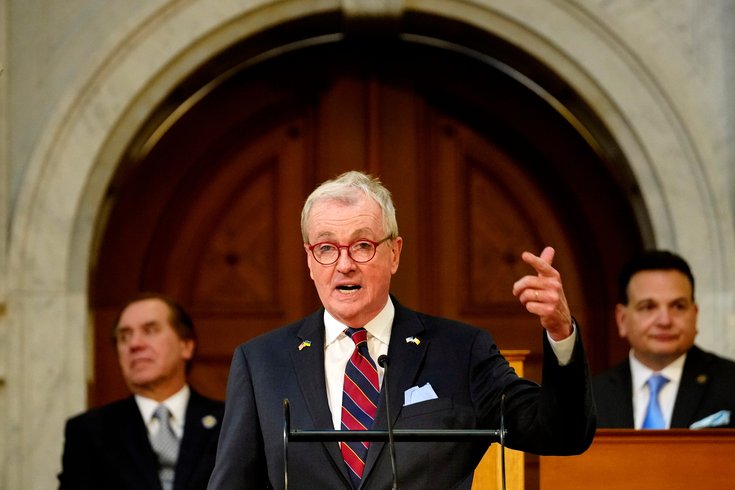 Kevin R. Wexler/Imagn Images
New Jersey Democratic lawmakers want to limit the governor's clemency powers after outgoing Gov. Phil Murphy, above, granted pardons or commutations to 455 people, including a woman convicted of murdering her two toddler children in 1996.
A trio of Democratic lawmakers want to alter the pardon powers of New Jersey's governors after Gov. Phil Murphy issued waves of clemencies that lifted sentences for some convicted of serious violent crimes, up to and including murder, shortly before leaving office.
Sen. Vin Gopal (D-Monmouth) and Assemblywomen Margie Donlon (D-Monmouth) and Luanne Peterpaul (D-Monmouth) urged changes to state pardon powers, arguing the wave of state clemencies and alleged abuses at the federal level demanded change.
SIGN UP HERE to get PhillyVoice's free newsletters delivered to your inbox
"At a time when we are seeing a federal administration exploit executive power, New Jersey leadership must remain committed to serving the public welfare, not abusing power to sidestep our justice system," they said in a joint statement.
A commutation Murphy granted to Maria Montalvo, a Monmouth County women convicted of murdering her two toddler children, has incensed Gopal, his running mates, and Monmouth County Prosecutor Raymond Santiago.
A jury convicted Montalvo of killing her children, aged 18 and 28 months, in 1996. Prosecutors said she doused them in gasoline before setting her car ablaze in the driveway of her husband's parents. The court sentenced her to 100 years, with parole ineligibility until 2054.
Murphy's grant of clemency did not release Montalvo, but it did make her immediately eligible to seek parole.
Montalvo has maintained her innocence. Witness accounts of the incident varied, and her attorneys have argued the evidence used to convict her was based on science that has since been discredited.
Backers of Murphy's expansive clemency program, which pardoned or commuted the sentences of 455 individuals, urged against denuding clemency powers, calling it a valuable tool to reduce the state's prison population.
"From the mid '90s to 2024, we only saw around 100 instances of clemency being granted in New Jersey over 30 years across so many governors. It's a tool that is widely underutilized, and it's something we should use to address systemic injustices in the criminal legal system," said Amol Sinha, executive director of the ACLU of New Jersey.
The road to limit the governor's pardon powers runs uphill.
The power to overwrite state criminal convictions and penalties stems from New Jersey's constitution, and the document provides no means for anyone — not legislators or courts — to review grants of gubernatorial clemency.
That means only a constitutional amendment could change how pardons and commutations are meted out in New Jersey.
Amending the state constitution requires a voter referendum, but getting a constitutional question on the ballot requires legislative approval — either by simple majority votes in the Senate and Assembly in two consecutive years or by a single vote that wins a three-fifths supermajority in both chambers.
It's not clear whether a broader set of legislators is willing to make those votes, especially with Murphy out of office. Gopal said he had not polled his colleagues broadly on changes to pardon powers.
"I can tell you my running mates and I are outraged," Gopal said, adding he'd heard concerns about clemencies from members on both sides of the aisle.
Also unclear are what changes Gopal and his fellows might seek to make to gubernatorial pardon powers.
The senator said legislators were still in the process of determining how reformed pardon powers would function, a process that would include reviews of clemency authorities in other states.
Most commonly, clemency powers belong solely to the governor, though some states require a recommendation from a third-party board before the governor can issue a pardon or commute a sentence. Four states vest clemency powers solely in a board or advisory group, according to the ACLU.
"I think I would be potentially comfortable if there was a board that was not political that was a third-party board that looked at these types of reforms and politicians had nothing to do with it," Gopal said.
Murphy convened a Clemency Advisory Board to solicit and review clemency applications and make recommendations in June 2024.
Sinha questioned whether an independent body could actually exist in New Jersey, noting any members would likely be nominated by the governor and could face Senate confirmation, including vetoes by individual legislators invoking senatorial courtesy, a tradition that allows senators to indefinitely and unilaterally block gubernatorial nominees from their home county or legislative district.
"They can all be influenced," he said. "I don't think that means we stop doing the work. I think it means we make sure there are objective, clear and transparent criteria to determine who gets clemency and who doesn't."
New Jersey Monitor is part of States Newsroom, a nonprofit news network supported by grants and a coalition of donors as a 501c(3) public charity. New Jersey Monitor maintains editorial independence. Contact Editor Terrence T. McDonald for questions: info@newjerseymonitor.com.