




April 12, 2026
 Kyle Ross/Imagn Images
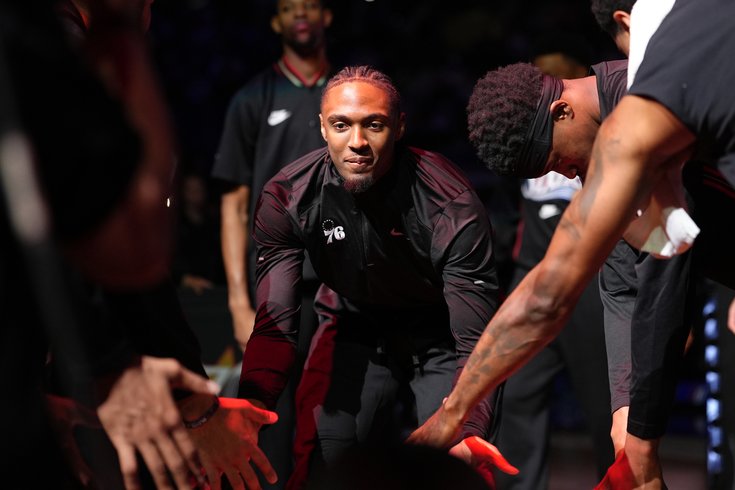
For the first time in his six-year NBA career, Tyrese Maxey is headed to the postseason as a primary scoring option.
PHILADELPHIA – One last time in the 2025-26 regular season, the Sixers took the floor on Sunday night, playing host to the remnants of the Milwaukee Bucks.
Somehow, a group of seven Bucks pulled ahead of the Sixers by the end of a desolate first half. But in the ultimate ironic twist, the Sixers won their final game of the season after routing their opponent in the third quarter. In public address announcer Matt Cord's final regular-season game on the microphone, the Sixers managed to give Cord something worth being excited about in the second half.
The Sixers, who lamented their relative struggles to protect their home floor all season long, finished the season with a 23-18 record at home, one game better than their 22-19 mark on the road. Most of those home wins did not come as easily as the one on Sunday.
A mix of short-term and season-long observations on all 11 players in the first-half rotation during the Sixers' 126-106 victory:
Maxey's sixth NBA regular season is officially over, and this one was his best yet. Maxey appears to be a lock for his first All-NBA selection, a deserved honor for a player who has shouldered a massive workload all year long and been at the forefront of a necessary culture shift in Philadelphia.
At Media Day back in September, Maxey lamented how things went last season. The Sixers allowed adversity from injuries to prevent them from ever getting the operation off the ground. Joel Embiid's frequent absences provided a built-in excuse; oftentimes it felt like the Sixers were willing to use it. This time around, Maxey made sure to set a higher standard for the group. Its performance without Embiid early in the season was spectacular, but as the Sixers got more used to the former NBA MVP being available, it became harder for them to adjust to life with him sidelined.
For the first time, Maxey will enter a postseason as a team's primary scoring option. Embiid has referred to his sidekick as the Sixers' best player for many years; it has not usually been true. But Maxey is the head of the snake for now. Ironically, his goal will be to keep the Sixers afloat for long enough that he can return to a secondary role behind a returning Embiid.
That will be the biggest challenge of Maxey's NBA career, in part because he is clearly compromised by his right finger injury. Maxey is playing with a splint and attempting to understate its impact, but he is very obviously playing through discomfort in addition to having limited movement ability with that finger. It was evident in the first half on Sunday before he grew more comfortable.
Maxey has not ended 2025-26 the way he wanted to, and it would not be stunning if his postseason performance is negatively impacted by his injury. But Maxey's sixth NBA season should be remembered fondly no matter how it ends.
MORE: Five years later, the 'Seven Sixers' recall the day Maxey's ascent began
Before the season began, Sixers head coach Nick Nurse declared that whether or not Edgecombe's rookie season was a success would be determined by how many minutes he played.
More than 2,600 minutes later, it is safe to say this was a wildly successful debut campaign for the 20-year-old Edgecombe, who took full advantage of Nurse's early endorsement and started all 75 of his games, logging heavy minutes on a consistent basis and showing marked signs of improvement on both ends of the floor all season long.
Where does Nurse believe Edgecombe has grown the most since October?
"Probably just his individual scoring," Nurse said. "I think he had all the other stuff coming out of the gates. I mean, we didn't know that, but the defense, the rebounding, the shot-blocking, all those kinds of things. But I think his ability to go get a basket with the shot clock winding down, or just when we need a bucket to keep the scoreboard moving or make one in the fourth quarter or something like that, I think it continues to get better."
As Nurse spoke about the impressive rapport developed by Maxey and Edgecombe – the Sixers' clear franchise cornerstones moving forward, whose dynamic is "still unfolding," according to Nurse – he added that Edgecombe's play as a point guard, from ball-handling to organizational skills to playmaking, has continued to improve.
It may be hard to envision the Sixers making any real noise in a playoff series, which puts a damper on their Play-In Tournament pursuit. But getting Edgecombe into some high-intensity playoff games as a secondary ball-handler also managing backup point guard minutes would be beneficial for his development.
Oubre just completed his best three-point shooting season as a member of the Sixers by far. He has always been a high-volume shooter, so defenses respect him on the perimeter much more than most players hovering around 30 percent from beyond the arc. This year, he spent much of the season handily above 35 percent on long-range tries despite his volume remaining quite significant.
While Oubre will never be a perfect player, he is a versatile defender capable of getting to the rim in short bursts. For that player to enter unrestricted free agency again coming off an effective season as a three-point shooter bodes well. Oubre could benefit quite a bit from a standout playoff performance or two; at this point in his career he is more likely to join a playoff-caliber team looking to bolster its wing mix than a bottom-feeding team.
Generally speaking, the Sixers have only turned to Oubre for considerable scoring efforts when they have been severely undermanned. But he is one of the only players on this team capable of exploding on any given night. It is difficult to predict whether or not this postseason will be the closing act of Oubre's Sixers tenure, but the veteran swingman deserves credit for the effort he has played with, even if the whole picture of his production has never been perfect.
Initially signed to a veteran's minimum contract, Oubre has done more than enough to pay off the salaries the Sixers have given him by a whole lot.
George said when he returned from his 25-game suspension on March 25 that he was hoping to finish the season by playing in each of the Sixers' final 10 games, including both legs of their two remaining back-to-backs. He followed through on that and was largely excellent in the home stretch of the season, but it was only his 37th game out of 82 this season. Even before being suspended, George was frequently unavailable for the Sixers.
In the first half of a four-year, $211 million max contract signed in the 2024 offseason, George has only played 78 regular-season games. And while the latter portion of this season has provided some glimpses of the nine-time All-Star finding his peak form, the overwhelming majority of his outings as a member of the Sixers have been considerably worse than his career norms.
Make no mistake, George is still a good player; he was even before his post-suspension surge. George turns 36 years old next month, but he remains a tremendous defensive player and has been the Sixers' stabilizing force on that end of the floor whenever he has been on the court this season. He is a high-level shot-maker, too. What has come and gone during his Sixers tenure – but mostly gone – is his off-the-dribble burst.
When he is not getting by defenders and creating advantages, George's signature mid-range jumpers go from a feature to a bug. But when defenses feel they are at risk of getting burned downhill, he has mastered the art of pulling up for a smooth jumper. If the Sixers want to have any chance of winning postseason games without Embiid, George will have to carry a significant scoring burden.
MORE: Will George's post-suspension surge turn him into a trade asset this summer?
For months, Nurse has felt like Bona is finally more or less the player the Sixers envisioned him being. There are always teaching points and areas for improvement – Bona still needs to be a more disciplined and thoughtful defender, and perhaps some extra offensive utility being added to his game would be helpful – but the Sixers have worked hard to simplify everything for the sophomore center.
Bona's jobs are simple: pursue rebounds with as much energy as possible, protect the rim, block shots, set screens and roll hard to the rim. Bona is mostly good at those things, and while it is never the package that creates an All-Star without truly elite defense and rebounding, it does give him the makings of a long-term backup center at this level.
Now two seasons into his career, Bona has certainly done enough to justify the Sixers using the No. 41 overall pick in the 2025 NBA Draft to select him. But he is not an unquestionably qualified rotation big heading into his first NBA postseason action, and with Embiid out that is of course a cause for concern.
"His balance, his energy, his athleticism his shot-blocking," Nurse said before Sunday's game, "we just need to make sure that happens on a consistent basis. We need his 20-25 minutes to be that Bona. And we see that most of the time. But that needs to continue to tick upward in the [number] of games that he's able to provide that."
Drummond, meanwhile, is entering the postseason with much more momentum. He has been definitively better than Bona since Embiid's appendectomy, and while that is a small sample size, Nurse's usage of Bona and Drummond all season has indicated he is most comfortable riding a hot hand until it gets cold.
An elite rebounder with a newfound ability to step out and knock down a three – Drummond connected on a corner triple to end Sunday's opening frame, then hit another one in the second half, giving him a career-high 32 three-pointers to end the season – Drummond might be more of a known commodity than Bona, even if that means living with his weaknesses as a mover and rim protector.
For much of the season, the Sixers have been ravaged on the defensive glass. Perhaps more of Drummond on the floor – as opposed to the much more slight youngster Bona – will help remedy those issues. Drummond, coming off a disastrous campaign in 2024-25, has been much better than the Sixers could have reasonably hoped, even if much of his middle portion of the season was unproductive.
It was a weird season for Grimes; it often is for a player signed to the qualifying offer. He started the season looking like a prime Sixth Man of the Year Award candidate and was the key to the Sixers' wildly successful three-guard lineups early in the season. He was a staple in crunch time and looked like a potential swing piece for this team as it surpassed expectations in the early portion of the season.
Then Grimes became invisible for a while; his skills make him a great fit around ball-dominant players on paper but once the Sixers finally got healthy he rarely had chances to make an impact. Just as Grimes was making important strides fitting alongside the stars, they all went down. He was forced into a significant on-ball role for the second straight March and, for the second year in a row, scored a lot of points.
The Sixers' hope is that Grimes will find the happy medium between aggression and making the right play. They could certainly use a heater or two from the 25-year-old, who at the start of the season felt like a lock to depart Philadelphia at the end of the year. Now, with Jared McCain gone – and Sixers President of Basketball Operations Daryl Morey following up that deal with some optimistic comments about retaining Grimes' services – the fifth-year guard could end up back in the fold if his market is not tremendous.
After the Sixers' very first official practice of the season, Nurse highlighted Edgecombe and Barlow as the team's early standouts. Edgecombe's mention was hardly a surprise, but Barlow was not even thought of as the Sixers' highest-caliber two-way power forward entering training camp. While Barlow and Jabari Walker both earned standard contracts by outperforming expectations as two-way players, it is the 22-year-old Barlow whose contributions have been immeasurable.
Barlow immediately clicked with Embiid; their clear fit together makes Barlow the early favorite to start at power forward next season. But Embiid's indefinite absence will undoubtedly put a cap on how much Barlow plays in high-leverage settings for the remainder of this season. He is just about a non-shooter, which already limits his playoff utility. Without being able to leverage Embiid's gravity, Barlow does not have much to hang his hat on aside from offensive rebounding.
The Sixers have had plenty of hits on two-way contracts in recent years, but Barlow may be the biggest of them all. If the team cannot come to terms with Barlow on a long-term contract this summer, it will happily pick up his team option worth just over $3.5 million.
As the Sixers continue to grapple with their rebounding issues, playing Walker looms as the most obvious solution. Nurse has liked to make the same comment about Walker all year: it never feels like he plays poorly. Yet in recent weeks, Nurse appeared to grow less and less optimistic about the 23-year-old's role.
Walker is the Sixers' best defensive rebounder, by Nurse's own estimation. He is also likely their best defensive option against bruising forwards who command physicality. He is not a good shooter, but he is not quite a non-shooter like Barlow. There is a case to be made for him.
Meanwhile, Walker closed the first half on Sunday as a small-ball center. It was likely a counter to a very small Milwaukee lineup as much as anything else, but with the Sixers not having much of a third-string center, they would have to go to Barlow or Walker in that spot if someone else is needed to man the middle. For what it's worth, the Sixers had some early-season success playing Walker and Barlow together.
Watford's first-half minutes on Sunday were both surprising and, unfortunately for him, reaffirming. Watford's fit on this team is far more theoretical than practical. The idea of a jumbo-sized ball-handler capable of grabbing a defensive rebound and pushing the pace in transition or getting an offense organized, with some chops passing out of the post, is intriguing.
Watford is a terrific ball-handler and passer for his size, but he is not nearly good enough at either one to justify taking the ball out of the hands of players like Maxey, Embiid, George and Edgecombe. Then, he becomes invisible or worse as a non-shooter without any defensive versatility or playmaking. Watford is not even a particularly good rebounder for his size, either.
The Sixers have a tiny team option to decide on with Watford, for right around the veteran's minimum salary. Perhaps in part because he is extremely close with Maxey, bringing Watford back is a viable option, though it should not be with the idea of him being a rotation staple.
Between Maxey, Edgecombe, Oubre, George, Bona, Drummond, Grimes and Barlow, Nurse has eight rotation fixtures for now. Lately, it has seemed like Edwards was the leader in the clubhouse for the ninth and final rotation spot – which, in the playoffs, could mean one short stint of minutes or none at all.
Nurse acknowledged before Sunday's game that Edwards is currently the most likely of a group of reserves also including Walker and Watford to play in the postseason. Why is that?
"Just solid play," Nurse said. "Go in there and guard, go in there and help rebound. Take a shot, if they run you off the line, take it to the right place. Don't be afraid to put one up now and then."
Nurse repeated something he has been saying for two seasons now: "The ball seems to find" Edwards, which he attributes to the young wing's feel for the game. Edwards, who shot the ball very well on Friday, certainly has the quick trigger and the confidence to swing a game with his three-point stroke, and Nurse has quite a bit of trust in him across the positional spectrum as a defender.
MORE: How Edwards gets off to strong starts and 'embodies being patient'