




July 17, 2026
 Melinda Sue Gordon/Universal Pictures
Christopher Nolan's movie adaptation of 'The Odyssey' ditches the fanciful language and British accents associated with sword-and-sandal epics.
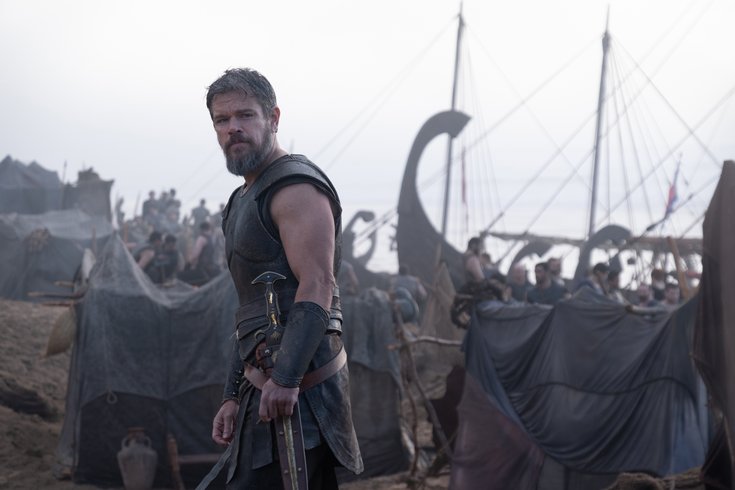
When the ancient Greek hero Odysseus steps onto the screen in the new film adaptation of "The Odyssey," he looks familiar — and not just because he's played by Matt Damon. The mythical king is dressed in the weathered bronze armor and linen robes long associated with the era. His beard roughly matches the one carved into statues and rendered in mosaic for centuries, even if it's not quite as curly.
But he sounds much different. Not long into the nearly three-hour movie, opening Friday, Odysseus erupts in a fit of frustration. He and his soldiers on the Greek side of the Trojan War have been fighting for "10 years on this f---ing beach," and he's ready to go home.
It's a startling choice for the epic, and not the only starkly modern language that writer-director Christopher Nolan employs. Telemachus, the son of Odysseus, calls the hero "dad." Antinous, one of several men squatting at Odysseus's home to pressure his wife Penelope to abandon hope of his return and marry him, refers to the king as "daddy." Another suitor tells a beggar in the banquet hall to "f--k off."
Though these choices are all Nolan, one University of Pennsylvania professor's influence is unmistakable. Emily Wilson drew notice for the simple — and, relative to past translations, modern — language she used in her 2017 translation of Homer's epic poem. Her version of "The Odyssey" became a bit of a phenomenon among classicists and Greek myth nerds, largely praised for its inventiveness and musicality.
It was also criticized in some corners for excessive creative liberty, though the loudest detractors tended to be more fixated on culture wars than content. Wilson was the first woman to translate the story into English and applied a more empathic and nuanced lens to the female characters.
Wilson's goal as a translator, she explains in a note that opens the book, is to "remind readers that this text can engage us in a direct way."
"I have frequently aimed for a certain level of simplicity, often using fairly ordinary, straightforward and readable English," she writes. "In using language that is largely simple, my goal is not to make Homer sound 'primitive,' but to mark the fact that stylistic pomposity is entirely un-Homeric. ... Impressive displays of rhetoric and linguistic force are a good way to seem important and invite a particular kind of admiration, but they tend to silence dissent and discourage deeper modes of engagement."
Nolan aligns with this mission. The director avoids overly fancy dialogue and British accents in his interpretation. He also gives his actresses meatier material — particularly Anne Hathaway (as Penelope), Samantha Morton (as Circe) and Lupita Nyong'o (as Helen of Troy and Clytemnestra). How much of this was directly inspired by Wilson is unclear, but Nolan has name-checked her in interviews, and expressed a similar philosophy in the production notes for his movie.
"I made a decision when I was writing the script that I wanted the film to be accessible," he said. "I wanted the world of 'The Odyssey' to feel like a world that a modern audience could relate to. We didn’t want it to look or sound like previous movies set during antiquity, as many of them take their cues from certain periods of art and music, like Neoclassical painting from 18th and 19th century Europe or Romantic Era orchestral compositions. We wanted an earthy, modern, relatable tone to ground the story."
Wilson was not a consultant on the film, as the credits and the woman herself confirm. But she's "grateful to Mr Nolan for bringing more multitudes of people back to this great mythical world," per a Bluesky post, even if she doesn't totally rubber stamp all his choices.
Follow Kristin & PhillyVoice on Twitter: @kristin_hunt
| @thePhillyVoice
Like us on Facebook: PhillyVoice
Have a news tip? Let us know.