





June 04, 2026
 Nathan Ray Seebeck/Imagn Images
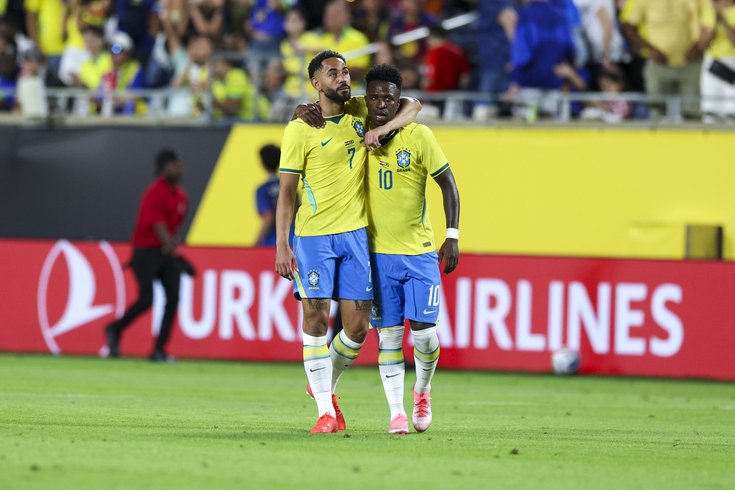
Brazil forwards Matheus Cunha (7) and forward Vinícius Junior (10) will be asked to elevate their country back into powerhouse status in the 2026 World Cup. Their mission starts in Philly.
The World Cup is about to take over stadiums across North America and Philadelphia and for some, it's the sporting experience of a lifetime. For other more casual sports fans, and for many four-for-four Philly fans, it's hard to really unpack what's about to happen.
Over the course of around six weeks, the stadium typically called Lincoln Financial Field will host six games, five group stage matches and one knockout game boasting teams from nine different countries.
It's time for a crash course.
We'll help introduce you to each of the national squads competing in Philly in June and July, continuing with Brazil — the South American soccer powerhouse trying to regain elite status. Can Brazil end two decade-long Cup drought, and can one of its most popular star players shine again on a global stage?
Some more things to know about Brazil:
The overwhelming favorite to win Group C, which is also home to Scotland, Morocco and first-round opponent Haiti, Brazil should cruise over the Haitians, although the Seleção are playing a pragmatic, tactical pace of soccer under Italian manager Carlo Ancelotti compared to the country's long history of employing an aggressive, fast-paced attack.
Ancelotti is widely considered one of the sport's all-time greatest coaches, with a record five Champions League trophies, including at least one trophy in each of the five major European leagues. Playing Ancelotti's way is a calculated risk given Brazil's appetite for – and pedigree of – playground-style soccer fueled by elite athletes, but it's a recipe that Brazil hopes will lead the country back to elite status.
Brazil, whose five World Cups is the most in the event's history, hasn't won the Cup since 2002. Former national team great Naymar, Brazil's all-time leading scorer, was once considered among the planet's greatest players. But he's dealt with injuries at 34 years old and hasn't played for his country in nearly three years. Many were surprised he was even invited to play for the national team.
Brazil still offers plenty of firepower, athleticism and speed among its prolific forwards. And as if talent up front isn't enough, Brazil's goalkeeping is also outstanding and should make the match very difficult for Haiti, which hasn't played in the World Cup since 1974.
• Vinícius "Vini" Júnior: The quick, tenacious Real Madrid star is known for his elite dribbling and agility. He's led Real Madrid to two Champions League trophies, but he's looking to fare better playing for Brazil. He hasn't performed as well for his country in international competition.
• Raphael Dias Belloli: Better known as "Raphinha," the La Liga phenom will attack from the opposite flank of Vini Jr., giving Brazil a double-dose of playmakers. Raphinha's trademark speed helps drive the engine for Barcelona, and this summer for the Brazilian national team.
• Álisson Ramsés Becker: A star goalkeeper, "Alisson" is widely considered one of the world's best between the pipes all-time. The Liverpool keeper is notoriously stout in 1-on-1 situations, which could come in handy in any post-regulation penalty kick shootouts.
• Gabriel Magalhães: A star defender for the Premier League's Arsenal, "Gabriel" has gained a reputation for being one of the top defenders internationally. He lacks desired height but is super fast and really shows out in the aerial game, which makes him dangerous on set pieces.
• Brazil is one of Earth's largest countries, in both population (estimated between 212-221 million) and size (almost 3.3 million square miles). Its population is almost 20 times the size of Haiti's.
• One of the planet's largest Japanese populations outside of Japan is in Brazil, with nearly two million Japanese-Brazilian people living there, mostly in São Paulo.
• Brazil is home to the world's second-most airports behind only the United States and borders every single South American country except Chile and Ecuador.
• Portuguese, the country's main language, isn't spoken commonly in any other South American country.
SIGN UP HERE to receive PhillyVoice's Sports newsletters.
Follow Geoff on Twitter/X: @geoffpmosher
Like us on Facebook: PhillyVoice Sports