





January 01, 2026
 Provided image/David Bloovman
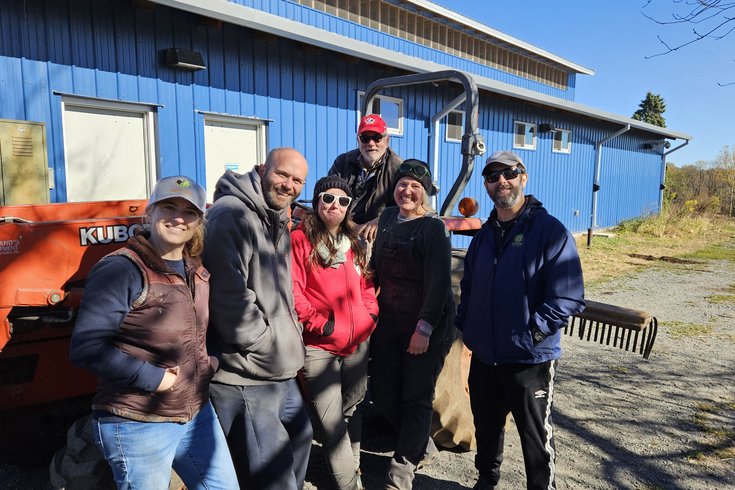
Bennett Compost and Circle Compost will merge operations in 2026. Pictured from left to right are Back to Earth Compost Crew owner Colleen Falicki, Bennett Compost founder Tim Bennett, Circle Compost co-founder Michele Bloovman, Walter B. Saul High School teacher Scott Blunk, Bennett Compost co-owner Jen Mastalerz and Circle Compost co-founder David Bloovman.
For roughly a decade, two private haulers have competed for Philadelphia's compost scraps. But starting in 2026, they're joining forces to collect fruit peels, egg shells and coffee grounds from city households and businesses — and rescue a few million pounds of garbage from landfills in the process.
Bennett Compost and Circle Compost said the merger of their businesses officially began Thursday, bringing their total customer base up to over 9,000. Collectively over the past year, they picked up roughly 5.3 million pounds of food waste.
The two companies have offered compost pickup services since 2009 and 2016, respectively, and long employed a similar business model. Customers who sign up for a subscription at either business get a bucket with an airtight lid to collect their compostable kitchen scraps. Then, on their appointed pickup day, they place their bucket outside their home. A truck or bike stops by to empty the contents and transport them to a site where they can be broken down naturally into nutrient-dense soil. Customers with a green thumb can purchase that dirt at a discounted or comped rate. Residential plans at both businesses range from $13.50 to $28 a month.
One of the easiest ways to distinguish the companies' buckets is by color: Bennett Compost provides white 5-gallon tubs, while Circle Compost favors red. But as the competitors-turned-coworkers are quick to acknowledge, they often coexist on the same block.
"Every single time any one of us does a route, you see Bennett buckets next to Circle buckets," said David Bloovman, co-founder of Circle Compost. "... It's impossible not to think, well, I could be emptying these three Bennett buckets that are right next to these two Circle buckets."
Bloovman said he approached Bennett Compost about merging not out of financial necessity — Circle Compost has grown every year it's been in business, he says — but to maximize opportunity. By combining customers, the companies say they will be able to streamline their routes and cut down on the gasoline their respective trucks burn picking up all those buckets from the same blocks. Circle Compost employees, whom Bloovman says will retain their jobs and current salaries in the merger, will also have more room for advancement at a larger company. While Circle Compost had struggled to secure its own Department of Environmental Protection-permitted composting site in recent years, relying instead on farm partners, Bennett Compost runs two sites and is pursuing a third. This setup, Bloovman said, creates the type of middle management roles he was unable to offer.
"Technically, we've been competing with them since our inception, but I never saw it that way," Bloovman said. "It was never a goal of ours. We had zero desire from the start to have any of their customers change over from Bennett to Circle. The goal was always to get more people composting who were not previously composting. That was always our goal. Our only true competitors are landfills and incinerators."
When Tim Bennett, the founder of the company that bears his name, heard the pitch, he saw his own opportunity to keep composting in the hands of Philadelphians.
"We are looking to make sure that the local composting scene is as strong as possible," he said. "So that the people who are handling composting and talking about composting and making things happen are Philadelphia companies and aren't these larger, multinational corporations."
Nothing will change for customers in the immediate future, both Bennett and Bloovman insist. Pickup days may eventually shift as the companies merge their service routes. Further down the line, they may discontinue some services that Circle Compost offers but Bennett does not. There is no plan to change pricing, according to Bennett.
Apart from figuring out the finer points of the merger, the pair hopes to spend 2026 growing new partnerships. Bennett already contracts with the city to collect scraps from Philadelphia recreation centers and playgrounds, and has a separate initiative to compost food waste from the city's prisons. Signing up more apartment buildings, schools and office buildings is a priority for Bloovman, who will be the director of finance and commercial sales for Bennett Compost.
But both companies have long worked to simply get more people composting. While Bennett acknowledges that he tends to have more customers in wealthier neighborhoods, he doesn't believe interest in composting is limited to certain Philly ZIP codes. His company services all of them, and he's seen "a big uptick in customers" in Kensington since Bennett began a free pilot program in 2024.
"That shows that some of the barriers are just whether people can afford, or believe they can afford, to pay for a trash service or a composting service," Bennett said. "Because the city does pick that stuff up for free. But I think there's this kind of narrative that some neighborhoods, that the people there aren't interested in composting. And every time I go to any group and I'm speaking, whether it's in Mount Airy or Hunting Park or Kensington or South Philly, there are plenty of people who wanna do it. ... I don't think that's grounded in reality."
Follow Kristin & PhillyVoice on Twitter: @kristin_hunt
| @thePhillyVoice
Like us on Facebook: PhillyVoice
Have a news tip? Let us know.