





January 15, 2026
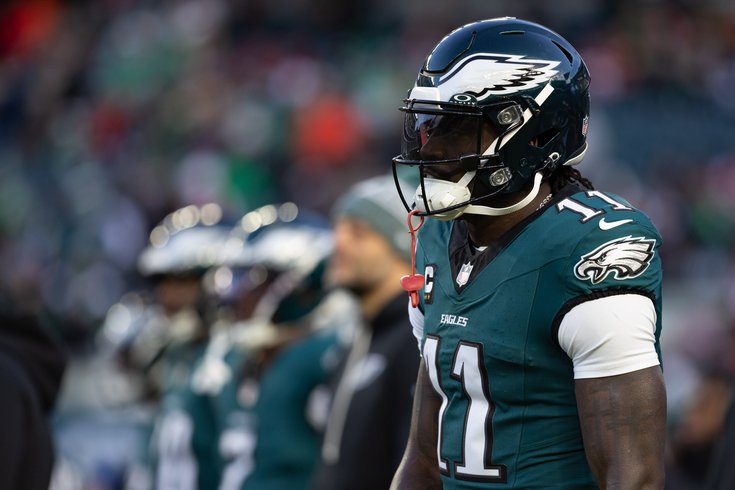
Howie Roseman and the Philadelphia Eagles are going to have a lot of hard decisions to make this offseason, and one of the top things on the list will be figuring out what to do with an unhappy A.J. Brown.
This offseason will be about a month longer than last year's, and the merits of trading Brown will no doubt be a heated debate until a decision on his future with the team is made. But before we get to all of that, let's first examine the financial feasibility of trading Brown, who signed a three-year extension worth $92 million during the 2024 offseason.
If Brown is traded this offseason before June 1, the Eagles would incur a dead cap charge of $43,515,106. Worded another way, he would count for $43,515,106 on the Eagles' cap in 2026, while playing for another team. If the Eagles simply kept him, Brown would count for 23,393,497 on their 2026 cap, and, you know, he would be playing for the Eagles. (The dead cap charge would still be $43,515,106 if he's traded after June 1, but $27,161,609 of it would count toward the 2027 cap.)
That's about as far as some will get in terms of the feasibility of trading him. Michael Ginnitti of Spotrac pointed out that it would be the fourth-largest single-season dead cap hit in NFL history.
So that's it. Untradeable, right?
Nah. "Dead cap" is not a term that should scare Eagles fans.
With the way the Eagles operate within the confines of the salary cap, they are always going to have high "dead cap" numbers. In fact, they've landed in the top quarter of the league in "dead cap" each of the last five years, despite having a pretty good recent hit rate of successful signings relative to the rest of the league.
| Year | Dead cap | NFL rank |
| 2021 | $63,769,525 | 2 |
| 2022 | $64,487,877 | 4 |
| 2023 | $63,868,823 | 5 |
| 2024 | $63,634,011 | 8 |
| 2025 | $85,767,966 | 5 |
| 2026 | $40,359,938 (so far) | TBD |
And, spoiler, they will almost certainly be among the league leaders in dead cap once again in 2026.
One of the great advantages the Eagles have is the way they are willing to structure player contracts. They get use of players now, get charged for their services on the salary cap later.
Let's start with a very simple example. Let's use Mekhi Becton, who signed with the Eagles in 2024 on a one-year deal worth about $5.5 million. Becton counted for about $2 million on the Eagles' cap in 2024, the lone year he played in Philly. He counted for about $3.5 million in "dead money" in 2025, when he played for the Chargers.
Before we continue on with this example, let's first show how the NFL salary cap has increased each year:
| Year | NFL salary cap |
| 2021 | $182.5 million |
| 2022 | $208.2 million |
| 2023 | $224.8 million |
| 2024 | $255.4 million |
| 2025 | $279.2 million |
It has gone up by almost $100 million in five years.
If Becton had counted on the salary cap for the full $5.5 million in 2024, he'd have eaten up about 2.2 percent of the Eagles' cap. Instead, at $2 million, he ate up 0.8 percent.
Becton's remaining $3.5 million counted toward the 2025 cap in the form of a "void year." As the above chart shows, the NFL's salary cap rose by about $24 million from 2024 ($255.4 million) to 2025 ($279.2 million), a 9.3 percent increase. In other words, the bulk of Becton's salary cap charges were paid in a year in which the salary cap was higher, and thus easier to fit.
Let's compare that example to a mortgage. As any homeowner is aware, a mortgage is a loan you get from a lender to finance a home purchase. When you take out a mortgage, you promise to repay the money you’ve borrowed in future years with an agreed-upon interest rate tacked on.
In terms of NFL contracts, spreading out base salaries over several years is similar to taking out a mortgage on a player, in that you get the use of that player now, while paying for him later. The big difference is that NFL teams pay no interest for that right, while interest-free mortgages on houses don't exist.
NFL teams can borrow from future years to expand their current spending ability, again, with no interest penalties, and they all do at least to some degree, but arguably none as much as the Eagles, who employ this strategy with almost every player they sign, drafted rookies or players making league minimums excluded.
So let's bring it back to Brown for a moment.
In 2024, Brown counted for a mere $11,878,894 on the cap. In 2025, it was $17,523,497. The Eagles got a great player's services for low numbers on their salary cap early in the contract with the understanding that they would have to pay more later, but again, interest-free.
Certainly, when they signed Brown to an extension in 2024, they were hoping that he would be a core player for the long haul. Trading him after two seasons is not what they had in mind. Let's not get that twisted. But they also did so knowing that there would be a significant dead cap hit on the back end, no matter how it played out, as they know with all their big signings.
When viewed through that lens, again, "dead cap" should not be the scary term it's made out to be.
For one, the Eagles could still get a high draft pick in return for Brown (duh), and that player will be cost-controlled (and cheap) for four or so years.
But also, after the pain of doubling Brown's cap number in 2026 passes, there will be major savings in 2027, 2028, and 2029, when he is scheduled to count for $133,121,609 on the cap during those three seasons combined. That's over $44 million per season. That's all gone if they were to trade him now.
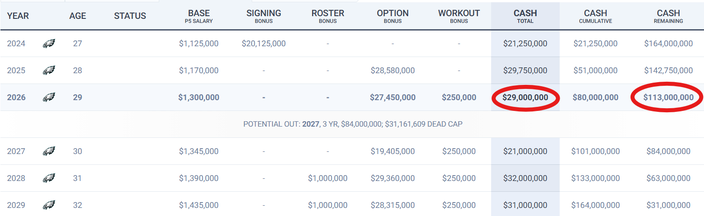
The Eagles would also save $113 million in cash payouts to Brown, including $29 million in 2026. Via Spotrac:
That is money that can go toward signing young star defensive players like Quinyon Mitchell, Cooper DeJean, Jalen Carter, Jordan Davis, Jalyx Hunt, Nolan Smith, etc.
Trading Brown would put a dent in the Eagles' 2026 cap, but there are long-term benefits, and probably a short window in which Brown can attract a high draft pick in return.
So, yes, financially, they can afford to trade him.
*H/T to Sam Lynch for his help with the financials.
Follow Jimmy & PhillyVoice on Twitter: @JimmyKempski | thePhillyVoice
Like us on Facebook: PhillyVoice Sports
Add Jimmy's RSS feed to your feed reader