






April 10, 2026

 Courtenay Harris Bond/PhillyVoice
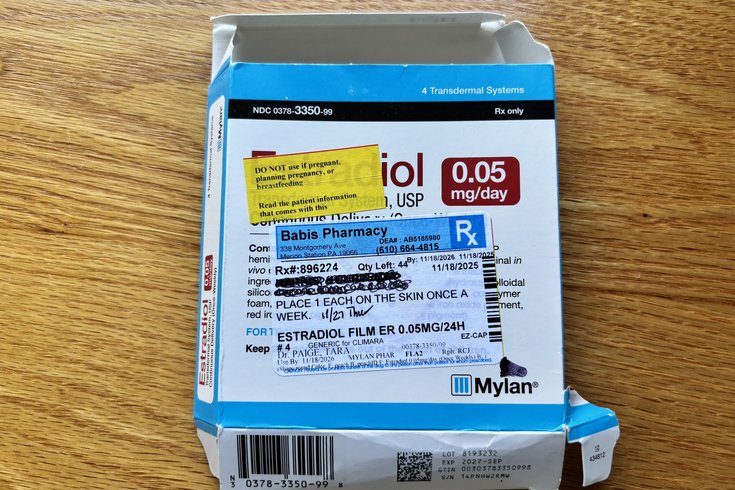
Estrogen patches are in short supply due to shortages and increased demand. More women have been turning to hormone replacement therapy to treat menopause symptoms in recent years.
Women who use hormone replacement therapy to ease menopause symptoms are struggling to get estrogen patches as a nationwide shortage drags on.
Dr. Ryan Elizabeth Offer, medical director of Penn Health for Women at Radnor, said she began hearing from patients who were having trouble filling estrogen patch prescriptions in January.
MORE: U.S. fertility rate dropped to another record low in 2025, CDC report shows
"The demand (for hormone replacement therapy) has increased significantly over the last few years, which is the good news," said Offer, a gynecologist. "The bad news is that we don't have access to the patches at the moment, so we've been doing a lot of … reworking, redosing, cutting patches, trying different formulas."
As of Thursday, the American Society of Health-System Pharmacists listed 20 estrogen patch products as unavailable. And the New York Times reported that prescriptions for estrogen patches jumped 72% between 2021 and 2025.
In November, the FDA removed black box warnings that had linked hormone replacement therapy to a heightened risk of cancer and heart disease, increasing demand for hormone replacement therapy.
But interest in menopausal hormone treatment had been surging for years due to increased media attention on the lack of research about how to help women deal with symptoms, such as hot flashes, sleep difficulties, mood instability and low sex drive. In particular, more women started asking their providers about hormone replacement therapy after a 2023 New York Times story ran with the headline "Women Have Been Misled About Menopause," Offer said.
The story described the four-year-long "biologically chaotic phase leading up to a woman's last period, when her reproductive cycle makes its final, faltering runs," and highlighted how providers often fail to offer hormone therapy as a viable option for coping with menopause symptoms.
"Thankfully, we're having somewhat of a menopause revolution," Offer said. She added that "anyone who takes care of a woman in the general specialty should be able to manage basic menopause.
"Our goal right now is to educate the next generation of residents, and to try to get people who are in practice up to speed, because (treating menopause) wasn't something that was really trained when a lot of us were going through our training," Offer said. "So women's voices are being heard, and it should hopefully become — just like you have routine reproductive care — you have routine midlife care, routine postmenopausal care."
When the shortages of estrogen patches began, Offer said she was hoping they would be short-lived, but now the shortages seem like they may last until the end of the year, Offer said.
Reuters cited industry sources Thursday saying the shortages could last as long as three years.
CVS said in an email that "manufacturers had been unable to provide sufficient supply of hormone replacement therapies (HRT) over the last several weeks. When these manufacturer supply interruptions occur, our pharmacy teams make every effort to ensure patients have access to the medications they need and, if possible, will work with patients and prescribers to identify potential alternatives."
Some independent pharmacies in the Philadelphia region, including Babis Pharmacy in Merion, Montgomery County, and Heritage Pharmacy in Newtown, Bucks County, said pharmacy chains have been referring customers seeking patches to them.
"The beauty of us is we are not stuck with one or two wholesalers," Heritage Pharmacy owner Manoj Parikh said, adding that he has many of the estrogen patch strengths on hand.
"I usually order like 10 or 15 at a time now, when they become available," Parikh said. "The only issue we run into is with the small wholesalers, being the small pharmacy, the prices get jacked up like any other thing. Something's on back order. Price triples. But you still get paid the same amount by the insurance companies. You can't do business that way, but we try to keep all that in mind and kind of shoot for the middle, hoping people will stick with us."