




March 04, 2026
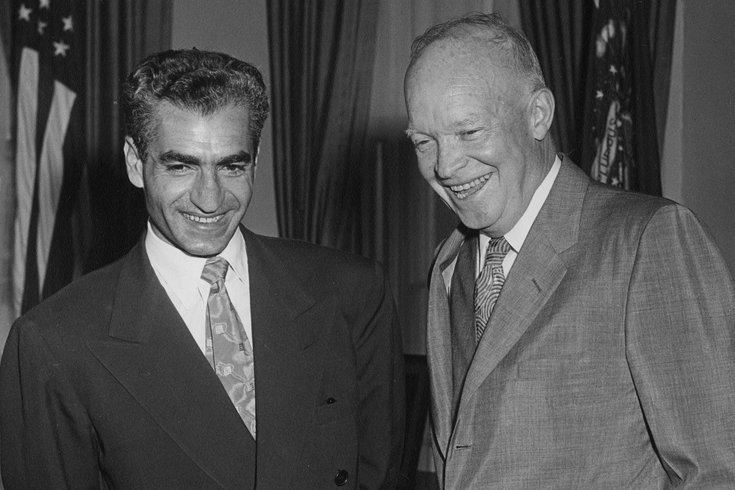 Public domain/National Archives
President Dwight D. Eisenhower meets with Shah Mohammad Reza Pahlavi of Iran in 1958. Eisenhower supported the coup that brought Pahlavi to power.
The U.S. military shocked the globe Saturday by deploying missiles and drones in Iran. The strike, a coordinated effort with Israel, assassinated Supreme Leader Ayatollah Ali Khamenei and killed hundreds. Six American soldiers died in a retaliatory attack on a Kuwait base, leading the United States to shutter embassies in Saudi Arabia, Kuwait and Beirut.
The events of the past few days have fractured an already contentious relationship between America and Iran. Many will remember the 1979 hostage crisis at the U.S. Embassy in Tehran if not from the headlines at the time, then the Oscar-winning dramatization "Argo." The United States also adopted an arms embargo in the 1980s — which the Reagan administration secretly broke, sparking another international scandal — and a trade embargo in 1995. But to really understand how the nation landed in the current situation, a Villanova University historian says, you have to go back even further.
David Barrett, a political science professor at the college, has devoted much of his research to American presidents and the CIA. He argues the 1953 coup which overthrew Iranian prime minister Mohammad Mosaddegh set the stage for how the White House would engage with Iran — and how the Middle Eastern nation would view the United States — for generations to come. Even now, he says, we're feeling the effects.
Barrett explained the cataclysmic event and what followed in the discussion below. It offers a partial, though hardly complete, recent history of U.S. and Iran's complicated relations:
This interview has been edited for clarity, length and flow.
You mentioned how crucial the Eisenhower administration was in understanding this relationship. How was it a departure from how previous presidents had engaged with Iran?
Some people think he was kind of a passive president, but that image didn't really fit reality. He decided with his secretary of state, John Foster Dulles, and CIA director, Allen Dulles, and in consultation with the British, that the government of Iran was heading in a Marxist communist direction and should be overthrown — not by any sort of war, not by the way that we're currently involved in, but by covert action. So the CIA, working with British intelligence, arranged to have a coup carried out, with the installation of the man whose title was the shah of Iran. That was a huge shift in Iran because the leader that we overthrew, in fact, had been democratically elected.
The shah knew that he owed his position, his power, mainly to the Americans, secondarily the British. And so what the U.S. got out of this was a more or less pro-American government. They replaced a government that was somewhat anti-American, not communist, but somewhat anti-American, with a pro-American government.
The Iranian Revolution, which came to fruition by 1979, was very much a response to that. The Islamic government had been in power ever since.
The CIA didn't formally acknowledge its role until 2013. Is it fair to say that Iranians were aware of the American involvement pretty much from the start?
Everyone knew it. I mean, books had been written, the CIA guy who was the top man in charge — actually was a grandson of Theodore Roosevelt, by the way — wrote a memoir about it. So it was known, it just wasn't officially acknowledged, which is kind of crazy.
How did President Dwight D. Eisenhower engage with Iran publicly after that coup?
There was a total pretense on the part of the U.S. government that this coup that happened simply occurred because of the Iranian people and certain Iranian military political leaders. The U.S. had nothing to do with it. … People at the State Department were asked that, and the answer was no, this is an Iranian event. And at the time, the American news media pretty much accepted that.
(Eisenhower) irregularly kept a diary … and he was very pleased because a lot of this comes back to oil and gas, right? Very pleased to have a government that he expected would be more or less pro-American, protecting energy supplies for the United States. So he was delighted that this happened. If you think about it, 1953 was his first year in the presidency. So it put the CIA in good standing with the president because of the success.
Would you say that subsequent presidents were, like Eisenhower, typically saying one thing publicly to or about Iran and then doing something very different behind the scenes?
If you think about John F. Kennedy onward through Jimmy Carter, they simply accepted what they considered the facts on the ground. There was a government of Iran, it was headed by the shah of Iran. We wanted to have good relations. I talked about oil and gas supplies, but also Iran was considered strategically important to the U.S. because of its literal sharing of a border with the Soviet Union. … And so there was a real consistency of, starting with Eisenhower all the way through Carter, the U.S. government treated the shah as a great man, as a great leader.
You had said earlier that the Islamic Revolution was a direct response to the coup. Could you explain a little more about what you mean by that?
The shah had been pushing reforms that, in American eyes and Western eyes, looked good … (but) the Islamic leadership, much of it felt marginalized by the shah. He did not think he was marginalizing them, but, ultimately, he did not tolerate opposition. And so there was discontent with the shah. He had a police force, the Savak, that was repressive toward any sort of dissent. And so what discontent there was in Iran tended to center in the mosque and the Islamic religious leaders.
Others, they hated the shah because of the repression of freedom of expression there. So after the revolution came to fruition at the end of the ‘70s, there was initially some thought in the U.S. that the government will be a kind of a coalition of Islamic radicals, but also secular Iranians who had been in opposition to the shah and the government, we hope, might not be that bad. But then (there was) the break-in to the American embassy in Tehran by students and others, which was a gross violation of international law.
It was absolutely the top story of the day for about a year. And it's really one of the things that led to the defeat of Carter, which is that he did not succeed as much as he tried. The hostages were not out by Election Day in 1980, so he lost to Reagan.
By the way, other presidents have absolutely been bedeviled by Iran. Reagan had this thing called the Iran-Contra affair, where the U.S. government secretly sold armaments to people we regarded, thought, hoped were so-called moderates in Iran without congressional consultation and the idea was to get hostages free. Well, a couple of hostages were freed, but some other people were taken hostage.
The Iran-Contra affair really further made a mess of U.S.-Iranian relations.
Tensions also grew after 9/11. Why did President George W. Bush include Iran in his Axis of Evil?
I think Bush was responding to both the current events and things that had been happening for previous years. It's not like Iraq under Saddam Hussein and Iran had good relations. There was an Iraq-Iranian war, which was horrible, and I think Americans know nothing about that. But that was sort of ongoing. There was this tendency in the Bush era when he talked about the Axis of Evil to sort of single out the most, in our view, vicious opponents of the U.S. who, in turn, had extremely repressive governments. Iraq, Iran, North Korea.
I think Bush was using that phraseology to appeal to the public to support his foreign policies, to call them evil. However, it doesn't amount to a strategy. It just doesn't.
When President Barack Obama took office, there was this new emphasis on nuclear de-escalation. Could you speak to that?
In the Obama era, there was some hope that there were ways to moderate the relationship between the U.S. and Iran, with the hope that the Iranian government would become, in our views, a more responsible actor and might evolve in a more democratic direction.
I have read about the diplomacy that was just recently carried out between the U.S. and Iran, and I was reading about how (the foreign minister of) Oman, who sort of was facilitating the negotiations, was very unhappy that the Americans sort of just gave up on these very recent negotiations with Iran. He thought that things were progressing slowly. There obviously was a greater emphasis on diplomacy in the Obama era, and I suppose that's fair to say about the Biden era, than in the Trump era.
Do you think that disappointment you referenced is widespread?
Usually what happens is that when the U.S. is involved in some kind of foreign policy crisis, in the short run, the public rallies around the president. I don't see this happening currently because I think it's quite obvious that President Donald Trump chose to take the U.S. into this war without any real congressional authorization.
How would you describe the current administration's strategy in Iran?
One of the things I say to my students is that while it’s true government leaders very often distort or accentuate the positive to the extent that they're lying, we should look carefully at what they actually do say and think about it. In this case, the tricky part is we've had a number of justifications in the last three days for the war from Secretary of State Marco Rubio and Trump and Vice President JD Vance and others. President Trump has made various statements giving differing emphases. You know, there was this one statement where he said the goal of this war is to bring about freedom and peace in the Middle East, and even in the whole wide world.
We're not gonna get peace in the Middle East, I don't think, from this war. The U.S. (could) obliterate most, maybe not all, of their military assets. But then there's the question of democracy and freedom. I just don't know what's coming in Iran. … Is this a war of regime change? Is that what this is all about?
Rubio said the most remarkable thing, which is that, well, Israel was going to attack Iran soon. And knowing that Iran would probably then attack certain American forces in that part of the world, we had to join Israel in attacking Iran as a way of a preemptive defense. And I just think that's a very interesting thing that he said because he's sort of saying we’ve simply deferred to Israel. They're gonna go to war with Iran. We have to join them. And I'm thinking, who's the senior partner in this diplomatic relationship?
We've touched on a lot of things here, but is there any other event or maybe administration's decision since the coup that you feel like is key to understanding where we are now?
We really under President Richard Nixon and Secretary of State Henry Kissinger did solidify relations, strong relations. Strong sharing of intelligence, and giving lots of foreign aid. The Nixon era was kind of the full flowering of strong relations between Iran, the shah of Iran, and the U.S. government. And so after that, Gerald Ford and Carter were just carrying on after Nixon having this close relationship. Iran was important to us. They served as a listening post for the U.S. in the Cold War context. The shah mattered to the U.S. government to a very great degree because of the way that his country allowed U.S. intelligence to place not only human assets, but technological assets there. And we lost that with the Iranian Revolution at the end of the 1970s.
Follow Kristin & PhillyVoice on Twitter: @kristin_hunt
| @thePhillyVoice
Like us on Facebook: PhillyVoice
Have a news tip? Let us know.