




February 09, 2026
 Bill Streicher/Imagn Images
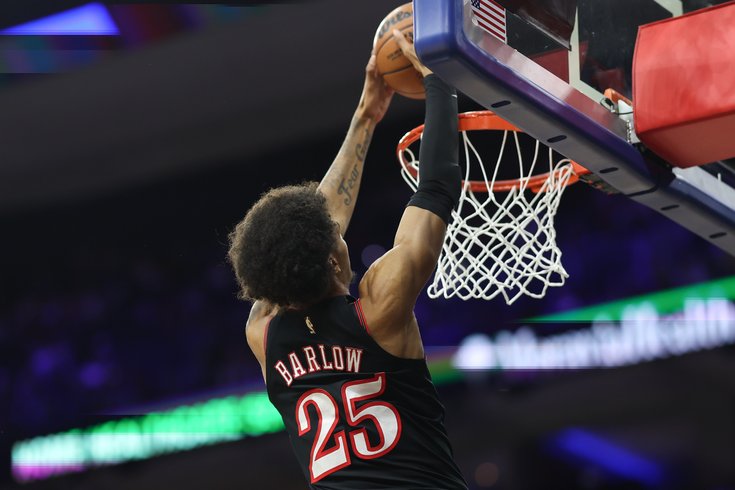
Dominick Barlow has been an impactful piece from the very start this season.
After a recent Sixers home victory, a host of reporters huddled around VJ Edgecombe's locker as the rookie guard spoke. We all held our phones as close to Edgecombe as possible, looking to secure the highest-quality audio possible. Dominick Barlow walked across the locker room and stood to my right, lifting his arm in Edgecombe's direction as if he was holding a phone up. Barlow's wingspan is listed at 7-foot-3, which is a bit longer than mine. So I handed Barlow my phone and he recorded the remainder of Edgecombe's availability.
Moments later, I explained to Barlow that I would have a much easier time transcribing the interview thanks to his efforts. A colleague walked over and jokingly asked Barlow if he was pursuing a career change to sports media, informing the 22-year-old that it would require him taking a tremendous pay cut.
Before leaving, Barlow quipped that he was currently working on getting a raise. And on Thursday, he did, putting pen to paper on the standard contract it has been abundantly clear he would receive for months now. Barlow's deal covers the remainder of this season with a team option for the 2026-27 campaign, a source told PhillyVoice after it was signed, and reporting has recently emerged that Barlow will earn much more money over the life of the deal than previously anticipated.
As we kick off another week with 5 Sixers thoughts, a reminder of how Barlow got to this point and an exploration of his unique deal before focusing on Jared McCain's first few days with the Oklahoma City Thunder and more thoughts on the Sixers' evolving rotation at power forward:
If 100 Sixers fans were asked what has been most impressive about Barlow's first season with the team, there would only be one answer: offensive rebounding. It was the main subject of head coach Nick Nurse's prolonged comments about Barlow's impressive start to training camp after the team's very first practice, and it is clearly his primary focus when the Sixers have the ball.
And while Barlow's offensive rebounding percentage of 10.3 percent is quite good, it is not exactly an elite figure. In fact, it would be Barlow's third-highest offensive rebounding percentage across his four NBA seasons. Barlow's offensive rebounding actually feels much more noticeable and impactful in games than it looks statistically. Why is that?
The answer: the Sixers do such a tremendous job capitalizing off of Barlow's crashing that every individual offensive rebound he collects is far more likely to lead to a basket. On a team full of high-volume shot-takers, all Barlow is focused on offensively is ensuring those players have as many opportunities to fire away as possible,
"In the simplest terms, we love to find a bunch of guys that will go chase Tyrese and VJ and Joel's misses and give it back to them, and he does that job really well," Nurse said on Jan. 29. "...Those are huge plays. Those are not only an extra possession, three points, but they're kind of spiritual plays, too. They give the team a big spirit lift. So it's good. He's got a knack for the ball and continues to play hard. Kind of plays good about every time we throw him out there."
Every time Dominick Barlow has grabbed an offensive rebound and immediately collected an assist as a member of the Sixers: pic.twitter.com/r5ooL9xdBU
— Adam Aaronson's clips (@SixersAdamClips) February 8, 2026
On Jan. 30, Barlow talked through his mentality once he has collected an offensive rebound. It is quite simple.
"Most teams are crashing, so unless a put-back is clear, personally I think that the best decision is usually a kick-out," Barlow said. "Everybody's in the paint and somebody could be wide open, maybe a good shooter. But you've just kind of got to read it and see it and find the open man."
MORE: Sixers future draft pick tracker
Barlow's new contract including a team option for next season is not surprising; it is the same structure the Sixers used with Justin Edwards and Jared Butler last season. While the team opted to let Butler go, it declined Edwards' option to re-sign the hometown kid on a longer-term pact. They could do that with Barlow, but if those negotiations are fruitless, they will have the team option to fall back on and ensure they secure at least one more full season of his services.
What is unusual about Barlow's deal is not his $3.4 million team option for 2026-27, but his $3.4 million salary for the remainder of 2025-26. It is a significant payday, roughly four times what Barlow would have made if his new deal came at the minimum salary as do many of the deals signed by two-way-turned-standard players.
The value of Barlow's $3.4 million prorated salary for the remainder of 2025-26 is on par with a full-season salary of nearly $9 million. It puts the Sixers much closer to the luxury tax threshold than previously realized, but with nearly $1.6 million in breathing room the Sixers should not have much difficulty filling out their two soon-to-be open roster spots with prorated minimum deals.
MORE: Morey on inactive deadline, Paul George suspension, luxury tax, more
Shortly after Sixers President of Basketball Operations Daryl Morey spent a significant chunk of his 29-minute media availability explaining his decision to trade McCain – including a controversial comment that he is "quite confident" that the team "sold high" on the 21-year-old guard – McCain met with reporters in Oklahoma City for the first time. His full availability is below, with transcriptions of his three Sixers-related answers:
Here's Jared McCain's first media availability in OKC from Justin, who is a must follow if you want to keep up on McCain moving forward. He got asked three Sixers-related questions: https://t.co/UhDE5jf5PR pic.twitter.com/8eTXzgxR9j
— Adam Aaronson (@SixersAdam) February 6, 2026
On Saturday afternoon, McCain came off the bench for an injury-decimated Thunder team on national television against the Houston Rockets. He received an enormous ovation from Thunder fans and ended up scoring his first points in Oklahoma City with the bump mid-range jumper he likes:
Jared McCain comes off the hand-off & hits the mid-range step-back for his first Thunder bucket. pic.twitter.com/pka12JbLxC
— Thunder Film Room (@ThunderFilmRoom) February 7, 2026
In just two partial seasons, McCain has played in front of two of the most passionate groups of fans in the NBA. Exactly how he will fit into Oklahoma City's loaded rotation once the Thunder reach full health remains to be seen.
When the Sixers traded their fourth and fifth guards in McCain and Eric Gordon without bolstering that group at all, a lot of focus on the team's sudden lack of depth there ensued. Nominally, 39-year-old Kyle Lowry is the Sixers' fourth guard now. The Sixers could be in serious trouble if Tyrese Maxey, VJ Edgecombe or Quentin Grimes goes down; all three guys need to be even better and more durable than they already were.
In reality, the Sixers' fourth guard is a 6-foot-8 point forward. It is Trendon Watford, who is finding his stride at the right time. His minutes have been very strong of late, and now that he finally seems to have created some semblance of continuity with the guys he is sharing the floor with he is finding ways to impact the game despite his unorthodox style. Watford is not cut out to be a primary offensive initiator throughout an entire game, but he can certainly do it in spurts.
Watford gave the Sixers much better play in Saturday's win over the Phoenix Suns than his line in the box score might indicate, and much of it stems from the value that comes from another steady hand on the ball. Watford can get the Sixers into their stuff; what is just as important is that every time Watford kickstarts a possession it saves someone like Maxey the trouble of doing so. Watford is also, slowly but surely, figuring out the nooks and crannies of life as Embiid's teammate:
A super interesting play: Trendon Watford screens for Joel Embiid and ends up getting the ball back from Embiid in a 2-on-1 and finds a cutting Dominick Barlow for an and-one: pic.twitter.com/da9iNWABuQ
— Adam Aaronson's clips (@SixersAdamClips) February 8, 2026
Perhaps the most obvious beneficiary of McCain's departure is Grimes, whose status as the Sixers' third guard is now going to be unimpeachable for the remainder of the season regardless of how he plays. But it has also turned Watford's skillset from somewhat of a luxury to an obvious necessity.
A wise gamble pays off for Justin Edwards to get the Sixers out in transition, where Trendon Watford notches a no-look assist: pic.twitter.com/h28oMo8izG
— Adam Aaronson's clips (@SixersAdamClips) February 8, 2026
Watford's pass-first style remains the headliner of his minutes, but what has separated his play during this recent surge is that he is showing some scoring aggression to keep defenses honest and punish mismatches. Watford has a solid post game that Nurse has liked to lean into every now and then, as well as a floater/push shot game that he feels comfortable with. Watford is rounding back into form, and the timing is ideal for the Sixers.
It once felt close to inevitable that Walker would receive a standard contract just like Barlow. The Sixers used up the 23-year-old's 50 games of availability in their first 50 games of the season, and he was the only player to dress for all of those games. But now, Walker remains with the team but in street clothes during games.
Will the Sixers consider using one of their last two roster spots on a deal that gets Walker back into uniform? Morey was surprisingly noncommittal in response to that question:
"For sure. I have to reference the CBA we all live under. It's sort of annoying, I'll use the word, that just how it all works, that Jabari can't play for some games here. But he's obviously been part of our ‘next man up’ mentality. I think Coach Nurse has done a good job, when we've had players in and out, which we've had less of this year, but we've still had quite a bit, especially with recent Paul news, things like that. He's been a tremendous next-man-up type contributor, and we hope to have his services, but we do have to weigh optimal use of our scarce two roster spots, and against the other opportunities as well. So that will be written over time, whether or not we do that conversion."
What happens if the Sixers find two players on the buyout market they deem more helpful pieces than Walker? Well, he would simply be out of luck. Walker is ineligible to play on a two-way contract for the Sixers again, no matter what. Would he spend the rest of the season playing for the Delaware Blue Coats then? That is perhaps an answer, but there would be no use for the Sixers to hold onto Walker for two-plus months when he cannot help them at the NBA level.
If the Sixers do not end up signing Walker to fill one of their last two standard roster spots, they probably should waive him. Even a player signed to a two-way contract near the end of February can at least be active for a handful of games. Maintaining Walker's non-Bird rights is likely not very valuable, especially considering the unlikelihood of him wanting to stay with a team that put him on ice for multiple months.
MORE: After anticlimactic deadline, who could Sixers poach from buyout market?