


March 19, 2026
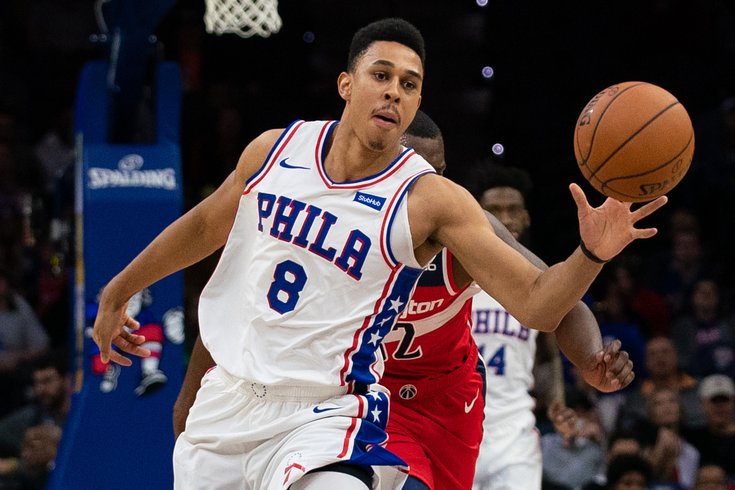 Bill Streicher/Imagn Images
Zhaire Smith's place in Sixers lore may be infamous. But Smith, now 26, is grateful for a challenging experience in Philadelphia.
Welcome to Sixers Memory Lane, a periodic series of stories in which moments, games and storylines of Sixers past are revisited and explored. From events that fans only vaguely remember to ones they do not know about but should, these stories will take readers back in time and provide fresher perspectives regarding what took place.
Up first: on Zhaire Smith, a failed first-round pick of the Sixers in 2018 whose career took a tragic turn when a near-death experience – an allergic reaction – derailed his chances of sticking in the NBA.
Smith, now 26 years old, has remained around the NBA since being traded by the Sixers after two shortened seasons, logging many appearances in the G League. He now plays for the OKC Blue, who visited the Delaware Blue Coats last week. Smith has yet to step on the floor for a regular-season NBA game for another team.
After facing the Blue Coats, Smith spoke with PhillyVoice about his unusual and devastating early-career adversity, why he is at peace with what happened to him in Philadelphia, his continued hope of breaking through into the NBA and more.
WILMINGTON, Del. – Zhaire Smith was just happy to be back home. Returning from the hospital after his two-month stay caused by a frightening allergic reaction, Smith was eager to get back on the basketball court. He had already lost plenty of time during his rookie NBA season.
Then he looked in the mirror. What he saw shocked him.
"It's very scary, looking back in hindsight. When I was in it, I didn't know about it. I didn't know I lost that much weight until I got home out of the hospital," Smith said. "I'm still thinking I'm in my normal form, until I looked in the mirror and I was just skin and bone. I was like, 'Wow.' So that made me work harder. But looking back in hindsight, it was just a wild story. I don't think it's – I've really never heard of [an NBA player] being in the hospital for two months – and that just shows that I grinded and persevered through all adversity."
Smith's allergic reaction forcing him into a hospital bed for months is infamous these days. It is not as if Smith needed more adversity in his life at that time. He was already sidelined due to a broken foot, which was going to delay the start of his rookie season. As he was recovering from that injury, his sesame allergy nearly killed him and complicated his rehabilitation process.
It was only when he finally got out of the hospital that Smith learned, in the hardest of ways, that he had lost 40 pounds.
Remarkably, Smith actually went on to play that season. His action was not limited to the NBA G League; he ended up logging six appearances for the Sixers near the end of his rookie season, plus another two in the playoffs. There was not much to make of a small sample of minutes, but he had finally worked himself back onto the court. It was an accomplishment during a lost year.
The first shot attempt of Zhaire Smith's NBA career: pic.twitter.com/k8Qq6rFgWF
— Adam Aaronson's clips (@SixersAdamClips) March 18, 2026
Smith's second season had an uninspiring start; he spent most of his time in the G League. He made seven appearances midway through the season. COVID-19 hit, and before the Sixers and 21 other teams entered the "NBA Bubble" in Orlando, Smith suffered a knee injury. He did not go to Orlando with the team. In the ensuing offseason, he was dealt to Detroit and waived. He did not play again until 2023, when he joined the Cleveland Charge. Smith spent two seasons in Cleveland, where he did earn one 10-day contract with the Cavaliers but never got into a game, then was briefly with the Texas Legends, the affiliate of the Dallas Mavericks.
Now, Smith is with the OKC Blue. He is averaging 20.8 points, 5.2 rebounds, 4.6 assists and 1.7 steals per game with the Blue, shooting 56.6 percent from the field and 41.8 percent on threes. They are impressive numbers, but the G League has become more prone to eye-dropping numbers in recent years.
Smith's journey sounds very much like an NBA cautionary tale, the sort of story players live in fear of as they enter the league. But as he discussed it, Smith smiled and demonstrated that he is genuinely at peace with it all. He even went as far as to say he was glad all of those things happened to him because they enabled him to get "closer to God."
"It was out of my control. During that time, I got closer to God. And I'm glad that happened. If that would have never happened, I probably would've never gotten closer to God," Smith said. "...Whatever happens, happens. The goal is the NBA. If not, I just trust in His plan and I'm at peace with it... When I was out for three years, I didn't know if I was going to play. There were times I couldn't walk, couldn't jump, and I'm like, 'Is this it?' When I got closer to God, I prayed to Him. I said I'd do the right thing, I'd transform my life, and if I get another opportunity I won't take it for granted. So every time I play on that floor, I give it my all, 110 percent. Because I know it could be taken any second."
As if a failed first-round pick did not sting enough for a Sixers team trying to build around emerging superstar Joel Embiid and young running mate Ben Simmons, the opportunity cost of acquiring Smith will never be lost on Sixers fans. Even more than they remember what Smith was with the Sixers – a developmental project which never panned out – fans focus on what Smith was not: Mikal Bridges, the NBA-ready wing out of Villanova, who grew up cheering for the Sixers and Phillies, and whose own mother worked for the organization.
Armed with the No. 10 overall pick in the 2018 NBA Draft, the Sixers selected Bridges. Their fans were thrilled. He was a sure thing. But, right in the middle of his first press conference as a member of the Sixers, news broke that Bridges had been traded. The Phoenix Suns had the No. 16 pick, and offered it to the Sixers with an unprotected 2021 first-rounder in exchange for Bridges. With head coach Brett Brown leading the front office on an interim basis, the Sixers described Bridges and Smith as options 1A and 1B, with the former being considered a safe bet and the other viewed as an upside play.
The additional first-rounder tipped the scales in favor of Smith. Then it was traded as part of the valuable package of assets the Sixers parted with to land Tobias Harris. Neither player was better than Bridges. It is one of the most infamous sequences of deals in Sixers history.
In the orbit of the Sixers, Smith is always viewed in contrast to Bridges. Has he followed Bridges' career closely? He said "not necessarily," but made a point to clarify that he would never root for someone else to fail.
"I really don't keep up with people," Smith said. "...I wish everybody success. I'm not in competition with anybody. But if any man can do great, I'm not hating on him."
Smith's focus is all on himself, and it has to be. His road back to the NBA remains an uphill battle. But on Friday night in Delaware, he played like the best version of himself, the unconventional and effective player the Sixers were intrigued by coming out of Texas Tech. Smith said he "most definitely" feels more like that player now – "probably even better."
While Smith's jump-shooting mechanics look as odd as ever, he has made considerable progress in terms of three-point accuracy. And he is doing the things that made him a unique prospect at 6-foot-4: setting screens, making plays out of the short roll and impacting the game as an offensive rebounder.
Smith swung Friday's game in the Blue's favor by dominating in all three of those areas, totaling 21 points on 9-for-12 shooting from the field, grabbing all three of his rebounds on the offensive glass and sealing a victory with a put-back bucket. Afterwards, he smiled at the implication it looked like a 2018 Texas Tech Red Raiders game. The player he was then is the foundation for who he is now. But with eight years of growth and maturity comes progression.
"I feel like I've grown in all aspects of my game," Smith said. "The shooting; that was a big deal coming out of college. Pace; I used to just go one speed. Defense; just knowing the schemes and really using my IQ, because there's a lot of talented guys, and I was always the most athletic... you've got younger guys coming in [who are] more athletic, so you have to just use your IQ of the game. So my IQ has expanded as well."
Smith laughed as he discussed becoming a mentor of sorts for some of OKC Blue's younger players. After all, he had just mentally transported himself back to his time as a 19-year-old with an injury and an allergy, just trying to find his way.
"I came in this league 19 [years old and am] 26 now, so I grew a lot," Smith said. "Just learning aspects of the game – of the NBA game, NBA G League game. So my first two seasons here, I had a lot of learning to do. Now, I'm teaching."
Smith's goal of returning to the NBA is not yet complete, and he is willing to go overseas if the financial considerations become too significant to ignore. But he has a family now, and his dream remains here. He feels he is in the right spot, as the Thunder have a stellar reputation when it comes to player development. Smith, who said "I love it here," hopes to either become the next Oklahoma City success story or use this opportunity as a launching pad to another organization eager to give him a chance.
Smith is grateful for the situation he finds himself in, and after all he has been through, that is a victory in itself. He has found a way to be grateful for the unfortunate turn of events that has made his road back to the league such a long and challenging one. He does not yet have the desired result of his years of dedication, but he is grateful for what he does have: his health, and the ability to step onto a basketball court and feel like himself.
"When I was out for three years, I didn't know if I was going to play," Smith said. "There were times I couldn't walk, couldn't jump, and I'm like, 'Is this it?' When I got closer to God, I prayed to Him. I said I'd do the right thing, I'd transform my life, and if I get another opportunity I won't take it for granted. So every time I play on that floor, I give it my all, 110 percent. Because I know it could be taken any second."
Smith has matured a lot, and he completely understands his place in Sixers lore. He is appreciative that most fans do not vilify him – "even if they were doing that, it's just their honest opinion," he said – but he is not the generic draft bust. He did not decide he wanted to leave Philadelphia after crumbling under pressure like Simmons. He is a sympathetic character in the long, twisted story that has been the last decade-plus of Sixers basketball. He has largely been discussed as the victim of brutal circumstances.
"It means a lot," Smith said. "If I come on this court every single time and give my 100 percent, fans respect that, and I feel like that's what they did. They say, 'He came in and played hard. He just had adversity.' And this is a tough, hard-working, blue-collar city. So they like that."
Smith has moved past what happened to him while he was with the Sixers, but it is a fundamental part of who he is and the career he is still trying to get back on track. To some degree, he carries his time in Philadelphia with him, and if he achieves his goal of getting back into the NBA, he will have done it at least in part because of his motivation sparked by how his Sixers tenure went. And, years later, he has some Sixers fans in his corner. After all, Smith said, there is "nothing like Philly love."
"They're always going to have that attachment," Smith said. "I'm always going to have that attachment. I love Philly fans."