

March 20, 2026
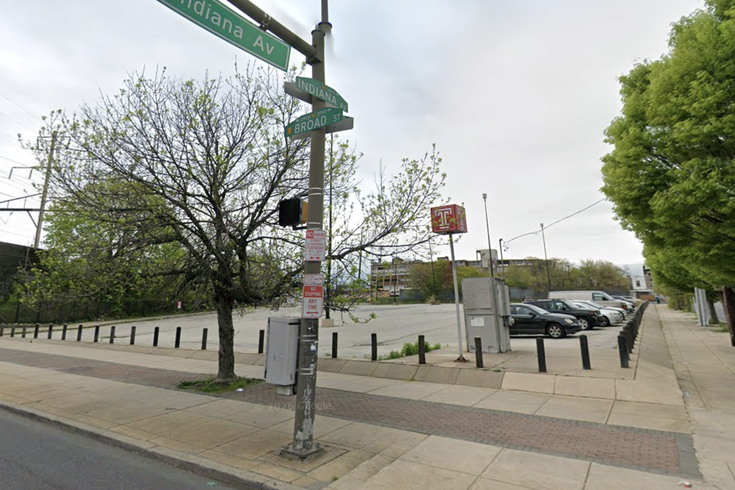 Street View/Google Maps
Temple University is partnering with Shift Capital and Essence Development to create the North Station District near the Amtrak station in North Philadelphia. Future plans would include building homes on the parking lots shown above at Broad Street and Indiana Avenue.
Temple University plans to partner with a pair of developers on a long-term plan to revitalize the former industrial area surrounding Amtrak's North Philadelphia station.
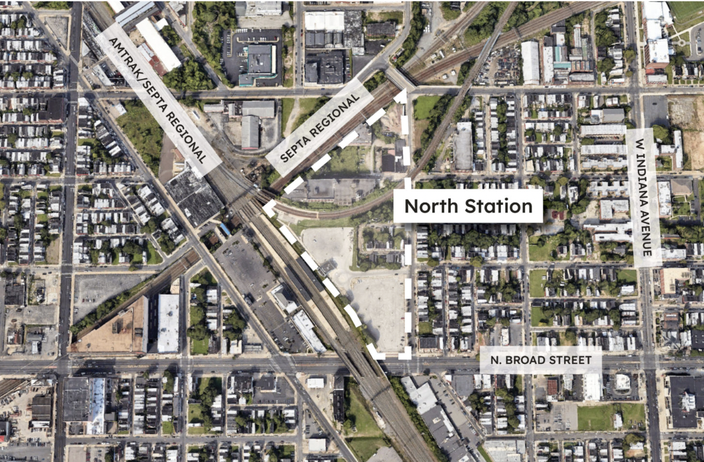
The proposed North Station District spans about 6 acres on a wedge of lots just off Broad Street, between Indiana and Glendale avenues. Amtrak's station, a little less than a mile north of Temple University Hospital, serves the regional Keystone line that connects Philly with Harrisburg and New York City.
The mixed-use project, led by Shift Capital and Essence Development, is the latest attempt to harness the potential of a section of North Philly that has long lacked investment. The two developers, known for their missions of equitable growth, have been in conversations with Temple over the past few years to bring the university into the fold.
"Temple is very interested in housing and, in particular, workforce housing," said Julia Limongello, development manager at Essence Development, which has offices in Philly and New York. "They are trying to provide opportunities for their faculty and staff to live nearby campus. And with our proximity to Temple Health, a lot of priority right now is determining their needs."
Temple President John Fry, who championed neighborhood development projects during his years leading Drexel University, said the partnership with Shift and Essence will "accelerate the revitalization of North Philadelphia" by expanding access to jobs, transit and housing.
The properties surrounding the Amtrak station include several parking lots and vacant industrial buildings that could be restored for commercial use. Shift and Essence purchased the parking lots in 2023 along with the vacant, six-story Ink Factory building at at 2935 N. 16th St., which is adjacent to SEPTA's Chestnut Hill West Line. The developers later bought another parcel that includes three buildings near the corner of 16th Street and Indiana Avenue.
An aerial map shows the triangular area where the North Station District would be built in North Philadelphia in the coming decade.
Planners envision the North Station District becoming part of a research triangle that complements the transit and employment hubs of University City and the Navy Yard in South Philly.
"The goal of this project is to revitalize that area, similar to how Boston has two very well-known and well-used transit locations," Limongello said. "We're trying to bring back and get the North Philadelphia station hopefully on par to what's at 30th Street. We're a little bit closer to New York City, so we're really trying to reinvigorate this area to be part of the broader Northeast Corridor."
In the years before the COVID-19 pandemic, New York-based developer HMZ Group had plans to construct a series of apartment buildings on the site and repurpose vacant properties as spaces for light manufacturing and startups. Plans went before the city's civic design review panel, but the project never materialized and the properties were later put on the market. HMZ had purchased the lots from Amtrak and SEPTA.
Over the next decade, Shift and Essence are hopeful that the economic climate will support large-scale development of the site. Limongello cited Mayor Cherelle Parker's proposal to expand incentives for home-building around transit hubs and her broader initiative to expand housing.
"There's a growing recognition that North Philadelphia deserves some sustained investment, so we're trying to capitalize on that right now," she said.
Temple did not respond to requests for an interview about the university's role in North Station District and what resources the university might provide.
In January, Temple laid out a 10-year strategic plan that includes adding a new residence hall, building STEM facilities and creating campus green space. Fry framed the campus development plan as part of a broader push to strengthen community relationships, economic development and public safety in North Philly.
The developers behind North Station District say Temple's participation fosters a public-private partnership that can address some of the university's priorities.
"Most of their faculty, staff and even students — especially graduate students — do not live in the North Philadelphia area," Limongello said. "They live in Center City or beyond, so Temple is trying to fill that gap where it's needed."
Shift Capital has been an active developer in North Philly and Kensington, where it opened the Maken North and Maken South industrial studios a decade ago in a pair of formerly vacant buildings. The facilities offer work spaces for ceramists, metal sculptors, furniture makers and other creators.
The firm's most anticipated project has been the yearslong effort to repurpose North Philly's Beury building — known for its "Boner4Ever" graffiti — at the intersection of Broad Street, Erie Avenue and Germantown Avenue. Plans to convert the 14-story, Art Deco building into a Marriott hotel were paused two years ago when a key lender backed out of financing the project.
Shift Capital said it is still working with the city and other local partners to move the Beury building project forward, but gave no further updates.
North Station District's early phases likely will involve adapting the Ink Factory building and other vacant structures, which could be used for additional spaces for creators. The parking lot sites along Broad Street would primarily be developed into residential buildings and retail during the later stages of the project.
"Our main focus is equitable growth, thinking intentionally about workforce opportunities," Limongello said. "We're trying to have housing at a range of price points that works for the surrounding communities and Temple. The goal is to create pathways for existing residents and businesses to benefit. We want to create a place that's distinctly North Philadelphia and really rooted in that community."