



December 16, 2025
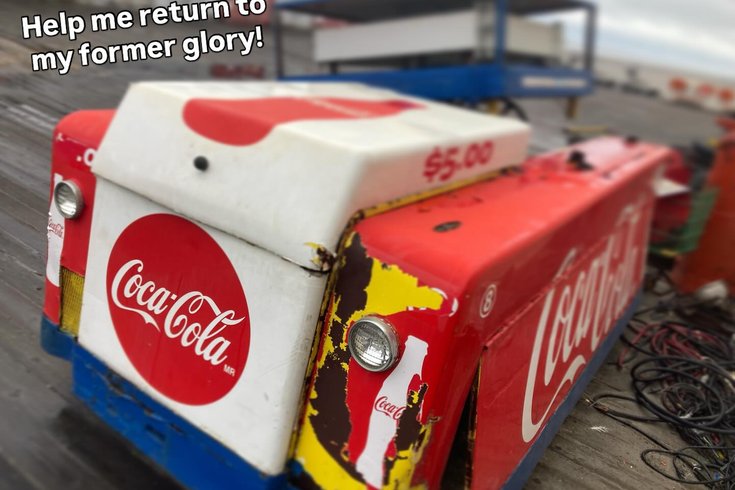 Provided Image/Wildwood Historical Society
A 1963 tram car from the Wildwood Sightseer tram is being restored to its original condition with plans to display it at the George F. Boyer Historical Museum. The Wildwood Historical Society, which saved the rusted vehicle, is raising money to pay for the project.
An engine car that once pulled the Wildwood Sightseer Tram was spared from the scrapyard recently by the city's historical society. Now the organization is raising money to restore the boardwalk heirloom to become a museum piece.
The 1960s-era Tram Car No. 8, one of Wildwood's last remaining traditional vehicles, was retired at the end of the summer. Since then, it has been in storage on Hunt's Pier with plans for it to be junked. Wildwood started testing using Ford Maverick hybrid pickup trucks to power some of its tram cars on the boardwalk during the summer, part of a plan to eventually replace the eight battery-operated tram engines that have been in service for decades.
MORE: Distillery to open in stables of Gilded Age mansion on Elkins Estate in Montgomery County
When the Wildwood Historical Society learned the old tram engine was going to be scrapped, they stepped in last week and had it hauled it across town to a fabrication studio. The plan is get it back to its original condition and put it at the George F. Boyer Historical Museum on Pacific Avenue.
"The tram cars hold a special place in the hearts of Wildwood residents and visitors," historical society president Taylor Henry told the Wildwood 365 blog. "We're thrilled to have the opportunity to preserve one and share it with the community."
The Sightseer Trams have carried more than 20 million passengers along a 2-mile stretch of the Wildwood Boardwalk since 1949. The original tram cars were built by Greyhound for the 1939 New York World's Fair before they were bought and repurposed for Wildwood. The city overhauled the fleet in 1963, ordering three new tram cars that were fabricated in Camden. The boardwalk still has engines in operation from every generation, including the most recent fleet upgrade in 2007.
Tram Car No. 8 is rusted and still wrapped in Coca-Cola decals that were part of a branding deal in years past. The historical society wants the tram engine restored to its original blue and yellow colors, and when it's on display, allow museum visitors to hop aboard. A button will play the famous, "Watch the tramcar, please" warning. Floss Stingel, the woman who recorded that message in 1971 sued the city last year seeking compensation for the use of her voice.
Money raised by the Wildwood Historical Society will cover the engine's restoration along with the costs to transport the tram car and create the display for it at the museum. There's also the expensive problem of getting the tram inside the historical society's building: Henry told the Cape May County Herald the entrances to the museum are not big enough to fit the tram car.
"We are going to have to make a large opening, like a garage or warehouse door," he said.
The historical society is selling 2026 calendars at $16.99 apiece with photos showcasing Wildwood's history to help cover the expenses. Other purchases from its website and direct donations also go to the cause. The organization's officials did not say how much the project will cost or how soon the tram car might be displayed.
Since 2004, the Sightseer Tram has been operated by the Wildwoods Boardwalk Special Improvement District, which donated Tram Car No. 8 to enable its restoration. Patrick Rosanello, the district's executive director and mayor of North Wildwood, explained in the spring that maintaining the original fleet would not be economically feasible in the long term. To build replicas would cost $200,000 per engine, he said, and keeping them in order would require specialists from out of state.
"With a system this old, it's a perpetual project," Rosanello explained in May. "You're always doing something."