




July 31, 2025
 Provided image/Mural Arts
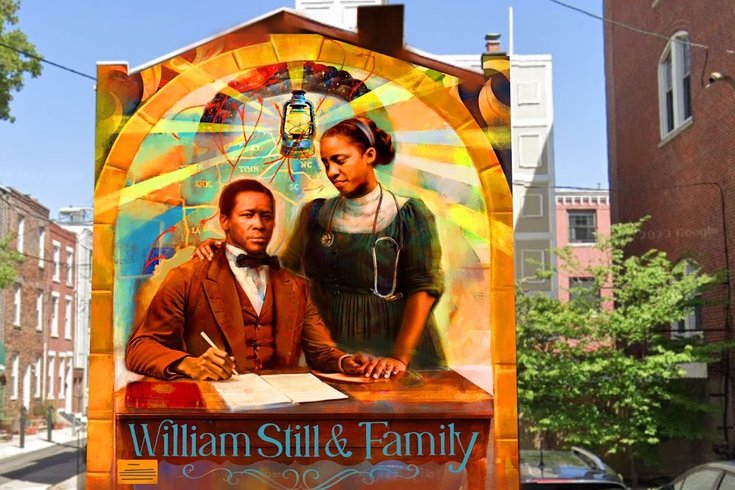
A rendering of the new 'William Still and Family' mural in Bella Vista. The portrait includes the abolitionist, who helped nearly 1,000 people escape on the Underground Railroad, and his daughter Caroline Still Anderson, one of the first Black female physicians in the country.
A freshly painted mural on the side of the brick building at 625 S. Delhi St. shows a man seated at a desk, pen in hand as he records information. Standing next to him is a woman with a stethoscope around her neck, her hand placed affectionately on his shoulder.
The man is William Still, the abolitionist activist who helped lead hundreds to freedom through the Underground Railroad. The woman is his daughter Caroline Still Anderson, the first Black licensed physician in Philadelphia — and one of the first Black female doctors in America.
This Mural Arts project pays tribute to the remarkable family, which also included Still's son Robert George, the first Black Democratic candidate for City Council in Philadelphia; elder son William Wilberforce, an attorney; younger daughter Frances Ellen, a teacher; and wife Letitia, a dressmaker and boardinghouse manager. Still, Letitia and their two eldest children once lived in the building that now bears this tribute. It will be officially dedicated at a ceremony Friday featuring descendants of the Stills and the artist who painted their portrait, Ernel Martinez.
"(Still) was such an important figure that just gets overlooked too frequently," Martinez said. "So we wanted to make it somewhat iconic, but at the same time have a balance between him and the women in his life. ... Unfortunately, the stories of women's contributions historically have always been sort of excluded. So we wanted to make sure that we kept both aspects of his life represented."
Still helped almost 1,000 enslaved people to freedom, earning him the nickname the father of the Underground Railroad. He kept meticulous records, which formed the key historical text "The Underground Railroad," self-published in 1872. A prominent businessman in Philadelphia, he also successfully fought to end segregation on city streetcars.
Though Still was born a free man in Burlington County, his parents had been enslaved. Still's brother Peter was also kidnapped and sold into slavery as a child, separated from his family for over 40 years. After he purchased his freedom, he went looking for his parents and siblings in Philadelphia, and unknowingly bumped into his brother at the Pennsylvania Anti-Slavery Society. Still was the group's secretary.
Martinez referenced Still's work through totems like a lantern at the top of the mural, illuminating a map of the South, and a book and pen. Earlier designs featured more objects to represent additional aspects of his life, like the stove company he owned, but Martinez scraped them from the final image to make the mural less "visually busy."
The artist had also hoped to include Letitia in his portrait, but no known images of her survive.
"I did try to fabricate a woman that looked like his wife, but that didn't work out," Martinez said. "So we settled on his daughter representing the family."
Martinez, who's painted 27 other Mural Arts projects, has brought his own family into his work. He jokes that he's "forced" his two sons to get involved "to some degree" with his pieces their whole lives. One of them helped out on the Still mural.
Martinez sees a responsibility in creating celebratory representations of Black men around the city. Public murals, he believes, bring "immediacy" and relevance to history that isn't all that old.
"My wife's grandfather, he's still alive and he's in his 90s, and his parents were sharecroppers and his grandparents were slaves," Martinez said. "That family connection is still right there. We might think of this stuff as hundreds of years in the past, but it's really not."
Follow Kristin & PhillyVoice on Twitter: @kristin_hunt
| @thePhillyVoice
Like us on Facebook: PhillyVoice
Have a news tip? Let us know.