


August 04, 2025
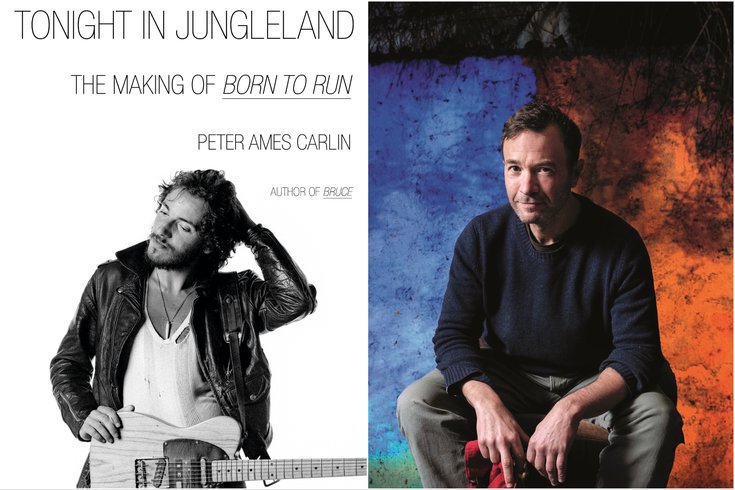 Provided image/Doubleday/Penguin Random House
Peter Ames Carlin, who wrote the biography 'Bruce' in 2012, focuses on the making of 'Born to Run' in his latest Bruce Springsteen book 'Tonight in Jungleland.'
The stakes were never higher for Bruce Springsteen than they were in 1975, the year his classic album "Born to Run" hit record stores and radio waves.
Though it was only the rocker's third studio release, "Born to Run" was the album that supercharged and ultimately saved Springsteen's career. As author Peter Ames Carlin tells it in his new book "Tonight in Jungleland," the Boss's label was disappointed in his previous sales, especially given the enormous publicity push he received for his debut. If "Born to Run" bombed, too, the execs were likely to drop Springsteen from their roster.
"He spent that entire process of writing and recording the songs for 'Born to Run' with the knowledge that if he set a foot wrong, that it was gonna be over for him at Columbia (Records), and maybe that would mean the end of his career as a recording artist," Carlin said. "... So based with that realization, it was, shall we say, a very emotionally intense period for him."
Carlin would know. The writer penned the bestselling biography "Bruce" in 2012 with the musician's cooperation, and interviewed him yet again for "Tonight in Jungleland," a focused history of "Born to Run" out Tuesday. The book features additional insight from Springsteen's collaborators, like his producer Jon Landau and E Street Band regulars Roy Bittan, Max Weinberg and Steven Van Zandt.
Luckily for everyone involved, "Born to Run" was a hit. The album peaked at No. 3 on the Billboard 200 chart and received rapturous reviews from critics who had, since the rocker's debut, seen enormous potential in Springsteen. In the nearly five decades since its release, "Born to Run" has gone platinum seven times.
Carlin spends much of his book wrestling with what changed between Springsteen's first two albums — "Greetings from Asbury Park, N.J." and "The Wild, the Innocent & the E Street Shuffle" — and his breakthrough. There were some new faces in his band and a new producer in Landau when "Born to Run" went into production. But Springsteen was also finessing his songwriting and finding a voice that straddled the line between popular rock and brainy folk ballads.
"It was this cold fusion of Elvis Presley and the sort of visceral power and excitement of him as a performer and the intellectual and literary heft of Bob Dylan," Carlin said. "...You don't think about rock stars being that smart or having that kind of literary toolkit, but that's what made Bruce who he is."
There were roadblocks along the way. Springsteen and his manager Mike Appel struggled to secure studio support for "Born to Run" — initially, the skeptical record execs demanded he cut a single before they released the money for an album. When Springsteen came back with the title track, they weren't impressed. Columbia held the song hostage until Appel leaked it to supportive radio hosts — including WMMR's Ed Sciaky.
Springsteen's own self-doubts and creative quibbles were another matter. Carlin describes engineers falling asleep in the studio as the singer tinkered with lyrics or the same few notes for hours. After hearing the final album for the first time, Springsteen threw it in his hotel pool, convinced it was garbage. These insecurities went back to the rocker's childhood, Carlin writes. Though his grandparents adored him and his mother bought him his first electric guitar, Springsteen's father, who suffered from mental illness, could be cruel to him.
"That weirdly bifurcated sense of himself as simultaneously being the golden boy, but also being an utter loser was something that he carried into his days as an artist," Carlin said. "On the one hand, you have to have an amazing amount of confidence to get up on the stage and do the things that Bruce can do, but on the other hand, it's fueled by this desperation to not be revealed as the loser that you're terrified you actually are."
While "Tonight in Jungleland" provides this and other pre-"Born to Run" context, it's tightly focused on 1974-1975, the period before and immediately after the album's release. Fans will read about the live shows in between, lost or rearranged tracks, hipster backlash and the time Appel broke into his children's college savings to keep the band afloat. It all forms a picture of an artist on the edge of enormous change, in the moment, as Carlin puts it, "he becomes Bruce Springsteen."
"When you look at the Bruce on the cover of that album, you're seeing a guy who is a lot closer to the guy we see on stage today than the guy who's on the cover of 'The Wild, the Innocent & the E Street Shuffle' or 'Greetings,'" Carlin said. "He found his voice and he found his identity in a way that is still recognizable, that was kind of for keeps."
Follow Kristin & PhillyVoice on Twitter: @kristin_hunt
| @thePhillyVoice
Like us on Facebook: PhillyVoice
Have a news tip? Let us know.