





July 10, 2025
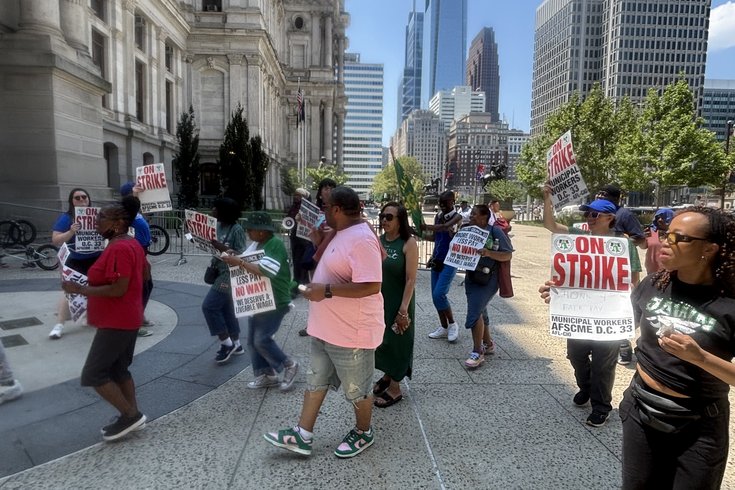 John Kopp/PhillyVoice
The municipal workers strike ended Wednesday morning after DC 33 and the city reached a tentative agreement on a three-year deal. But the long-term impact of the work stoppage remains to be seen. Above, strikers at City Hall.
Blue-collar municipal employees are back to work after a strike of over a week ended Wednesday morning when a tentative agreement was reached on a new three-year contract. But it's not a done deal quite yet.
"I think that [the union was] realistic in understanding where things are politically," said Francis Ryan, a labor historian and professor at Rutgers University. "It's probably the best deal they can get right now, but I have to say that it's not done until the members ratify this contract, and I'm not certain right now that a majority would do so."
The agreement includes an annual 3% raise for the next three years, a one-time $1,500 bonus during the first year and a 2% step increase in the salary scale for longtime employees. The American Federation of State, County and Municipal Employees District Council 33 had been asking for 5% annual raises, among other requests. The deal still needs to be ratified, and voting is scheduled for July 14-20.
While it's unusual for a proposal to be rejected, there's recent local precedent. A group representing research and teaching assistants at Temple University overwhelmingly said no to a deal in February 2023 by a vote of 352 to 30.
This is also new territory for a conflict between the city and its workers, with this being DC 33's first strike since 1986
This time, social media plays a role in the circumstances surrounding the dispute, giving the general public a firsthand look into the life and struggles of the strikers. Ryan thought posts from the picket lines painted a picture of the country's wealth disparity, which led to more public support for strikers than any accounts he'd seen from the previous work stoppages in Philly, which go back to 1938.
At the height of the labor movement in the 1970s, Ryan estimates about 300,000 workers were represented by unions in Philadelphia. Now, the AFL-CIO, which DC 33 is an affiliate, represents about half of that amount so it took a public dispute like this, with the help of social media, for many people to get their first exposure to collective bargaining.
"You have a lot of younger citizens who have no memory of a trash shutdown. You have a lot of union members and leaders who've never been on strike. And you also have in the city government, a lot of younger officials who've never been through this before, either," Ryan said. "It was a moment of education for a lot of people about what a strike is, the role that a union plays in our economy — in our city, and I think a lot of people were discovering what this entails."
The strike came at a unique time in Philly, after the COVID-19 pandemic altered working conditions and ahead of the World Cup and other major events in 2026 for the semiquincentennial, which put pressure on the city to ink a multi-year deal. At the same time, workers were dealing with rising costs of living and inflation that put them over the edge.
In the short term, the tentative agreement means that the city's sanitation workers, librarians, and crossing guards are back on the job. But the longer-term impact of the work stoppage remains to be seen.
Although Ryan expects this deal will likely be disappointing to many union members, he noted that the growing awareness and support for workers could lead to future organizing.
"For a younger generation of Philadelphians, this was not something that they necessarily learned at the dinner table the way that earlier generations may have," Ryan said. "This was an important historical moment, and I'm curious to see what develops from it in the coming years."