





December 12, 2025

Content sponsored by
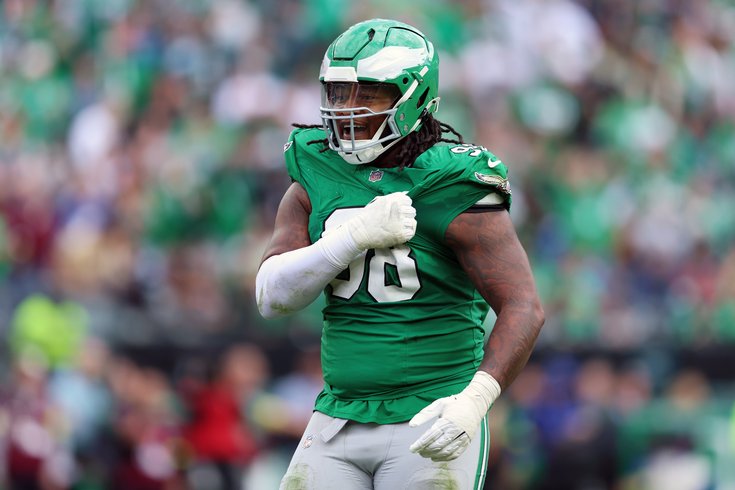 Bill Streicher/Imagn Images
Philadelphia Eagles defensive tackle Jalen Carter (98) reacts in the third quarter against the New York Giants at Lincoln Financial Field.
Depth on the interior defensive line remains a concern for the Eagles, who will be without their best lineman, third-year iDL Jalen Carter, for the second straight game Sunday against the Raiders at the Linc.
Carter missed Monday night's 22-19 overtime loss against the Chargers after reportedly undergoing procedures on both of his shoulders a few days earlier. Throughout training camp and the season, Carter could be seen grimacing, laboring or holding his shoulder, signaling that he was playing through discomfort.
After the Bears loss on Black Friday, in which Carter played his lowest percentage of snaps this season, he cryptically acknowledged to reporters that his shoulder has been bothering him, per this video from the Inquirer's Olivia Reiner. Defensive coordinator Vic Fangio confirmed as much a few days later.
Jalen Carter exited the game with a shoulder injury, but he eventually returned. Said he "aggravated" an issue he had before. He'll get more info tomorrow.
— Olivia Reiner (@ReinerOlivia) September 28, 2025
"I've got to finish for the guys." pic.twitter.com/7YB3KGLnhX
After a breakout 2024, Carter hasn't been elite this year. He has 2 sacks, 11 QB hits, and 4 TFLs – not bad numbers at his position, but certainly not outstanding.
Carter's procedures took place Dec. 4, six days after that Bears loss, and he was reportedly deemed "week to week." The Eagles have not given any specific information about Carter's injury or treatment.
Internet sports physicians, like former San Diego Chargers team orthopaedist Dr. David Chao, then took to social media to explain that Carter most likely underwent platelet-rich plasma (PRP) injections, which gave him a better chance to return this season than surgery would have.
The Eagles were able to get outstanding interior defensive line play against a decimated Chargers offensive line Monday and made it through the game without any other injuries at the position.
Similarly, the Raiders have backups all over their offensive line and shouldn't be much of an issue for the Eagles' defensive front.
But going forward, the Eagles have two NFC East games left against the Washington Commanders, who have a much-improved offensive line, along with a major showdown against the Buffalo Bills in between.
If the defending Super Bowl champions are going to make another deep postseason run, they'll need Carter to not only return to their defensive front but also be an imposing player.
Dr. Dinesh Dhanaraj, the Attending Orthopedic Surgeon at St. Mary Medical Center in Langhorne, explained to PhillyVoice what PRP injections entail, why an athlete would have them, and what expectations there should be upon return.
Before getting started, an important note: The views and opinions expressed in this article are those of the author and guest authors and do not reflect any official policy or position of any NFL team or a team's athletic physicians.
In the procedure, Dr. Dhanaraj explained, blood from a patient is taken through IV, spun in a centrifuge machine to separate the platelets, and then the platelet-rich blood is re-injected into the sore area.
The objective, he added, is to accelerate the healing process for soft-tissue injuries because platelets are the part of blood that cause healing. These injections can be used to treat partial tears and sometimes full tears, he said, to "hypothetically" reduce inflammation and pain.
Dhanaraj carefully used the word "hypothetically" frequently throughout the interview because he said not enough data exists to support that PRP injections are "clear cut on it being a true, proven efficacy" over other forms of standard care, such as Cortizone injections or physical therapy. Only in cases like tennis elbow and Achilles tendinitis have PRP injections shown more healing promise, he added.
"Everything else, studies haven't been conclusive," Dr. Dhanaraj said. "We go by data being long term, randomized control trials that are the standard of what we use to determine efficacy. Some of these [PRP] studies are just early."
Dr. Dhanaraj added that there's no harm or downside to the injections.
Without knowing the exact nature of Carter's injury, Dr. Dhanaraj said he couldn't accurately project Carter's timetable for return. The procedure itself requires no recovery time, he added, noting that a patient should hypothetically start to feel improved within a few weeks.
The Eagles are in a tough spot with Carter sidelined. They could withhold Carter until the postseason to give him the maximum time for healing, but losers of three straight, they also haven't wrapped up a postseason spot yet.
It's also uncertain if Carter will feel any better than he did before the surgery. PRP injections aren't a pain reliever, Dr. Dhanaraj said, as much as they are an inflammation reducer, hypothetically. The injections also aren't a treatment for injury, per se, and it's still possible that Carter would require a surgery or lengthier rehab in the offseason.
"It all depends on the symptoms," he added.
For at least one more week, the Eagles will soldier on without Carter, and hope they can continue win the trench battle until he returns.
SIGN UP HERE to receive PhillyVoice's Sports newsletters.
Follow Geoff on Twitter/X: @geoffpmosher
Like us on Facebook: PhillyVoice Sports