





December 12, 2025

 Provided Image/Children's Hospital of Philadelphia
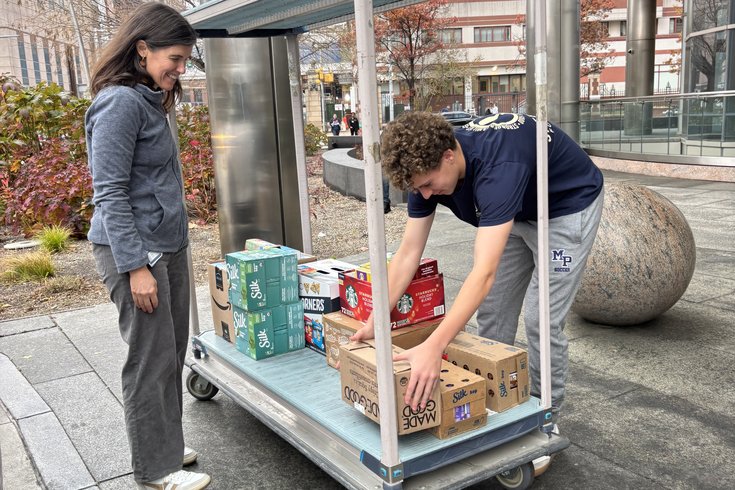
CHOP opened an allergen-free food pantry in August to help families that struggle to pay for allergen-free foods. Above, clinical dietitian Amy Dean, left, helps Malvern Prep sophomore Liam Matlack unload food he collected to donate to the pantry.
When Liam Matlack was 4 months old, he was diagnosed with a wide variety of food allergies, including to dairy, eggs, peanuts, tree nuts, sesame, oats and clams. His mother, Danelle, eliminated those foods from her diet and breastfed Matlack for months until it became overwhelming. Matlack, of Gilbertsville, had to go on a soy formula, the only option for him, which was very expensive.
When Matlack started school, Danelle quit her job. She didn't trust sending Matlack, who is now a sophomore at Malvern Prep, to daycare "with everybody walking around with dairy based-formula and goldfish snack crackers and all this stuff," Danelle said.
Matlack gradually outgrew some of his allergies. He also did food challenges at the Children's Hospital of Philadelphia, where he has received ongoing treatment. Food challenges introduce gradually increasing amounts of one food type at a time to see if the child can tolerate it and has outgrown the allergy.
Now Matlack is only allergic to peanuts and tree nuts, but learning to manage his food allergies has been a lifelong challenge, he said.
"Especially when I was younger, I didn't always feel included in things," Matlack said. "But as I've grown a lot older and more mature, I've seen that it's OK to have allergies, and you just have to advocate for others and just keep safe."
At a recent checkup at CHOP's allergy program in the Buerger Center for Advanced Pediatric Care in University City, Matlack spotted a supply of allergy-friendly foods stocked in the corner of the waiting room – a small food pantry CHOP opened in August for people who have trouble accessing and paying for these often higher-priced items, such as egg substitute and soy or almond milk.
"This kind of made me think about, 'How is everyone able to afford these safe foods for them?'" Matlack said. "And from previous experience and through my life, I've realized that they're very expensive, and that they have to follow specific diets."
Matlack started collecting donations for CHOP's food pantry for allergy patients after learning more about how widespread food insecurity is in the Philly region, he said.
One in 4 people in Philadelphia are food insecure, the city's Office of Homeless Services reports. Food insecurity is an U.S. Department of Agriculture designation that refers to people who do not have enough to eat and aren't sure where, or how, they'll get their next meal.
The 43-day federal government shutdown, during which President Donald Trump and the Department of Agriculture refused to release Supplemental Nutrition Assistance benefits to people, exacerbated the problem — leaving 2 million Pennsylvania residents, including 475,000 people in Philadelphia, without money to pay for groceries.
"Even with SNAP (now) being paid out, there's still a lot of uncertainty from families about if they're going to continue to be qualifying, like what's going to happen in the future," said Dr. Alex Navard-Keck, an attending physician with the Division of Allergy and Immunology at CHOP. "There are a lot of questions about Medicaid funding and Medicare funding, which a lot of these families also depend on. And so I think it is a really challenging time for people."
Accessing foods that are safe for children with allergies is already difficult for some families, especially for people living in low-income neighborhoods who may rely on local bodegas. All of these issues motivated Navard-Keck to start the food pantry, she said.
"We wanted to provide a safe place for them to sample foods, to try new things, get emergency stock, so that they can kind of bridge that gap until maybe their finances have changed, or maybe they're more stable," Navard-Keck said.
But not all CHOP allergy patients go to the Buerger Center for appointments. The allergy program has five other locations. And getting transportation to the Buerger Center may be challenging for some people.
So in January or February, Navard-Keck is helping to launch a pilot grocery-delivery program. Families of CHOP patients with food allergies, who are experiencing food insecurity or struggling access to food, will work with a dietician and receive customized food bundles specific to their allergen and nutritional needs, Navard-Keck said.
A donor whose child has food allergies provided enough money to start the pantry, and the grocery-delivery program also will rely on financial and food donations, Navard-Keck said. She added that it's been inspiring to see other people who've experienced food allergies, such as Matlack, get involved.
Matlack's food donation effort has become a family project, Danelle said. In the new year, they hope to obtain nonprofit status to help them expand their donation efforts to CHOP's pantry and other organizations.
"Life hands you different situations, and you make the best of them, and you learn from (them) and grow and help others," Danelle said. "So I'm not surprised that Liam is utilizing his resources and wanting to help and changing the way he looks at his allergies."
People who want to donate to CHOP's food pantry or food delivery pilot program can email foodpharmacy@chop.edu.