






February 23, 2026

 Provided Image/NexGen Hyperbaric
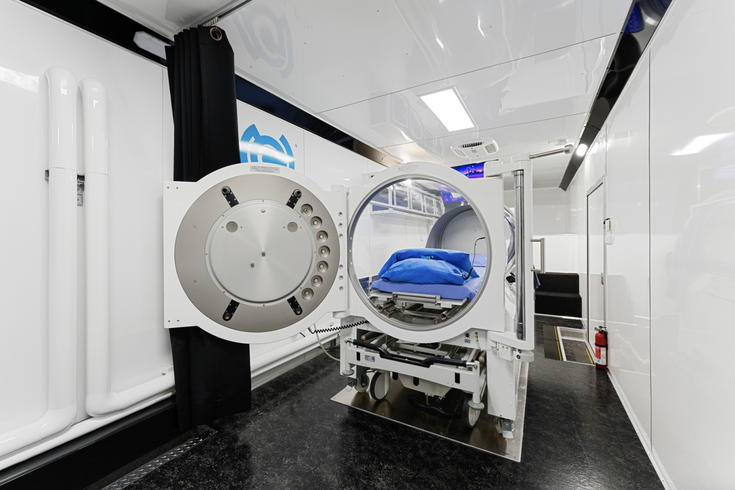
Hyperbaric oxygen therapy is on the rise among professional athletes, including players on the Phillies, Eagles and Flyers. Its uses are widely accepted for certain conditions, but some medical experts say more research is needed to demonstrate the benefits. Above, a photo of the NexGen Hyperbaric chamber used by Phillies players.
The Phillies have reported for spring training in Clearwater, Florida, where a mobile chamber for players to get hyperbaric oxygen therapy is waiting in the team clubhouse.
Last year, the Phillies joined the Eagles and Flyers in embracing the treatment as a season-long aid for injury management and general recovery. All three teams have deals with NexGen Hyperbaric, a Florida-based company that works in tandem with team trainers to offer medical-grade HBOT to athletes.
MORE: GLP-1 drugs are great weight-loss tools. But they work best with lifestyle changes, experts say
"There are quantifiable, measurable data points associated with the utilization of this medicine in comparison to not using it," NexGen Hyperbaric President and CEO Jonathan Rotella said. "These athletes are all using measurable devices and working with their respective training staffs to discuss some of the objective and tangible differences they've actually seen."
The Phillies, satisfied by the benefits of the treatment, decided to incorporate it in spring training this year. Rotella said it has helped pitchers recover quicker and be available sooner in the team's rotation, and the Eagles took the mobile unit to each of their Super Bowl appearances over the past few years.
"Every professional team is very selective in terms of the modalities they implement, but they need to see tangible and beneficial results for their players," Rotella said. "If they didn't see that, we certainly wouldn't be a part of the organizations."
HBOT involves entering a sealed, pressurized chamber to breathe in 100% pure oxygen. Its origins trace back the 1600s, when it was used in England to treat a variety of ailments, but its greatest advancements took place in the 1930s. It emerged as a life-saving tool to help deep-sea divers recover from decompression sickness — also known as the bends — after surfacing too quickly from underwater depths.
Historically, most hyperbaric chambers were located near dive operations and naval installations. By the 1960s, clinical research demonstrated that HBOT also is effective as a treatment to improve the healing of chronic wounds, burns and fractures. Giving patients pure oxygen in a pressurized setting stimulates blood flow to areas that need it, and the treatment promotes recovery among patients with diabetic foot ulcers, failed skin grafts, radiation injuries and other conditions.
"As we began to see it was helpful with wound healing, medical centers started investing in hyperbaric chambers to treat these wounds," said Milo Sewards, a physician and chair of orthopedic surgery and sports medicine at Temple University's Lewis Katz School of Medicine. "Hyperbaric oxygen treatment crossed over into the world of sports medicine as a way for teams to be on the cutting edge."
The science behind HBOT treating the bends and healing wounds is longstanding and well-accepted in the medical community. Using it for athletic injuries, wellness, anti-aging and other off-label health reasons is still part of an evolving field of study.
"They are starting to demonstrate the benefit to using this technique for improving healing and decreasing inflammation," Sewards said.
Still, he cautioned that more peer-reviewed research is needed to make definitive claims about HBOT's effects.
"It probably does have some impact on more rapid healing," Sewards said. "I think it's tough to define that right now with the information that we have available, except in populations that truly have blood flow issues."
In the world of professional sports — particularly football — players and teams have used hyperbaric chambers for years. Former Eagles wide receiver Terrell Owens used a portable, soft shell chamber in his living room as part of his recovery from a fractured fibula and torn ligament in his ankle ahead of the Super Bowl in 2005. His successful return to the field motivated Baltimore Ravens tight end Mark Andrews — whose circulation is affected by Type 1 diabetes — to use HBOT two seasons ago while recovering from a cracked fibula.
Pro Football Hall of Famer Joe Namath started using experimental HBOT to treat brain damage more than a decade ago. He swore by its benefits even as medical researchers questioned claims about its efficacy.
While a larger body of clinical research is needed to validate HBOT, Sewards said he understands why it's attractive to professional sports teams. They want to get the most out of their players, who suffer more wear and tear than the average person, and newer modalities can prove valuable even if the benefits are marginal.
"You're looking at a matter of a few days being a huge difference in an organization where you're paying a player tens of millions of dollars and you're looking at whether they're going to be out 20 games versus 18 games. Those two games can be a substantial difference and can justify the cost of a dive chamber."
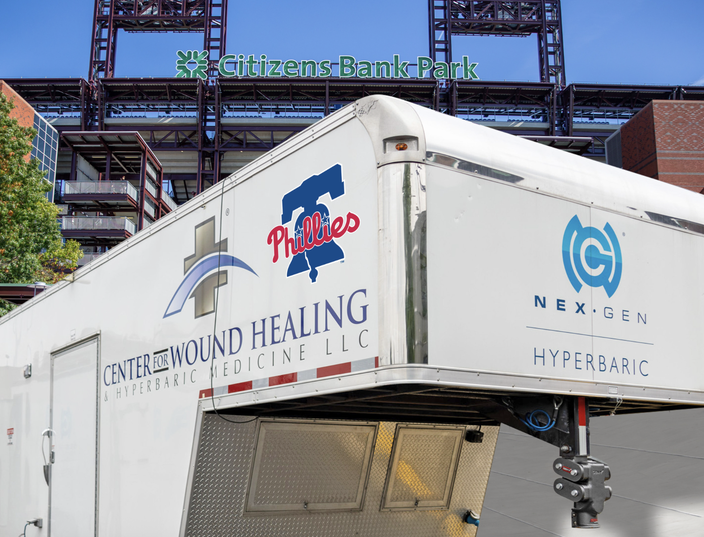
The Philadelphia Phillies and NextGen Hyperbaric are in the second year of their partnership to provide HBOT for players. A mobile hyperbaric chamber, shown above outside Citizens Bank Park, is now in Clearwater, Florida to make the treatment available during Spring Training.
As hospital-based HBOT clinics and free-standing treatment centers expand across the country, the treatment is becoming more prevalent for a wide range of conditions.
In the United States, there are now 14 FDA-approved conditions that allow patients to qualify for HBOT using Medicare, Medicaid and commercial insurance coverage. Other countries, including those in the European Union and China, approve HBOT for dozens of medical reasons.
Non-hospital clinics offer out-of-pocket HBOT to treat everything from hamstring tears and concussions, to broken bones and general recovery. Some offer it to help patients with conditions like Lyme disease, multiple sclerosis and Parkinson's disease.
"People are starting to become more educated about looking at alternatives as opposed to just traditional medicine," said Victoria Bliss, president and CEO of Oxygen Oasis, an HBOT clinic in Langhorne, Bucks County. "We know that without finding underlying causes, people are often thrown a lot of meds. They're really great, in some senses, but they can cause further damage and other symptoms."
Bliss opened Oxygen Oasis 12 years ago, obtaining certifications and hiring trained medical staff to oversee treatments. The clinic, which she described as more of a spa environment, has two medical-grade chambers with room for one person in each and a multi-chamber that holds up to six people at once. The clinic treats everyone from children to people in their 90s, and all treatments are administered with 100% pure oxygen.
"We've had multiple (high school and college) teams come and have meetings while they're doing hyperbaric oxygen treatment," Bliss said.
Typical sessions in a chamber last between 90 minutes and two hours. A technician adjusts the pressure inside the chamber throughout the sessions to ensure the patient's safety. Treatment plans may require anywhere from a few sessions to more than 40 over a period of months, depending on the condition.
Rotella said people interested in HBOT need to do their research on providers to ensure they are certified — preferably by the Undersea & Hyperbaric Medical Society — and that they use 100% pure oxygen. Clinics also should have medical staff who adhere to guidelines for checking vital signs and other risk factors before, during and after treatment. Without insurance coverage, clinics offer sessions that can range anywhere from $325 to more than $2,000
"There's a lot of mild hyperbaric out there that touts relatively the same benefits associated with what we do," Rotella said. "The rule of thumb is that any chamber you can put yourself in and take yourself out of is not a hyperbaric chamber."
Due to the expense and the need for quality care, Sewards doubts HBOT will become a routine treatment for recreational athletes unless it is more broadly covered by insurance. Even then, he said most athletic hobbyists don't need it.
"I think we're probably at a point where we'll see it be a little more widespread, but there will be a plateau," Sewards said. "I don't see a point at which this is done without some level of medical supervision. I don't see them popping up in strip malls."
Rotella is much more bullish on the future of hyperbaric medicine and its possibilities in the realm of anti-aging and brain health. He said he hopes to see HBOT studied and taught more widely in medical schools.
NexGen Hyperbaric's partnership with the Flyers includes making HBOT available to retired players, and Rotella said he encourages pro teams to give their players the chance to benefit from treatment.
"It really sends a message that, 'We care what you did for us on the ice and we still care about you long after you left the ice,"' Rotella said. "That's the DNA we love to work with and that's what medicine is all about."