





January 09, 2026
 Cary Edmondson/Imagn Images
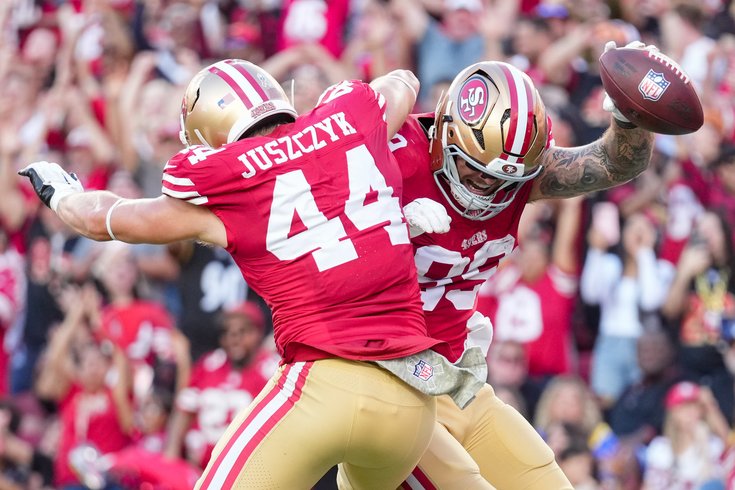
Ten-time Pro Bowler fullback Kyle Juszczyk (44) of the 49ers isn't your ordinary, conventional fullback.
When healthy, the San Francisco 49ers offense is legit scary.
It's not often they're at full strenegth, and they probably won't be Sunday in an NFC Wild Card game against the Eagles at the Linc, but they should have two of the game's preeminent stars at two positions in running back Christian McCaffrey and tight end George Kittle.
Their offense, which averaged 26 points per game during the regular season but 31 when starting QB Brock Purdy returned Week 11 from an eight-game absence because of a toe injury, begins with an even more accomplished stud than McCaffrey or Kittle.
Ten-time Pro Bowl fullback Kyle Juszczyk – affectionately known as "Juice," because, well, that's way easier to pronounce – is vital to the foundation of Kyle Shanahan's motion-centric, big-personnel heavy scheme, and has been for all nine seasons he's been in the Bay Area.
Only a select few NFL teams still lean heavily on the fullback, including the Ravens, Dolphins, Bills, but for the Niners, it's part of the identity of their gameplan. Juszczyk led all NFL fullbacks in snaps, with 510, just under 30 per game.
Although he's no threat to carry the ball – 2 carries for minus-3 yards in 2026 – and averages fewer than 2 catches per game, Juszczyk's presence is central to how the 49ers operate.
With Juszczyk on the field, the Niners are in either 21 personnel (two running backs, one tight end, two wide receivers) or 22 personnel (two running backs, two tight ends, one wide receiver), which usually – key word, usually – forces defenses to counter in base personnel, with a third linebacker on the field to guard against the run as opposed to an extra corner to guard against the pass.
The Niners then try to exploit those run-defense personnel groups with play-action passes, and with guys like Kittle and McCaffrey – an elite pass catcher – they're typically able to capitalize on those favorable matchups.
For what he lacks in game management and decision-making acumen, Shanahan compensates by being an elite play designer and play caller. His offense always features a steady diet of shotgun and under center formations, along with heavy motion and misdirection that use players as decoys and create an "eye candy" dilemma for defenses.
This year, Shanahan has added some aligment tinkerings with Juszczyk to create even more guesswork for the defense.
Fullbacks usually align in front of the running back when under center or to the opposite side of the running back in shotgun as they're expected to clear a pathway as the lead blocker for the ball carrier.
This year, a few times per game, Juszczyk will line up in a wing postion offset from a right or left tackle pre-snap and become the motion player – many times a decoy – in the team's run and run-action schemes. Juszczyk was used in motion on 235 snaps this season, per NFL Pro, the most of any skill position player in the NFL.
Against the Bears in Week 17, a 42-38 Niners win, Juszczyk aligned at the wing twice on consecutive McCaffrey carries that led to a 15-yard gain followed by a 5-yard touchdown run.
Here's the sequence, with two angles of each run:
On the first carry, out of 21 pesonnel, Juszczyk's motion to the left created the illusion of an outside run, but it was really just an inside zone. The tight end from the left side came across the line of scrimmage and put an excellent block on Chicago's backside edge defender (90) to create a wide pathway for McCaffrey.
Chicago's LB (53) and nickel (35) were forced to shift with Juszczyk's motion, which took them away from the play and left only one defender (49) in position to make a tackle, but he was engulfed by the RT. Chicago's deep safety (31) was the only player who had a chance to make the stop, but McCaffrey did McCaffrey things and juked him badly.
Juszczyk rarely touches the ball, but defeses still must follow the rules of motion, which is what Shanahan attempts to exploit.
Here's an example of Juszczyk's motion creating a pass-game mismatch, against the Seahawks in Week 18:
Juszczyk lined up in a typical fullback alignment next to QB Brock Purdy in shotgun but his pre-snap motion to the outside drew Seattle's S (20) while the slot WR's slant route took the outside CB toward the deep middle, leaving no Seattle defender within 5 yards of McCaffrey, who leaked out over the middle and had plenty of space for yards after the catch to get first down.
Purdy was never going to throw the ball to Juszczyk, but the safety can't just leave him undefended – an example of the Niners capitalizing on the rules of defense.
The Niners, also per NFL Pro, played either 21 personnel or 22 personnel on about 45 percent of their offensive snaps this year, leading the NFL in both groupings. They employed the NFL's third-highest rate of 22 personnel in a season since 2017, partly because of a ridiculous number of injuries at wide receiver.
They're also the league's most prolific 22 personnel offense, with an NFL-most six touchdowns on 32 pass plays from that grouping, four on nine pass plays inside the opponent's 10-yard-line.
But here's the rub.
The Seahawks, a predominantly nickel defense, didn't take the bait in their Week 18 showdown against the Niners, an outcome that not only decided the NFC West champion but also the No. 1 seed.
Despite the Niners' heavy usage of 21 and 22 personnel, the Seahawks stayed in nickel defense, trusting they could still defend the run even with one fewer linebacker and one more defensive back on the field. The Seahawks rotated alternated between traditional nickel (three corners, two safeties) and big nickel (two corners, three safeties) on 100 percent of their snaps, per Next Gen Stats.
The Seahawks held the 49ers to 73 yards in two-RB sets in Week 18. San Francisco had amassed at least 200 yards in those sets in each of the last three weeks.
— Next Gen Stats (@NextGenStats) January 4, 2026
Seattle's defense played nickel (5 defensive backs) on every play the 49ers ran with two RBs.#SEAvsSF | @Seahawks
Seattle held San Francisco to just 173 total yards in its 13-3 win, although the Niners were without All-Pro left tackle Trent Williams and top wide receiver Ricky Pearsall.
The Eagles, like the Seahawks, played some of the NFL's highest-percentage of nickel this year. Defensive coordinator Vic Fangio gets more production from Cooper DeJean and his defense when DeJean is aligned in the slot than when outside.
Although Fangio typically counters 21 and 22 personnel with base defense, he has at times elected to play nickel against those bigger offensive looks and could easily take a page from Seattle's playbook for this playoff matchup Sunday.
Regardless of what defensive package Fangio goes with, the Eagles will have to be disciplined with their eyes, with their run fits and swarm to the ball. The Niners thrive off operating in space and creating extra yards after the catch.
"Juice" will be loose for San Francisco, for sure, but with all of the Niners' injuries, how much can they squeeze from his usage against Fangio's stingy defense?
SIGN UP HERE to receive PhillyVoice's Sports newsletters.
Follow Geoff on Twitter/X: @geoffpmosher
Like us on Facebook: PhillyVoice Sports