





February 02, 2026
 John Kopp/PhillyVoice
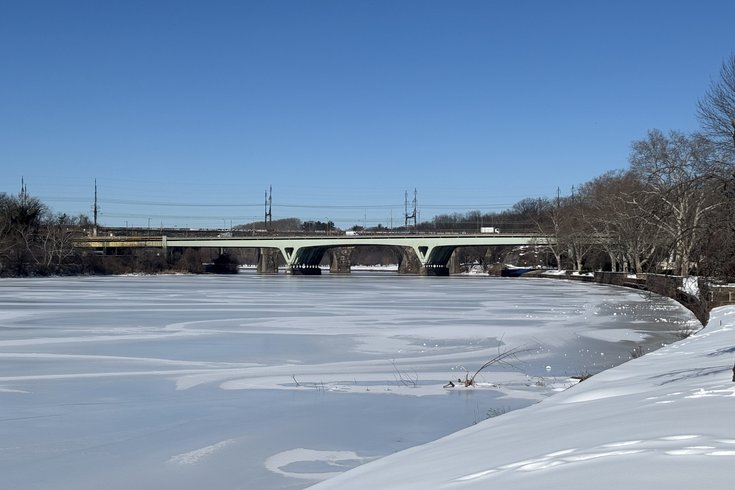
Philadelphia police are warning people to stay off the frozen Schuylkill and Delaware rivers after reports of people walking and ice skating on the ice. Moving water weakens river ice and conditions can change fast. This photo shows the frozen Schuylkill River near the Girard Avenue Bridge on Tuesday, Feb. 2, 2026.
It only happens about a couple times every decade that it gets cold enough for the surface of the Schuylkill River to freeze over. The lure of this unusual occurrence is proving too enticing for some people and they have wandered out onto the icy river.
This has prompted the Philadelphia police to issue a warning: Just don't do it.
MORE: PBS will spotlight Sun Ra and his Philly musical collective on 'American Masters'
"We're getting reports of people walking and ice skating on Philadelphia's rivers," police posted on social media on Sunday. "This is illegal for a reason. River ice is not as thick as it looks – moving water underneath weakens it and conditions can change fast. Please stay safe and stay off the ice!"
Police have responded to calls about people on icy rivers and streams, Sgt. Eric Gripp said Monday. In an incident over the weekend, a woman ventured onto the Schuylkill River with two children in East Falls. Police also have been called for people on the ice in South Philly, Northwest Philly and Northeast Philly.
So far, no rescues have been necessary, which is an emergency that would be handled by the Philadelphia Police Marine Unit.
Gripp reiterated the department's warning that people should stay off all the frozen rivers, creeks, streams and lakes. Anyone who does not heed this warning, faces a fine of at least $25. As of Monday afternoon, the department has avoided issuing fines to violators.
"At this time, we would not generally issue a citation solely for walking on the ice, provided the individual complies by removing themselves," Gripp said. "Our approach focuses on awareness, education, and safety."
If people refuse to get off the ice when asked, police can choose to issue citations for violations that occur within Fairmount Park. That includes parts of the Schuylkill River, Wissahickon Creek, Lansdowne Creek and Montgomery Creek. There also are several ponds and reservoirs within the park.
This is the first time the Schuylkill and Delaware rivers have frozen here since January 2018. In order for it to happen, there needs to be a stretch of about five days with with temperatures in the teens and 20s.
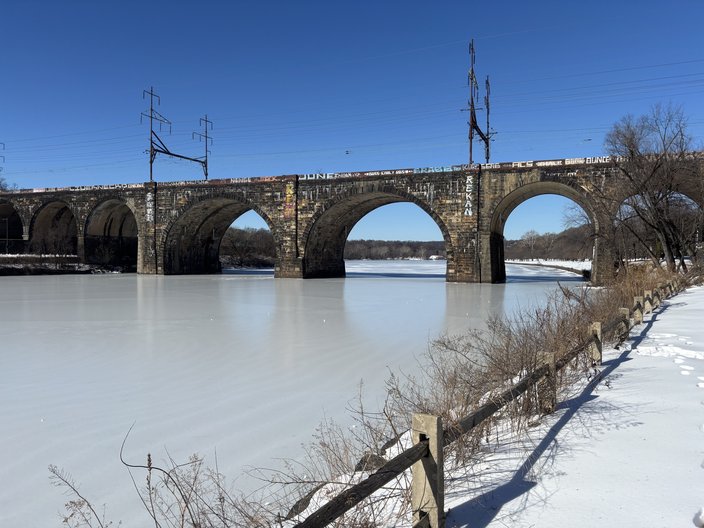
Philadelphia's rivers have partially frozen due to the frigid temperatures that have hit the region over the 10 days, but police say the ice is not as thick as it looks. They are warning people not to walk or skate on the rivers. Above, the frozen Schuylkill River under a railroad bridge in Fairmount Park on Feb. 2, 2026.
"It's just been a brutally cold stretch," said Eric Hoeflich, a meteorologist at the National Weather Service's Mount Holly station. "It's certainly not normal to have this much ice on the river. It happens once or twice every ten years or so."
Elsewhere in the region, people have been posting photos and videos of icy conditions at the Jersey Shore. One photo shows waves frozen along the shoreline in Cape May Point. The Cape May-Lewes Ferry, which canceled service Monday, was shown in a video last week navigating icy waters in the Delaware Bay.
Several people have posted videos skating at the beach in Wildwood.
Hoeflich said it will take days of warmer weather to melt the ice – not just a day. A brief warm up could make icy surfaces more dangerous if temperatures plummet again.
"You generally need temperatures to get into the mid-40s for it to really start to break up," he said. "We're not expecting that, at least for the next week or so and maybe even longer."
People should stay off any frozen body of water where the ice is not at least 2 inches thick, and for walking, ice skating and fishing, Hoeflich said it's safest when the ice is 4 to 5 inches thick or more.
In early January, police in Woolwich Township, Gloucester County, rescued a teenager who fell through an icy pond. One of the officers also crashed through the ice while attempting get the boy out of the water.
"The main message is ice on lakes and streams is never 100% safe," Hoeflich said. "So, you generally want to stay away from areas that have cracks or holes or (where) there's flowing water around the edges or ice that appears to have thawed and refrozen."
The Philadelphia Water Department, which has dealt with numerous ruptured water mains since last month's snowstorm, did not respond on Monday to calls about the thickness of the ice on the Delaware and Schuylkill rivers.
The Delaware River is deeper and wider than the Schuylkill, making its icy surfaces less stable. The Delaware River also has channel lanes and icebreakers meant to keep commerce open along the river.
The NWS forecast shows Philadelphia could have its first day above freezing, barely, in more than a week on Tuesday. Then it gets cold again Tuesday night and there is a chance of light snow overnight into Wednesday. During the second half of the week, highs will be in the 20s and lows will fall to the single digits most nights through next Monday.
"I think it's going to get worse before it gets better on our waterways," Hoeflich said.