




June 05, 2026
On Monday morning at 10:00 a.m., new Sixers President of Basketball Operations Mike Gansey will hold a press conference in his first public act as the lead decision-maker for an NBA team.
Gansey, whose long rise with his hometown Cleveland Cavaliers netted him the opportunity to replace Daryl Morey in Philadelphia, will field many questions from reporters. Quite a few of them will pertain to the offseason ahead, seen as yet another critical checkpoint in the Sixers' team-building process.
Will the Sixers focus on bolstering their 2026-27 rotation around Joel Embiid, Paul George, Tyrese Maxey and VJ Edgecombe, or will Gansey lead a youth movement, which disregards the shorter-term ambitions of Embiid and George to build around the longer-term potential of Maxey and Embiid?
Gansey's optionality in trades this summer should be limited, given the unorthodox makeup of the cap sheet he is inheriting. But as Sixers fans await their first impression of the organization's new shot-caller, it is worth thinking about the kinds of trades Gansey could aim to pull off:
Once the NBA Finals wrap up, the basketball world will turn to Milwaukee, where the Bucks seem increasingly likely to trade franchise icon Giannis Antetokounmpo, with a deal potentially in play as soon as the days leading up to the 2026 NBA Draft later this month.
As has been written here extensively, the Sixers should not be expected to contend for Antetokounmpo's services. But trades involving players of his magnitude rarely end up being simple, two-team trades. Could the Sixers factor into this equation as a third or fourth team?
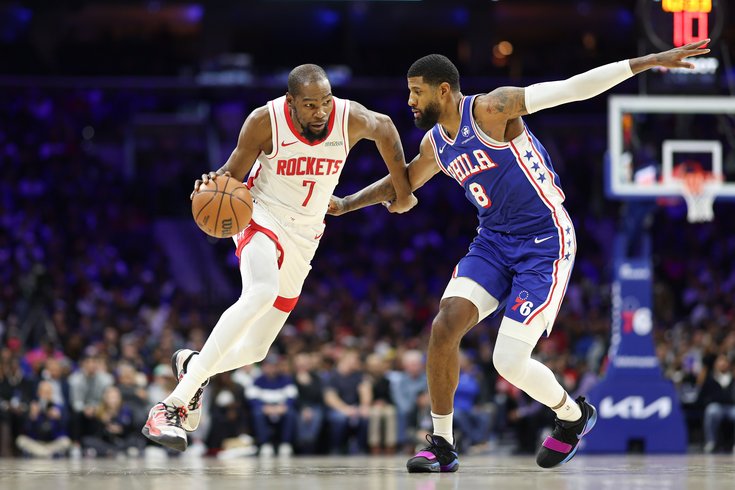
Even after George's post-suspension surge and brilliant first-round playoff performance, there is a solid case to be made for trying to get out of the final two years of his contract. The Sixers still owe George about $110 million, and with his deal on their books in addition to Embiid's even larger contract there is not much of a pathway to creating reliable depth.
George is a negative asset. In January, it would have felt impossible that the Sixers could break George's salary slot into two or three contributors without paying a massive premium. But after his resurgence late in the year, it is easier to conceive the Sixers trading him for multiple rotation pieces at a modest cost.
The team linked to Antetokounmpo in just about every piece of reporting about a potential trade: the Miami Heat, desperate for a pathway back to relevance. And, if their package entices the Bucks, there is a fairly obvious framework that can involve the Sixers:
| Sixers receive... | Bucks receive... | Heat receive... |
| Andrew Wiggins | Paul George | Giannis Antetokounmpo |
| Bobby Portis | Tyler Herro | Kyle Kuzma |
| Jaime Jaquez Jr. | ||
| Kel'el Ware | ||
| 2026 No. 22 pick (via PHI) | ||
| Two future second-round picks (via PHI) | ||
| 2026 No. 13 pick (via MIA) | ||
| 2029, 2031 unprotected first-round picks (via MIA) | ||
| 2028, 2030 first-round pick swaps (via MIA) |
George's trade value has become a polarizing topic; some will say the Sixers should do this trade in a heartbeat and others will scoff at the notion of trading a first-round pick and two second-rounders to downgrade from George to Andrew Wiggins and add Bobby Portis, a flawed player.
Does this trade, which assumes Wiggins will accept his player option worth over $30 million for next season, make the Sixers a better team? In a vacuum, the answer very well might be no. But it would save them about $10 million, and that would meaningfully improve their spending power in free agency.
The calculus behind making this trade would be more expansive than just weighing the value of George vs. Wiggins and Portis. For example, this specific deal would enable the Sixers to enter free agency with about $36 million in room below the first apron and one more rotation spot filled.
There is a real chance the Sixers would then be able to use the full non-taxpayer's mid-level exception – projected to be worth four years and just over $64 million, enough to sign a quality starter – and keep both Kelly Oubre Jr. and Quentin Grimes, while staying under the first apron and within striking distance of the luxury tax threshold.
A trade like this would detract from the Sixers' high-level talent. It is probably a trade Morey would not have made. But if Gansey pays off Bob Myers' implication that the organization must pivot to a depth-oriented approach moving forward, it is the sort of deal that makes perfect sense.
Would a mid-late first-rounder and two second-rounders be enough for the Bucks to take on George as they reroute Wiggins and find a new home for Portis? The answer could be no, but given they do not own their next few first-round picks, it is not like Milwaukee has any incentive to tank. If anything, the nine-time All-Star's massive salary would not be as difficult for the Bucks to take on, and next summer Milwaukee would have one of the largest expiring contracts in NBA history to play with.
If Gansey wants to rid his new team of George's contract, he must find a team that can more easily swallow the pill of paying him $110 million over the next two seasons. In a post-Antetokounmpo world, Milwaukee would fit that bill.
MORE: 2025-26 Sixers year-in-review
Thinking on a much smaller scale here, Gansey should prioritize the roster spots that do not necessarily go to full-blown rotation pieces this summer. In addition to leaving a standard roster spot open until the middle of February, the Sixers had two full-season spots occupied by non-contributors in Kyle Lowry and Johni Broome. Up until the trade deadline, they had Eric Gordon on the roster without using him.
With injury-prone players atop the roster, it was a recipe for disaster. It is how Lowry ended up making sporadic rotation appearances, Maxey led all NBA players in minutes per game and Edgecombe was not far behind him. It is also how, when the playoffs started, head coach Nick Nurse rapidly ran out of options.
One way the Sixers could add a stronger option to the mix: trading two of the players near the bottom of their cap sheet for a higher-level contributor whose salary is somewhere in the range of $5 million.
With the Indiana Pacers likely set to duck the luxury tax, Ben Sheppard fits that price range and, coming off a very disappointing third NBA season, should be available. Trendon Watford is actually a useful piece for a Pacers team that needs positional size and ball-handling; Dalen Terry's non-guaranteed salary could easily be waived if Indiana does not desire his services:
| Sixers receive... | Pacers receive... |
| Ben Sheppard | Trendon Watford |
| Dalen Terry | |
| 2028 second-round pick (via GSW) |
Sheppard emerged as a prototypical reserve role player in his first two seasons, thriving on a strong Indiana roster. And while the rash of injuries suffered by the Pacers last year did create an opportunity for Sheppard to log more minutes, it made it much harder for him to fill a role that suits him.
As he enters his age-25 season – with a trip to restricted free agency likely next summer – Sheppard is in a make-or-break year. He is someone the Sixers could rely on in the event Grimes or Oubre departs, but he could also fit into this team's bench mix if those two players return.
MORE: What should Gansey's Plan A for 2026 offseason be?