




February 17, 2026
 Colleen Claggett/For PhillyVoice
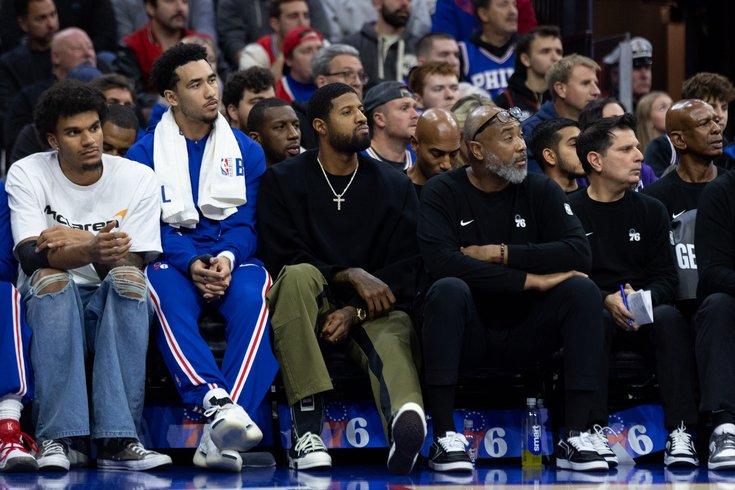
Paul George's suspension completely changed the Sixers' calculus five days ahead of the trade deadline.
Despite having posted a 30-24 record that is better than what just about anyone would have anticipated the Sixers posting before this year's All-Star break, it feels as if the Sixers have a point to prove when they return to action later this week.
Optimism surrounding the 2025-26 Sixers reached its peak a few weeks ago, with Joel Embiid absolutely rolling and his team following suit. The trade deadline was nearing, and the Sixers had a chance to capitalize on their momentum by bolstering a rotation that was in need of an upgrade or two.
Then, a nightmare ensued: Paul George got suspended for 25 games, which provided the Sixers a significant luxury tax credit and changed all of their math just five days before the deadline. The team traded Jared McCain and Eric Gordon to get under the tax line, receiving a decent haul of draft picks from the Oklahoma City Thunder for the 20-year-old McCain. But Sixers President of Basketball Operations Daryl Morey failed to even backfill McCain's marginal rotation spot with a trade acquisition, not adding a single player via trade at the deadline for the first time in his tenure with the organization
Since then, the Sixers have experienced a string of brutal losses. Embiid experienced his first two unplanned absences in over a month heading into the break. George is still over a month away from returning. And suddenly, the Sixers have gone from on the rise to on their heels.
In this week's Sixers mailbag, we focus on one question: how might all of this look different had George not been suspended?
From @bison8guacamole.bsky.social: If Paul George hadn’t been suspended, how different would the Sixers trade deadline have looked?
The Sixers would have had more cost-cutting to do. Had George not been suspended, the Sixers would have entered the deadline above $7 million over the luxury tax threshold, which there is little credible indication they would have stayed over.
Morey insisted that he had the green light to do so from ownership if he found a needle-moving pathway despite this being the fourth season in a row in which the Sixers began a season over the tax line and made a move or series of moves to maneuver below it at the deadline.
"For sure if we had found an add and we were going to end up higher, we would have ended up above it. We've done it several times while I was here. Over the history of ownership, they've done it many times," Morey said earlier this month. "We didn't see something that did that, and then we're under the normal pressures that every team is feeling, the CBA and the first apron, to sign Barlow to this deal, and things like that… They're completely supportive. They provide all the resources we can. Both David [Blitzer] and Josh [Harris] are very engaged and involved, but in a good way, asking good questions, things like that. And when we're talking about, ‘Hey, here's potential deals we can do,’ it's a trade-off. How much will he help? What are we having to give up? Where do we end up relative to the CBA? All those things factor in. But they're tremendous support for us, and appropriately involved, is what I would say."
Morey's assertion fell on deaf ears, given the team's significant history of tax-ducking in recent years.
"I understand the perception," Morey said, "and I'd hoped to defeat it by finding a deal that I can go to ownership and say 'We think this move is the right move to do for that,' and create the apron issues that it would create. But I haven't been able to recommend that move yet."
Before George had been suspended, it seemed that the Sixers' road to ducking the tax was salary dumping Gordon and Kelly Oubre Jr., which would have given them just enough breathing room to sign two-way players Dominick Barlow and Jabari Walker to standard contracts. They could have acquired a very cheap wing player to backfill Oubre's spot in the rotation; George's steady presence would have made it easier to justify parting with Oubre. If the Sixers wanted to replace the veteran swingman with a more established player at a slightly higher salary, they could have done so while also salary dumping Andre Drummond and backfilling his third-string center spot with a cheap big.
But those hypotheticals were all based on the assumption that the Sixers were not ready to consider dealing McCain. Clearly, that was not the reality. Because the McCain trade was not rooted in maximizing the 2025-26 Sixers, it is reasonable to assume it would have happened regardless of George's suspension – if anything, George carrying his original luxury tax hit would have made it more valuable for the Sixers to shed McCain's salary without taking any money back.
So, the guess here is that the McCain and Gordon trades would have still happened in their exact forms. Gordon was the most likely member of the Sixers to be traded before and after George's suspension was announced; he had no on-court role and not a significant enough job in the locker room to be worth keeping around.
That would have left the Sixers a hair over the tax line, still needing to sign Barlow and Walker to new contracts. Barlow's unconventional new deal gave him a salary of just over $3.4 million for the remainder of the season, a pretty substantial figure. They would have needed to not just get right under the threshold, but do so with considerable breathing room.
How would the Sixers have created that room? Salary dumping Andre Drummond would have provided enough breathing room below the tax to give Barlow and Walker the exact deals they received in reality, but the team would have been left without a third-string center head coach Nick Nurse has trust in. Could he have pivoted to using Barlow and Walker as small-ball five options more consistently for the remainder of the season? At one of the team's final practices before the deadline, Nurse acknowledged that he had considered going back to those looks, which provided somewhat encouraging results early in the season.
The Sixers could have traded Drummond and backfilled his spot by acquiring a capable center on a veteran's minimum contract. In this world, though, the Sixers would not have been able to stay under the tax while giving Barlow such a significant pay raise before signing Walker at his much lower salary later. Perhaps they could have negotiated a cheaper deal with Barlow, but surely the Sixers' willingness to give the 22-year-old such a major boost in short-term earnings played a role in their ability to secure a team option for 2026-27 in his contract.
Unless the Sixers were willing to utilize Barlow and Walker as centers moving forward when needed, their best path to getting under the tax without gutting their rotation in a world in which George was not suspended would have involved dumping an additional salary – perhaps Kyle Lowry, Trendon Watford or Justin Edwards, despite all three players being valued by the organization more than they might be by the consensus.
Oubre and his expiring salary of just under $8.4 million could have remained in play, too, and trading Oubre would not have had to be a pure salary dump. The Sixers would have just needed to shave a few million dollars. Trading him for a wing replacement making something in the range of $5-6 million would have gotten the job done.
All of these pathways were viable, even if imperfect. The Sixers' willingness to move McCain for draft picks was always going to give them an easier time figuring out the finances of this deadline, but George's suspension giving the team a luxury tax credit of nearly $6 million was far and away the most significant factor in the team's transactions (or lack thereof). When the primary objective of a deadline is to duck the tax, it is difficult to find a plan that does not have basketball-centric downsides.
Ultimately, the most critical pitfall of the last few weeks when it comes to basketball is that a nine-time All-Star cannot play for the better part of two months. It has weakened the Sixers' rotation in several respects already, and the suspension being levied so soon before the deadline threw the Sixers for a hell of a loop.
As much criticism as Morey has (rightfully) received for failing to bolster Nurse's rotation and as much criticism ownership has (rightfully) received for its continued focus on saving money at the expense of winning games, George also deserves a whole lot of criticism, too. His decision-making has forced the Sixers to play short-handed for a massive portion of the season after they had finally gotten healthy.
"I think no one's more disappointed than Paul. Obviously, he's talked to his teammates... He wants to be out there fighting more than anybody, and he will be," Morey said. "He's going to come back and have a strong ten games into the playoffs. I focus most on how a guy plays when he's out there, and he's playing tremendously out there. Obviously, really critical to our defense, and then contributing [with] shooting. He was a big part of how much shooting we had, and obviously, playing 30-40 minutes, a really important part of the team."
MORE: Morey talks inactive deadline, George suspension, luxury tax, more