






September 02, 2025

 Courtenay Harris Bond/PhillyVoice
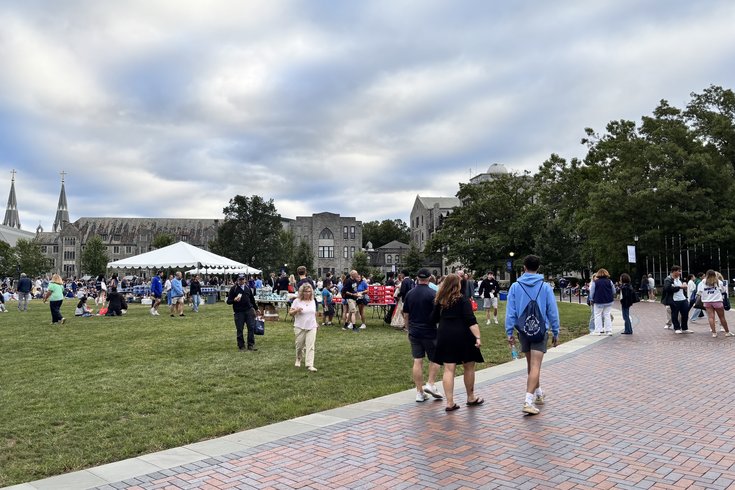
Starting college can stir homesickness, but there are tools for overcoming it. Above, Villanova University freshmen, transfer students and families gather for a picnic during orientation in late August.
College students have moved into their dorms and classes have at many campuses around the country. But that doesn't mean freshmen are settled, yet.
Adjusting to college rhythms and living away from home doesn't happen overnight.
College marks the first time many students have been away from their families and childhood friends for an extended period of time. This can trigger a mixture of strong emotions including homesickness, anxiety and depression – even grief, according to local experts.
"There is a degree of loss and mourning that happens with certain living away from those relationships, you're then thrust into this entirely new environment," said Dr. Richard Chung, an adolescent medicine specialist at the Children's Hospital of Philadelphia. "And it's not going to just be for a two-week experience, but ostensibly it's for four years or whatever it might be. So it's definitely a big thing to take on."
Since the COVID-19 pandemic, when schooling went online and socializing became a more remote experience, college freshmen have struggled more than in the past to adjust to communal living, said Scott Sokoloski, director of counseling and psychological services at St. Joseph's University.
"It doesn't mean that they can't make friends, but certainly when it comes to getting together in groups, there may be more students than in the past who are like, 'Oh, I'm OK. I don't really want to. I don't know that I'm comfortable with being able to do that,'" Sokoloski said. "They may be less likely to … put themselves out there in a way that students might have 10 or 20 years ago."
Students are also adjusting to less day-to-day oversight from teachers and advisors, on top of a more rigorous academic program.
"A lot of these young people are under a lot of pressure to perform from day one in the college environment," Chung said. "Not only are you dealing with, quote, homesickness, but you're also under this performance pressure. And all of that kind of bundles together into this real significant amount of stress."
But it's important for students to remember that, for the most part, what they are feeling is common — that they are not alone.
"We have (5,400) new freshmen coming in, and all (5,400) of them are brand new to Temple," said Jodi Bailey Accavallo, vice president for student affairs at Temple University. "Whether they had a parent or a sibling that went here, it's still new to them."
Here are some tips for coping:
"A lot of students may come in thinking they're going to hit the ground running, everything's going to be great, but you have to pace yourself," Sokoloski said. "You just have to kind of ease your way into how different it's going to feel."
Make one or two accomplishable goals each day, such as eating in the cafeteria, finding the gym, visiting the library, Accavallo said.
"Take it one step at a time," she said. "You're not going to ace college in your first week."
College students have more free time than they did in high school, which can be liberating but also disorienting. Starting to find a routine helps, Sokoloski said.
"How are you going to organize your time? Where are you going to study? Who are you going to study with?" Sokoloski said, noting that figuring out how to answer these questions helps students achieve a sense of balance and normalcy.
Many schools, post-pandemic, have beefed up orientation sessions and built in more structured activities to encourage students to get out of their dorm rooms and meet each other, said Sokoloski, who is president of the American College Counseling Association, in addition to his role at St. Joe's.
Organized activities for freshmen are designed to help students meet and have conversations and "to do it in a way that doesn't feel too stilted and weird and uncomfortable in order to just help them make that initial connection with somebody," Sokoloski said.
St. Joe's offers students group activities ranging from puppy yoga to a campus-organized Phillies game night to a back-to-school celebration with ice-pops and photo-ops with the Hawk, the campus mascot.
Temple has a robust peer mentorship program that allows any new student to sign up for a peer mentor. Students can ask their mentors questions and communicate with them online, in text messages or in person, Accavallo said.
Students should push themselves out of their comfort zone and avoid isolating, if possible, Accavallo and Sokoloski agreed.
"Go to one thing," Accavallo said. "You don't have to talk to anybody if you don't want to. Go to one event where you can see what it is that's happening."
In dealing with anxiety and other intense emotions stirred up by adjusting to college life, students may be tempted to go home the first chance they get, especially students who are local.
"There may be reasons why, especially at the beginning, going home can be beneficial, especially for managing some of that uncertainty," Sokoloski said. "It's like a booster shot."
There also may be situations, such as a family illness, where it's necessary for students to return home, Sokoloski said.
"But from a purely social perspective, I think we try to encourage people to stay on campus," he added.
Accavallo agreed.
"Try to stick it out the month," Accavallo said. "I will tell you that if a student stays and gets involved in the first six weeks of school, that they have a 50% higher chance of staying in school for the rest of their career."
When students call or text home with problems, parents should try not to jump in and solve the problems.
"You have to trust in the fact that you have reared a good human being, and that good human being needs to start falling a little bit to pick back up," Accavallo said.
Parents should avoid constantly calling and texting their students. Put cell phones on silent mode. Try not to immediately respond when their children text them.
"Really being able to pull away from that so that when they are texting, it's healthier, but you're not checking your phone every five minutes," Accavallo said. "There's going to be a withdrawal period, and you have to go through that because those kids do not want you up in their business when they're doing their business."
Learning to problem solve, face adversity and operate more independently is an important part of adolescent development and success as a college student, Chung said.
"As a parent, at the end of the day, sometimes the right thing is just to do nothing at all, even if that's the most difficult thing to do," he said.