




March 13, 2026
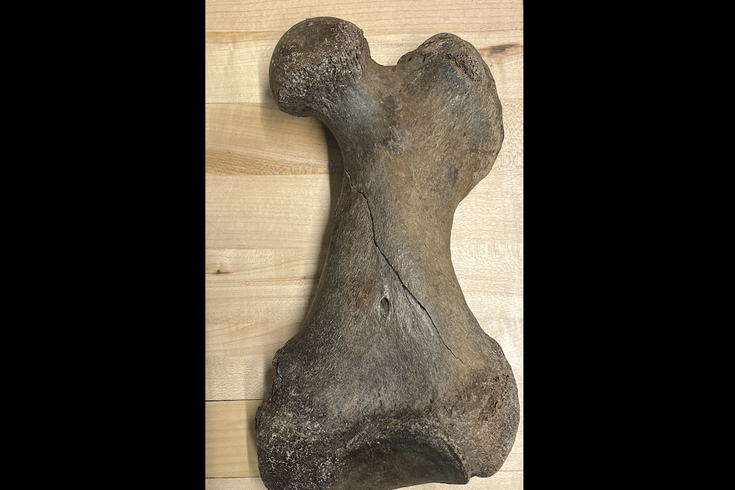 Provided Image/Zachary Boles
Oyster farmer Matthew Gregg and his German shorthaired pointer found a fossil believed to be a Walrus femur at the beach in Bay Head, Ocean County in late January. Gregg took the specimen to the Edelman Fossil & Museum Park in Gloucester County.
In late January, a man walking his dog on the beach in Bay Head came up with an unusual fetch.
The German shorthaired pointer discovered a fossil of a walrus that lived at least 10,000 years ago, when the mammals were abundant on the North Atlantic coast. Bay Head is at the northern end of the Jersey Shore in Ocean County, between Mantoloking and Point Pleasant Beach.
MORE: Bartram's Garden exposes its 'fraught' history amid federal push to take down slavery exhibits
Oyster farmer Matthew Gregg and his son marveled at the heavy object, which the dog had found atop the sand in the aftermath of a winter storm. Gregg's son sent an email to the Edelman Fossil Park & Museum in Gloucester County, where visitors are invited to dig for dinosaur fossils in a former marl quarry.
"We looked into it to try to figure out exactly what it was, and it's most likely a walrus femur," said Zachary Boles, assistant curator and head of collections at the museum.
Boles said two species of walrus are in the fossil record along the East Coast. One went extinct, and the other is a descendant of the modern walrus that lives off the coast of Alaska in the Pacific Ocean. Walruses died off along the Jersey Shore some time after the last ice age about 20,000 years ago. They remained further north in Canada, around Newfoundland and Nova Scotia, until they were hunted to extirpation by the late 19th century.
"We do have a lot of guests who find stuff along the beach and want to bring it in to have us take a look at it to identify it for them," Boles said. "In some cases, they'll donate it to us or loan it temporarily."
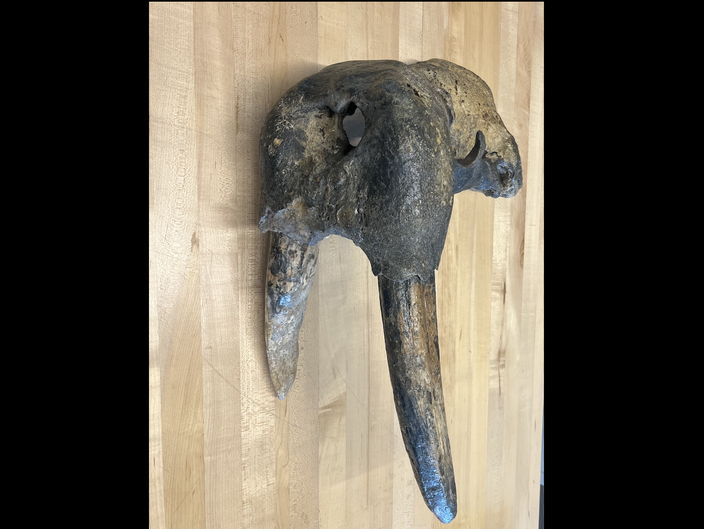
When news reports surfaced about the walrus femur from Bay Head, the museum was contacted by a fisherman from Cape May. The man said he had dredged up a walrus skull a few years ago off the coast of Long Island and wanted staff to look at it. Walrus tusks and pieces of skull have been taken to the museum in the past, but the femur is the first limb bone Boles has encountered. The new skull also offers a better glimpse into the animal's anatomy than previous finds.
"It's really large and really complete, so it's a very nice specimen," Boles said.
After the Gregg family found the walrus femur, a fisherman temporarily loaned a well-preserved walrus skull to the Edelman Fossil Park & Museum. The skull was found off the coast of Long Island a few years ago.
Gregg told News 12 in New Jersey that the family plans to keep the walrus femur. His 8-year-old son, Matt Jr., is a budding dinosaur enthusiast who wants to find a megalodon tooth. The extinct species of giant mackerel shark lived during the Miocene and Pliocene periods, about 3 million to 23 million years ago, and their teeth are rare finds on New Jersey's beaches and river inlets.
Boles said the Gregg family's dog, Charlie, may have been able to detect the walrus fossil with his sharp sense of smell. When he found it, Charlie did what dogs do.
"Charlie was chewing on the bone. He's a dog," Gregg told News 12. "He gets in trouble a lot. He brings a lot of things back to me."
The Edelman Fossil Park & Museum, owned by Rowan University, opened two years ago in Mantua Township. The museum has galleries of life-sized dinosaur reconstructions and allows guests to dig in the fossil-rich site, which has unearthed more than 100,000 specimens of land and marine species from as far back as 66 million years ago. The university purchased the former Inversand Company quarry in 2015, turning it into a research park in the years leading up to the museum's opening.
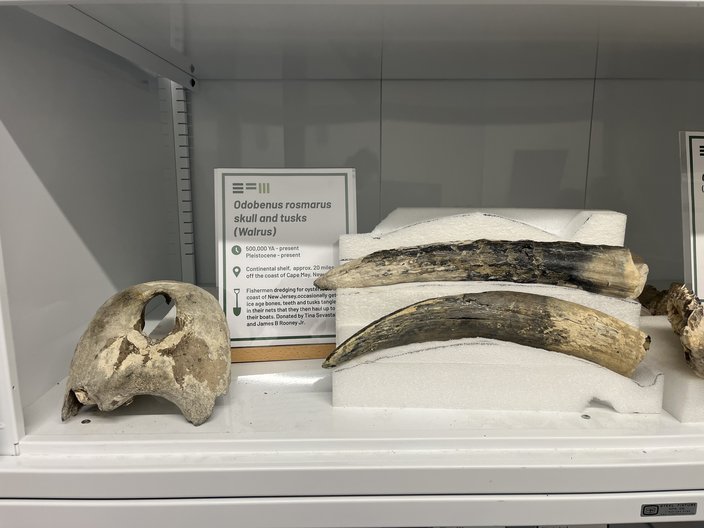
The Edelman Fossil Park & Museum displays several Walrus fossils, including tusks and partial skulls, that were donated to the museum after they were found in New Jersey.
Most of the fossils recovered at the fossil park belong to marine reptiles, but Boles said New Jersey was home to a wide range of species from different epochs.
"We had things like these walruses, mammoths, mastodons roaming around the area 10,000-plus years ago," Boles said. "Going further back in time to the Cretacious period, you had sea turtles, crocodiles and dinosaurs in this area and along the East Coast."
The fossil park and museum open to the public this season on March 20. Visitors can dig for fossils for up to 60 minutes at the roughly four-acre quarry site. Unless a specimen is extremely rare, people are welcome to keep what they find.
Boles encourages anyone who comes across fossils on the beach and at other locations in New Jersey to take them to the museum for identification.
"A lot of it is just kind of building that relationship with the community, getting people interested in science and paleontology," Boles said. "South Jersey was a much different place in the past."