





January 29, 2026
 Provided image/Philadelphia Youth Orchestra Music Institute
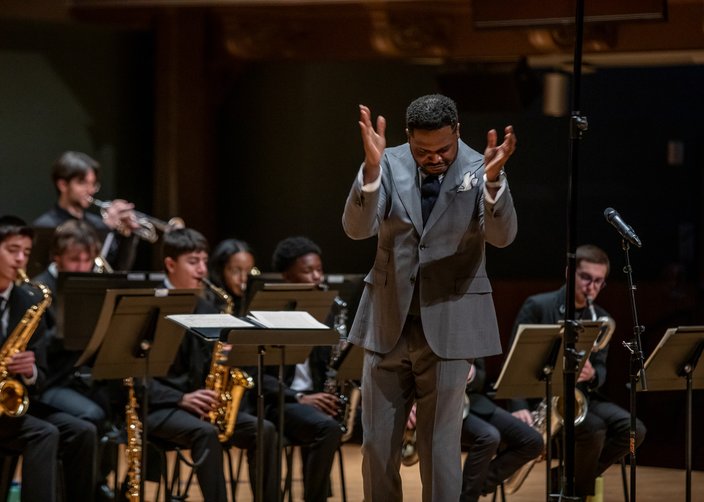
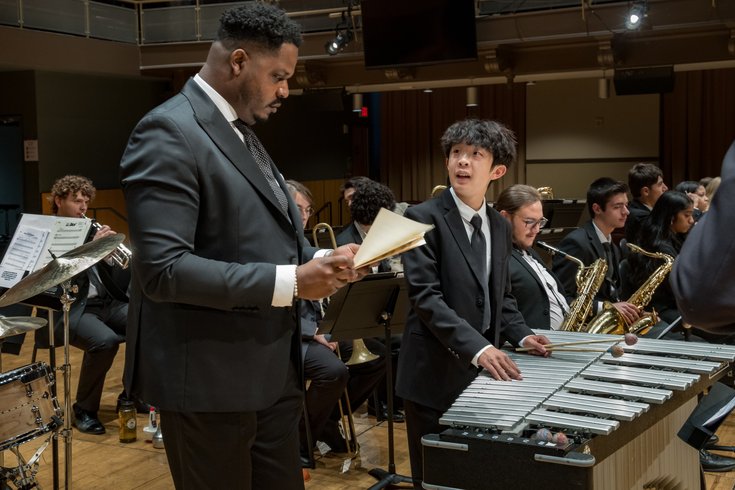
Justin Faulkner, a nominee for best jazz instrumental album at the Grammys this weekend, advises one of his students at the Philadelphia Youth Orchestra Music Institute.
Justin Faulkner remembers scrolling through the list of Grammy nominations last fall, searching for his friends in the categories. Many of them were there — including Immanuel Wilkins, Bilal and Christian McBride — but the West Philly native soon stumbled upon his own name. His latest release with the Branford Marsalis Quartet, "Belonging," was up for best jazz instrumental album.
It's the third time Faulkner, a drummer with the ensemble, has received a Grammy nod. At 34, he's accomplished what some musicians achieve over lifetimes — credits on more than 20 albums, performances in opera houses and concert halls around the world and collaborations with jazz legends who shaped the genre long before he was born. But after sharing his latest accolade with his mom, Faulkner simply continued with this day.
"I do my best to appreciate things and also keep moving forward," he said. "Because the work that we're doing, whether it be educationally or performance-wise, that's the reason why I do this."
Faulkner, who also serves as jazz director for the Philadelphia Youth Orchestra Music Institute, has been playing professionally since he was 13. But he's been studying music his entire life. He credits his mother, a classically trained pianist, and his father, an avid record collector, with nurturing his curiosity. As a kid, he often snuck into his parents' bedroom late at night, plugging a pair of headphones into their boombox and listening to music well past his bedtime.
Jazz was one of the many genres that played through the family home, but Faulkner initially hated it. Once he was a preteen, though, something started to click. It's a process he likens to developing a taste for unfamiliar foods like escargot. He just needed to build a palate.
"It's something that I see in my current students now, the ones that I've taught over the years," Faulkner said. "(Jazz is) a foreign thing to them. And it was to me as well. While I had been hearing it in the house, I didn't necessarily understand what it was. ... I think it just took time for my brain to process or even find a container or something for it, for it to make sense for me."
Once it did, he didn't need long to catch up. At 18, he joined the Branford Marsalis Quartet, anchored by its namesake saxophonist and bandleader, in 2009. The group already had three Grammy nominations and a win under its belt, and it has earned three more nods during Faulkner's tenure — for "The Secret Between the Shadow and the Soul" in 2019, "Upward Spiral" in 2016 and now, "Belonging."
The album is a cover of jazz pianist Keith Jarrett's 1974 release of the same name, which Jarrett recorded with a trio of Nordic musicians. While Faulkner says he and the rest of the quartet love the original, they had no intention of playing exactly like Jarrett and his collaborators. The group reworked tracks like "Long as You Know You're Living Yours" with a funkier percussion inspired by prolific R&B drummer James Gadson.
"We can only interpret them the way that we do," Faulkner said. "We have different cultural experiences. The majority of those guys were born in Europe. Whereas for me, I grew up playing in a Black church."
Justin Faulkner began playing drums professionally when he was 13. He now teaches students that age at the Philadelphia Youth Orchestra Music Institute.
As an educator, Faulkner tries to provide his students as many "entry points" into jazz as possible. Sometimes, he takes them to shows at Chris's Jazz Cafe and the Kimmel Center for the Performing Arts. Other times he plays for them himself, bringing in colleagues to augment the performance. YouTube is also part of the syllabus; Faulkner had two videos of Gil Evans, the focus of this year's program, queued up for his Thursday rehearsal.
The work can be a bit of a waiting game. Faulkner doesn't know when the kids will catch the jazz bug, but he's there to support them when it happens.
"I don't try to force the music on anybody," he said. "I think that the music is righteous enough. It has enough value to provide its own context. I just have to provide exposure."
His students are exploring a local jazz scene that's shifted in the two decades since Faulkner entered it. The most noticeable difference, he says, is the loss of giants like Bootsie Barnes and Jimmy Heath. But Faulkner still sees a dedication to the ideals that make Philly jazz what it is — chiefly, community and storytelling.
"I think Philadelphians, artistically speaking, have never been performative artists," he said. "While we are performing, there's a grounded nature that is rooted in community. This is one of the few cities that I've had the opportunity to spend time in that is community-based in every way, shape or form. ... You hear that in the music."
Follow Kristin & PhillyVoice on Twitter: @kristin_hunt
| @thePhillyVoice
Like us on Facebook: PhillyVoice
Have a news tip? Let us know.