



February 11, 2026
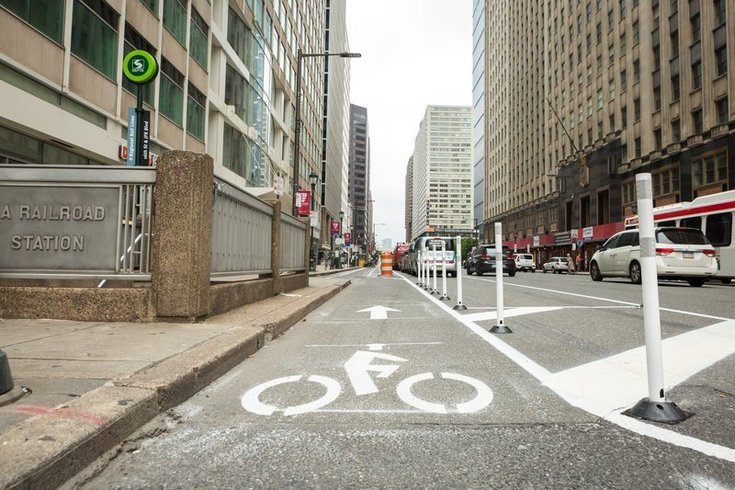 Thom Carroll/for PhillyVoice
Philadelphia is receiving a $1 million PennDOT grant to update outdated signage along bike lanes citywide. Instead of saying 'No Parking Anytime,' the signs will say 'No Stopping Anytime.'
Philadelphia has been awarded $1 million from PennDOT to install new street signs warning drivers not to illegally stop in bike lanes. The current signs, which only instruct drivers not to park in the bike lanes, need to be replaced under an ordinance that strengthens protections for cyclists.
The funding is part of a $27 million package that uses revenue from red light cameras to pay for traffic safety upgrades in Pennsylvania. Philly is receiving $13 million for six traffic-calming and improvement projects.
In December 2024, the city passed the "Get Out the Bike Lane" law that banned cars from parking or temporarily stopping in paths designated for cyclists. The law increased the existing fine from $75 to $125 in Center City and University City, and it bumped the penalty from $50 to $75 everywhere else. It also eliminated the 25-minute grace period that drivers formerly had before Philadelphia Parking Authority officers could ticket them.
Philly has more than 300 miles of bike lanes — including upwards of 30 miles of protected cycling paths — that mostly have outdated signage.
"Getting new signs in the city has historically been a very slow process," said Jessie Amadio, an organizer with Philly Bike Action, a cycling advocacy group. "It's important that every bike lane in the city, no matter the ZIP code, has this important safety policy enforced."
Last year, PPA started updating the signage along the bike lanes on Spruce and Pine streets in Center City. In some cases, stickers were slapped over existing signs to change the language from "No Parking Anytime" to "No Stopping Anytime," but the rest of the city lacks signage that communicates the change in enforcement.
City officials did not respond Wednesday when asked how long it will take to install the new signage and move forward with other projects funded by the grants.
Philly Bike Action and other cycling advocates pushed the city to update bike lane laws two summers ago after Barbara Friedes, a 30-year-old doctor at Children's Hospital of Philadelphia, was fatally struck by a drunk driver while riding her bike in a designated lane on the 1800 block of Spruce Street. The bike lanes on Spruce and Pine became the focal point of efforts to improve safety for cyclists.
When the city installed temporary loading zones on Spruce and Pine, giving motorists other areas to stop for a few minutes, a group of residents filed a lawsuit that resulted in a court order to remove the loading zones. The city since passed legislation formalizing the Streets Department's authority to create new loading zones citywide, but the case related to Spruce and Pine is still unresolved.
"They were working really well," Amadio said. "For the weeks that they were there, neighbors really liked them and bike lanes were much more clear of cars. It was a shame they had to be ripped out. If it's the intent of the city to provide more legal loading zone spaces near bike lanes, that's an awesome thing, because people do need a place to stop. It's not safe to do it in a bike lane, but there's plenty of other street space where they could stop."
PennDOT said part of the $1 million grant will pay for loading zone signage on bike lane corridors citywide. A separate $5 million grant includes money for upgrades to existing bike lanes and mentions concrete curb separation at some locations.
Philly Bike Action has been pushing to get concrete separation for the bike lanes on Spruce and Pine streets, a step city officials have supported in recent years. Bike lane protection was presented as a second phase after the creation of loading zones.
"Since the lawsuit happened, they haven't made any further public announcements. We don't really know what they're planning," Amadio said. "But I think what's important to realize is that the court order doesn't forbid protecting the bike lane. There's nothing stopping the city from continuing with their plan."
Amadio said she's encouraged by the grant money from PennDOT, but wants to see an updated plan from the city that addresses concrete curb separation.
"We're going to be out this spring asking what's taking so long," she said. "We're still fully expecting them to follow through on their promise."
Red light cameras have been expanding in Philadelphia in recent years. PPA now oversees more than 35 automated enforcement cameras in the city, including along Roosevelt Boulevard and in parts of Center City and South Philly. Another set was activated last month in front of the Philadelphia Museum of Art, at Kelly Drive and Eakins Oval, and fines will begin Feb. 27 for cameras installed at 58th Street and Baltimore Avenue in West Philly. Several more are planned at additional intersections.
PPA generated more than $33 million in revenue from violations last year. More than $25 million was remitted to PennDOT, which takes everything above the costs of maintenance. There were 340,931 violations last year, down from 374,262 in 2024. PPA's annual report in September recommended increasing tickets from $100 to $150, claiming a stiffer penalty would further deter motorists from running red lights.
PennDOT's Automated Red Light Enforcement program collects violation revenue from partnering municipalities and makes grant money available for traffic safety projects. The department received more than 113 requests this year and approved applications for 51 projects statewide.
"The ARLE program helps municipalities improve traffic flow and safety at intersections, not only for drivers, but for pedestrians, cyclists, and other road users," PennDOT Secretary Mike Carroll said in a statement.
John Boyle, research director for the Bicycle Coalition of Greater Philadelphia, called the ARLE program a "vital source of funding" for city initiatives that protect cyclists and pedestrians.
"We support all City projects that received funding in the most recent round," he said in a statement.
The latest round of PennDOT grants includes upgrades to pedestrian crossing signals at eight city intersections. Audible features are being added to signals along Penn Square in Center City and on sections of Broad Street, Washington Avenue, Market Street and Callowhill Street. Center City also is getting new signage to enforce no right turns on red lights.
Another grant aims to improve infrastructure for SEPTA's T5 trolley route that runs between Center City and Southwest Philly.
The city's "Neighborhood Slow Zone" program, which uses speed cushions and other measures to curb speeding, also is getting a grant to expand to the area of Second Street and Indiana Avenue in North Philly. The city's remaining grant money covers new side paths on the city's watershed park trail network and a range of other infrastructure projects meant to improve accessibility on city streets.