






September 02, 2025

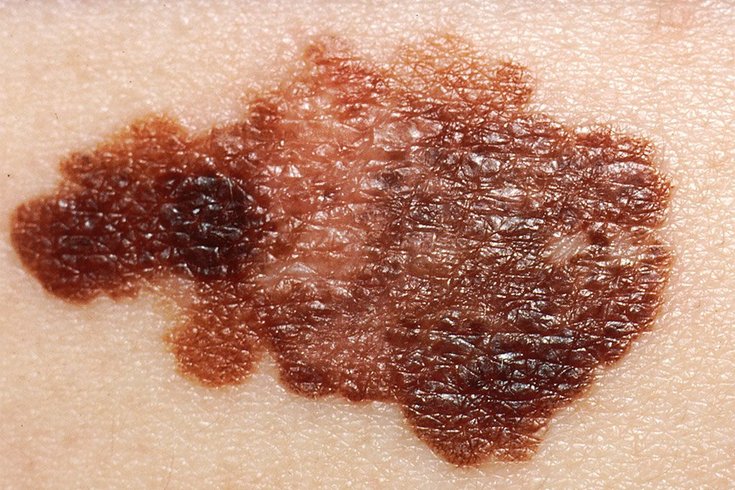 Source/National Cancer Institute
Moles that change or have an irregular appearance, as pictured here, can be a sign of melanoma. Researchers at the University of Michigan are testing an at-home skin cancer test that may increase early detection.
An experimental at-home test for skin cancer shows promise for the early detection of melanoma, the deadliest form of skin cancer.
Skin cancer is the most common type of cancer worldwide. Although melanoma accounts for just 1% of skin cancers in the United States, it causes the large majority of all skin cancer deaths, American Cancer Society says.
Finding melanoma early increases the chances of it being cured. Researchers at University of Michigan researchers who developed the at-home test say it would increase early diagnosis and treatment by enabling people to detect melanoma without a doctor's visit or biopsy.
The test involves placing a patch that has tiny needles coated with a special gel on the suspected area of skin for 30 minutes. The gel then is applied to a two-line strip test, similar to at-home COVID-19 detection kits, to show if melanoma is present.
The patch, which has been tested on mice, still needs to go through human trials.
Melanoma cases in the United States have jumped 50% in women since 1980 and are spiking in people under 30. It is the fifth most commonly diagnosed cancer in Americans 30 to 39, according to the Melanoma Research Foundation.
Melanoma cases are expected to rise nearly 2%, with about 8,500 Americans projected to die from the disease in 2025, according to the Skin Cancer Foundation.
Exposure to ultraviolet sun rays is the main risk factor for melanoma, with the average person's risk doubled if they have had just five sunburns or more, according to the Skin Cancer Foundation.
People with many moles – especially 50 or more – and those with several large moles or moles that are irregular in appearance, are at higher risk for melanoma, according to MD Anderson Cancer Center.
Normal moles usually appear as evenly colored, brown, tan or black. They can be flat or raised, round or oval, and are typically smaller than one-quarter inch across. That is about the width of a pencil eraser. Possible signs of melanoma include new spots on the skin, moles that grow or change, or spots that look different than other spots on the skin, according to the American Cancer Society.
Other risk factors for melanoma include:
• Having fair skin that freckles and burns easily, does not tan, or tans poorly
• Having blue, green or other light-colored eyes
• Having red or blond hair
• Using tanning beds
• Being exposed to radiation, solvents, vinyl chloride and polychlorinated biphenyls (PCBs)
• Having a family history of unusual moles (atypical nevus syndrome)
• Having a family or personal history of melanoma
• Having a weakened immune system